


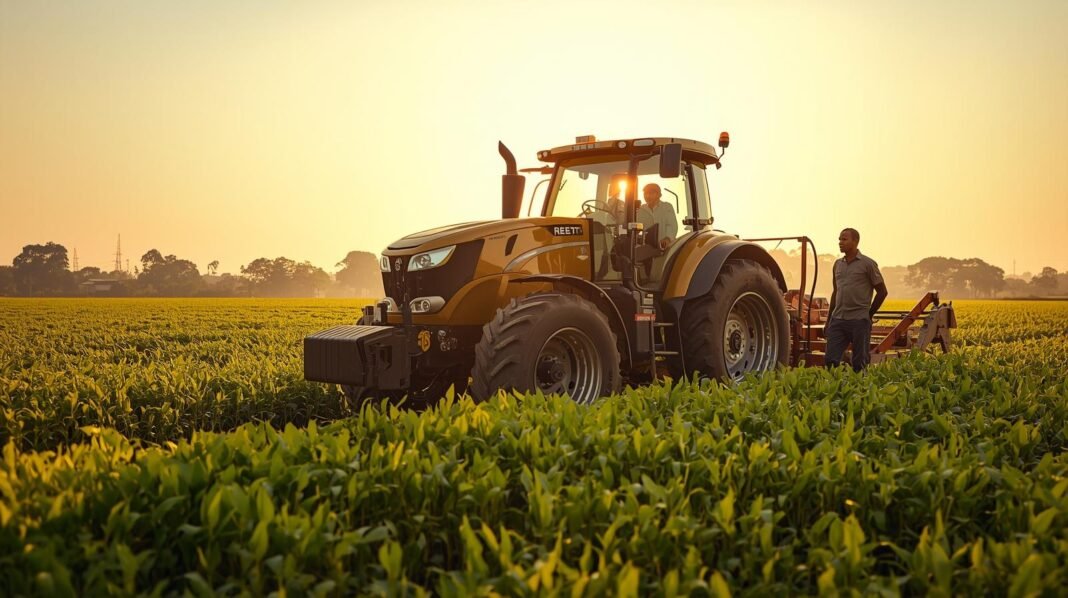

Nigeria’s agricultural sector is undergoing a quiet but significant transformation. Across farms in the North Central plains, the Niger Delta, and the savannah belts of the North West, the rumble of tractor engines is becoming increasingly familiar.
Tractor sales in Nigeria are on an upward structural trajectory in 2026 — driven by government policy, population pressure, rising food demand, and a growing recognition that manual farming can no longer feed a nation of over 220 million people.
This article explores the key forces behind this trend, the challenges that remain, and what it means for Nigeria’s agricultural future.
1. Government Mechanisation Programmes Are Injecting Demand
One of the most direct drivers of tractor sales is federal government spending. The Federal Executive Council approved the procurement of 2,000 tractors, 4,000 disc ploughs, 1,200 tractor trailers, and other equipment under the National Agricultural Mechanisation Programme (NAMP) — a flagship initiative aimed at boosting food security through modern farming tools.
This kind of large-scale public procurement not only puts machines in farmers’ hands; it also signals to private suppliers, dealers, and investors that Nigeria is serious about mechanisation.
In late 2023, the government announced John Deere’s intention to establish a tractor assembly plant in Nigeria — a development that, if fully realised, would reduce reliance on costly imports and expand access to equipment locally.
2. The Food Security Imperative
Nigeria is the most populous country in Africa, with a population projected to exceed 250 million by 2030. Feeding this population — with a large proportion living in rural areas and depending on subsistence agriculture — requires dramatically higher productivity per farm.
Manual and animal-powered farming, which still dominates smallholder agriculture, simply cannot meet this demand.
Tractors and mechanised equipment allow farmers to cultivate larger areas in less time, reduce post-harvest losses, and achieve more consistent yields. As food inflation bites and the government prioritises domestic food production over imports, mechanisation has become a national imperative rather than a luxury.
3. Rising Demand Across the Agricultural Value Chain
Tractor demand in Nigeria is not just about tillage. The Nigeria Agricultural Tractor Market is growing across multiple segments of the agricultural value chain, including:
- Land development — clearing and preparing new farmland
- Sowing and planting — mechanised seeding for key crops like maize, rice, and sorghum
- Harvesting — combine harvesters and tractor-linked equipment reducing post-harvest losses
- Transportation — tractor trailers moving produce from farm to market
This broad utility makes tractors one of the most versatile investments in agriculture, driving demand from large commercial farms and cooperatives alike.
4. Africa’s Wider Agricultural Mechanisation Boom
Nigeria’s rise in tractor adoption is part of a broader continental trend. Africa’s agricultural tractor market was valued at $1.9 billion in 2025 and is projected to reach $2.6 billion by 2030, representing a compound annual growth rate (CAGR) of 6.5%.
Nigeria, as Africa’s largest economy and most populous nation, is a key contributor to this growth.
International manufacturers and investors are paying attention. The establishment of local assembly partnerships — such as the John Deere initiative — reflects growing confidence that West Africa, and Nigeria in particular, represents a long-term growth market for agricultural equipment.
5. A Temporary Dip in 2024 — and the Recovery
The story has not been without turbulence. In 2024, Nigeria’s tractor market experienced a sharp decline, with its market value dropping by approximately 35% to around $275 million.
This dip was largely tied to Nigeria’s broader macroeconomic challenges: the dramatic devaluation of the naira following the removal of fuel subsidies, soaring inflation, and higher import costs for equipment denominated in foreign currency.
However, this contraction was a price effect rather than a demand collapse — underlying consumption of tractors and farm equipment actually increased.
As the naira stabilises and government support programmes expand, the market is expected to recover and resume its growth trajectory through 2026 and beyond.
6. Key Challenges That Must Be Addressed
Despite the positive momentum, several obstacles continue to slow the pace of tractor adoption in Nigeria:
Access to Finance: Most smallholder farmers — who make up the majority of Nigeria’s agricultural workforce — cannot afford tractors outright.
Commercial lending rates remain high, and agricultural finance products are underdeveloped. Expanding tractor hire services, equipment leasing, and cooperative purchasing models will be critical.
Import Duties and Costs: Many tractors are still imported, and high tariffs and logistics costs push prices beyond the reach of small and medium-scale farmers. Local assembly initiatives can help, but they take time to scale.
Rural Infrastructure: Poor roads, inadequate storage, and unreliable power supply in rural areas make it difficult to deploy and maintain equipment effectively. Without supporting infrastructure, the impact of mechanisation is limited.
Technical Capacity: Farmers and technicians need training to operate and maintain modern equipment. Investing in agricultural extension services and vocational training is essential to sustain the mechanisation wave.
7. What This Means for Nigeria’s Agricultural Future
The rise in tractor sales is more than a commercial milestone — it is a signal of structural change in how Nigeria feeds itself.
A more mechanised agricultural sector means higher productivity, reduced food imports, more competitive export potential for crops like sesame, cashew, and cocoa, and better livelihoods for millions of rural Nigerians.
For investors, equipment dealers, financiers, and policymakers, the message is clear: the window of opportunity in Nigeria’s agricultural mechanisation story is open, and 2026 represents a pivotal moment in that journey.
Tractor sales in Nigeria are rising because the country has no alternative. Population growth, food security demands, government investment, and the economics of scale all point in the same direction: farming in Nigeria must modernise.
The challenges are real, but so is the momentum.
As government programmes expand, local manufacturing takes root, and financial products evolve to serve farmers, Nigeria’s tractor market is poised for sustained and meaningful growth in the years ahead.
Also Read
How Wide Tyres Help Reduce Soil Compaction in Modern Farming
Tracked vs Wheeled Tractors: Which Performs Better in Heavy Fields?

Martin is a writer at Agrimachinery Africa specializing in agricultural machinery, mechanization trends, and farm technology across Africa. His work focuses on tractors, harvesting equipment, irrigation systems, and emerging innovations helping farmers improve productivity and efficiency. Through in-depth industry coverage, he highlights technologies shaping the future of modern agriculture.