


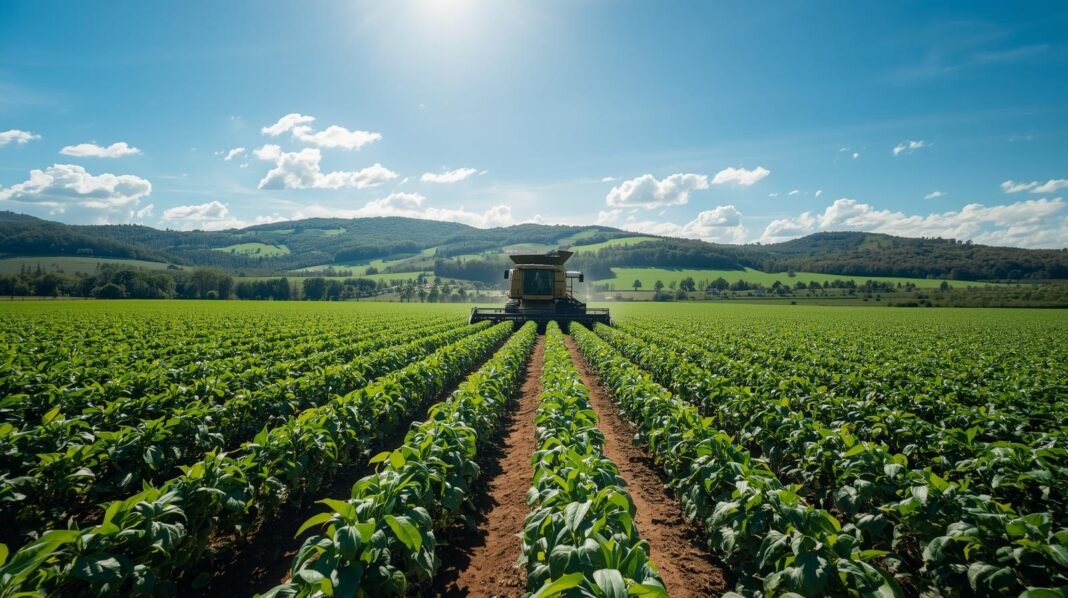

By a Special Correspondent | March 2026: In the sun-scorched soybean fields of Mato Grosso and the sprawling sugarcane plantations of São Paulo, a quiet revolution is unfolding — one measured not in bullets but in tractors, combine harvesters, and precision seeders.
Brazil, already one of the world’s dominant agricultural exporters, is doubling down on a long-standing bet: that generous government subsidies for farm machinery will keep its agribusiness juggernaut humming at full throttle.
The latest edition of the government’s flagship annual agricultural financing blueprint — the Plano Safra (Harvest Plan) — has released a record BRL 516.2 billion (approximately USD 93.9 billion) in rural credit for the 2025/26 season.
Embedded within this enormous envelope are specially priced machinery credit lines that put tractor and harvester financing well out of reach of ordinary market rates, channeling low-cost capital directly into the hands of farmers eager to modernize their fleets.
The Machinery Engine: Moderfrota and Beyond
At the heart of Brazil’s machinery subsidy architecture sits Moderfrota — the Programme for Modernization of the Agricultural Tractor Fleet and Associated Implements and Harvesters.
Operated through the Brazilian Development Bank (BNDES), Moderfrota finances the acquisition of tractors, combine harvesters, cutting-bar attachments, sprayers, planters, and seeders for rural producers and agricultural cooperatives with annual revenues of up to BRL 45 million.
The program’s interest rates — currently set at 11.5% per year for standard commercial producers and 10.5% under the PRONAMP window for medium-sized farmers — sit well below Brazil’s benchmark Selic rate, which climbed to 13.25% in early 2025, pushing unsubsidized commercial equipment loans above 20%.
For small-scale family farmers covered by PRONAF (the National Programme for Strengthening Family Agriculture), machinery financing is available at a striking 5% per year — a fraction of what private banks charge.
In a sign of the government’s commitment to expanding access, Plano Safra 2025/26 introduced dedicated credit lines priced at 2.5% interest for machinery purchases up to BRL 100,000 (roughly USD 18,200), with a 5% rate for purchases up to BRL 250,000.
A new product line specifically targeting small-scale equipment — including micro tractors — was also rolled out under the PRONAF umbrella, aimed at widening mechanization among smallholder farmers who have historically been shut out of large-scale credit programs.
The BNDES has separately committed an additional BRL 70 billion (USD 12.8 billion) exclusively for technology-enabled equipment bundles, linking funding approval to precision-agriculture performance indicators.
Digital grain receipts (CPRs) are now accepted as collateral, broadening access for tenant farmers who lack the land titles that traditional credit systems require.
The Numbers Tell the Story
Brazil’s agricultural machinery market reflects the power of these interventions. The sector is projected to be worth USD 8.42 billion in 2026, growing at a compound annual rate of 6.22% toward an estimated USD 11.38 billion by 2031.
Even amid a high-interest-rate environment that saw non-subsidized equipment loan applications drop by 30% in 2025, government-backed financing has kept the sector resilient.
The government’s own subsidy contribution to equalization funds — the mechanism by which it bridges the gap between market rates and subsidized lending rates — reached BRL 16.7 billion (USD 3.1 billion) in the 2024/25 season, a 23% jump compared to the prior year.
Large-scale commercial farmers accessed BRL 6.3 billion in such funds (up 24%), while family farmers received BRL 10.4 billion (up 22%), reflecting an ambition to broaden the program’s reach.
Green Strings Attached
One of the more distinctive features of Brazil’s latest machinery subsidy push is its deepening entanglement with environmental conditionality.
Under the Plano Safra framework, rural credit — including machinery financing — is increasingly conditional on compliance with sustainable agricultural practices.
Farmers must hold a valid Rural Environmental Registry (CAR) to access subsidized credit, and priority rates are reserved for those demonstrating active efforts in soil recovery, reforestation, and low-carbon production methods.
Separately, a new law — Law 15.042 — allows farms that upgrade to fuel-efficient tractors with Tier 4-final engines to monetize their efficiency improvements as tradeable carbon credits.
Petrobras has pledged BRL 450 million (USD 81.8 million) for forest-linked carbon offsets, and large grain growers are beginning to factor projected carbon revenue directly into their equipment purchasing calculations.
The National Green Mobility Program stacks purchase rebates on top of these credits, effectively shrinking the payback period for newer, cleaner machinery to under four growing seasons.
This green-financing approach aligns with Brazil’s broader climate commitments. Following COP 28, the country updated its Nationally Determined Contributions, pledging to cut greenhouse gas emissions by 53% below 2005 levels by 2030 — an ambitious target for a nation where agriculture remains the largest source of domestic emissions.
Who Benefits — and Who Doesn’t
Despite the headline figures, Brazil’s machinery subsidy system draws pointed criticism from researchers and development economists.
A persistent concern is that because subsidies are calculated as a percentage of loan value, larger farmers — who borrow more — capture a disproportionate share of the benefits.
Multinational equipment makers, including John Deere, CNH Industrial (Case/New Holland), and AGCO (Massey Ferguson/Valtra), collectively control an estimated 99.6% of tractor sales and 100% of harvester sales in Brazil, raising questions about whether public subsidies ultimately flow into the coffers of foreign corporations rather than building domestic industrial capacity.
Meanwhile, only 15% of family farmers currently access rural credit of any kind, according to a Climate Policy Initiative study from Pontifical Catholic University of Rio de Janeiro.
Rural credit is geographically concentrated in the south and center-west, with farmers in the northeast and Amazon frontier regions far less likely to benefit. Women, younger farmers, and indigenous producers face particularly steep barriers.
The Lula administration has stated its intention to address these disparities, but structural change in Brazil’s credit architecture is slow.
Market Realities and Headwinds
The expansion of subsidies arrives at a complicated moment for Brazilian agriculture. Farm revenues were squeezed in 2024 by a combination of factors: a severe drought that hammered the summer soybean and corn crop, a sustained drop in global commodity prices, and a Brazilian Real that weakened sharply against the US dollar — inflating the local-currency costs of imported machinery components, many of which are priced in dollars or euros.
As a result, Brazil’s agricultural machinery sector saw revenues fall 20% in 2024, according to industry association Abimaq.
Farmers postponed equipment purchases, waiting for commodity prices to recover and hoping for a more favorable exchange rate. Subsidy programs helped soften the blow, but were not enough to fully offset the headwinds.
Looking ahead, industry analysts and farmers alike are cautiously optimistic. The Selic rate is expected to plateau and eventually decline, easing pressure on commercial financing. The 2025/26 soybean crop has returned to more normal yields following the 2024 drought.
And the machinery market is benefiting from a new wave of precision-agriculture adoption — drones, GPS-guided planters, variable-rate fertilizer applicators — that is creating first-time demand in frontier regions like Matopiba (spanning parts of Maranhão, Tocantins, Piauí, and Bahia), Brazil’s newest and fastest-growing agricultural frontier.
Conclusion: A Bet on Modernization
Brazil’s expansion of farm machinery subsidies is, at its core, a wager on the future of its most important industry.
In a world where global food demand is rising, climate volatility is intensifying, and agricultural labor is increasingly scarce, mechanization is not optional — it is existential.
Brazil’s competitors in the US, Europe, and Australia are investing heavily in agricultural technology, and Brasília is determined not to fall behind.
The challenge for policymakers is to make this machinery modernization more equitable — ensuring that small farmers, women, and frontier communities capture a meaningful share of the benefits — while maintaining the fiscal discipline that keeps the overall rural credit system sustainable.
Getting that balance right will determine not just the competitiveness of Brazilian agribusiness, but the livelihoods of millions of rural families who depend on the land.
For now, the tractors are rolling. The question is: whose fields are they plowing?
Also Read
Why Tractor Sales Are Rising in Nigeria in 2026
South Africa’s Farm Equipment Market Braces for a Tale of Two Halves in 2026
