


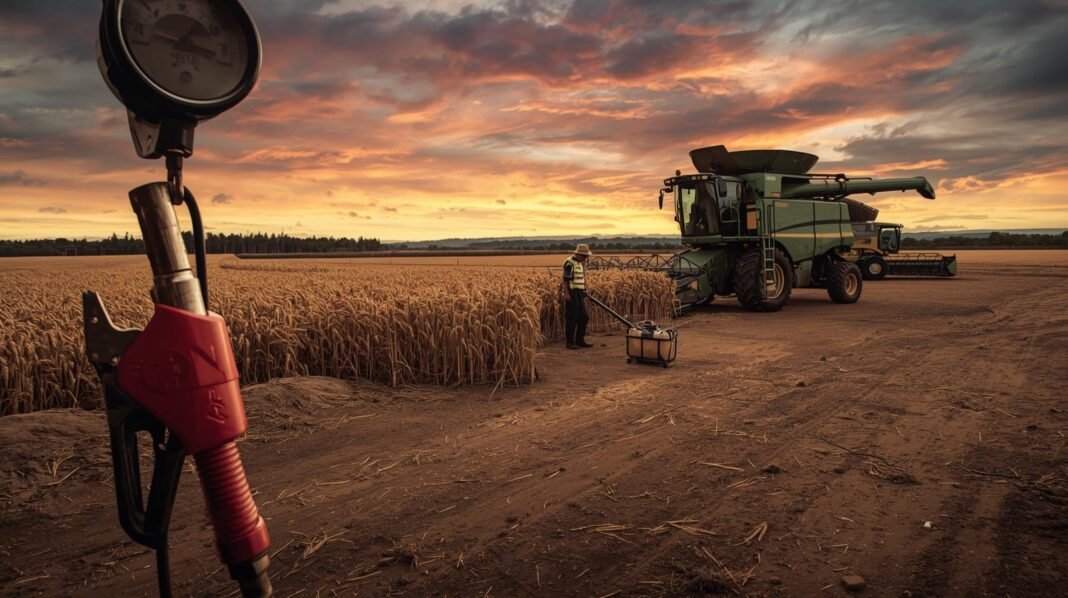

South Africa fuel restrictions are no longer a distant warning — they are now a reality on the ground.
Several major agricultural suppliers began rationing diesel sales in early March 2026, driven by a sudden surge in global oil prices linked to the ongoing US-Iran conflict.
The move is putting the squeeze on an agricultural sector already operating on razor-thin margins.
On 9 March, Oos-Vrystaat Kaap (OVK) Limited in the Eastern Cape notified customers that diesel orders at its distribution points were being suspended due to price increases from its fuel suppliers.
Meanwhile, VKB Group — one of the largest agricultural service companies in the country — capped purchases at 80 litres per customer per day.
For reference, a combine harvester burns through 300 to 600 litres over a typical harvest day, making the South Africa fuel restrictions a significant operational constraint for farmers.
Why South Africa Fuel Restrictions Couldn’t Come at a Worse Time
South Africa’s maize harvesting season typically gets underway in April, and fruit harvesting across major growing regions runs from January through May.
Diesel is the lifeblood of this activity — from tractors and harvesters to irrigation pumps and transport trucks.
The current South Africa fuel restrictions arrive at a moment when demand is at its peak, directly threatening the viability of this year’s harvest.
Agricultural cooperatives have historically offered a critical lifeline to farmers, purchasing fuel in bulk to secure discounted rates and passing savings on to their members.
Unlike petrol, diesel prices in South Africa are unregulated, allowing sellers to set their own margins above the wholesale price.
This system has worked well for decades — but the current price volatility is making it unsustainable for some suppliers to honour forward orders.
NWK in the North West was also forced to abruptly raise its diesel prices this week following hikes from its own suppliers.
The company had little warning and passed the increases on to farmers with minimal notice, deepening the impact of South Africa fuel restrictions across multiple provinces.
April Price Shock Set to Worsen South Africa Fuel Restrictions Crisis
Data from the Central Energy Fund (CEF) paints a worrying picture for the weeks ahead.
Based on current international oil prices and the rand-dollar exchange rate — which has slipped to around R16.54 to R16.79 against the dollar — the wholesale price of 50ppm diesel could increase by as much as R6.02 per litre in April.
That would bring prices close to the all-time record of R25.75 per litre last seen in October 2022, potentially entrenching South Africa fuel restrictions well beyond the current harvest window.
Compounding matters, fuel levies announced in the 2026 Budget Speech will add approximately 21 cents per litre from April, arriving at the worst possible time.
For grain farmers, where fuel accounts for roughly 13% of total input costs, the financial impact could be severe.
Beyond diesel, the conflict in the Middle East is also disrupting fertiliser shipments from key suppliers including Saudi Arabia and Qatar.
This dual pressure — on fuel and fertiliser simultaneously — risks a cascade of cost increases that will ultimately reach consumers at the supermarket checkout.
Government Response to South Africa Fuel Restrictions: Reassurance Amid Uncertainty
The Department of Mineral and Petroleum Resources (DMPR) has sought to reassure the public that the current South Africa fuel restrictions do not extend to ordinary motorists.
The department confirmed there is no immediate risk of petrol and diesel shortages at filling stations.
South Africa’s two operational refineries — NATREF and Astron Energy — are primarily supplied from West Africa and are therefore largely shielded from Middle East supply chain disruptions.
However, analysts warn that South Africa’s strategic fuel reserves cover only around 20 to 21 days of national demand — well below the international benchmark of 90 days recommended for energy security.
If the conflict escalates and disruptions persist, South Africa fuel restrictions could quickly spread beyond the farming sector.
For now, farmers and agricultural businesses are navigating the uncertainty as best they can.
But with OVK’s restrictions under review and more cooperatives likely to follow suit, the coming weeks could prove defining for both South Africa’s 2026 harvest and the broader trajectory of South Africa fuel restrictions.
Also Read
Why Tractor Sales Are Rising in Nigeria in 2026
Potato Industry Faces Structural Challenges as Producers Warn of Rising Risks

Martin is a writer at Agrimachinery Africa specializing in agricultural machinery, mechanization trends, and farm technology across Africa. His work focuses on tractors, harvesting equipment, irrigation systems, and emerging innovations helping farmers improve productivity and efficiency. Through in-depth industry coverage, he highlights technologies shaping the future of modern agriculture.