


By Special Correspondent
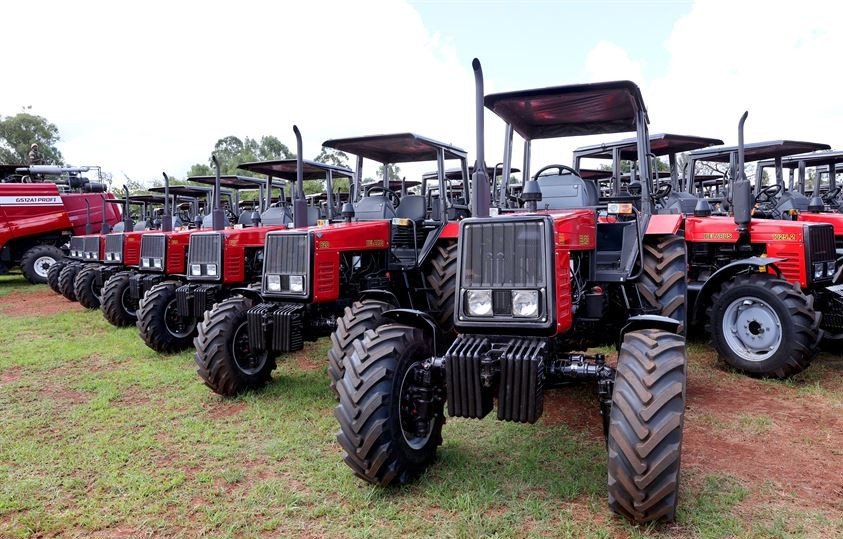
HARARE | MARCH 2026: When the latest consignment of Belarusian agricultural machinery rolled off transport trucks in Harare recently, it was not a surprise.
It was, by now, a familiar ritual — one that has been playing out between Zimbabwe and Belarus for the better part of a decade, growing in scale and ambition with each passing year.
The new batch, arriving under the third phase of the Belarus Farm Mechanisation Facility, adds to a fleet that has already transformed the calculus of Zimbabwean agriculture.
Tractors bearing the distinctive red-and-grey livery of Minsk Tractor Works (MTZ) have become a common sight on farms from Mashonaland to Matabeleland, symbols of a bilateral relationship that has quietly become one of the most consequential agricultural partnerships on the African continent.
We are glad that today we are talking about a strategic partnership that envisages work on a systematic perspective basis.
— Vitaly Vovk, Director General, MTZ
A PARTNERSHIP BUILT PHASE BY PHASE
The roots of the arrangement stretch back to 2018, when Zimbabwe began importing Belarusian machinery in earnest.
Phases 1 and 2 of the mechanisation facility delivered more than 2,000 high-tech tractors, combine harvesters, and associated implements, helping Zimbabwe record a landmark grain harvest in 2022 — its first self-sufficiency in grain production in five decades, according to Belarusian officials.
Phase 3, the most ambitious yet, is valued at US$282 million and encompasses the delivery of over 3,700 units of various machinery — tractors, combine harvesters, and grain carriers — across 2025 and 2026.
The current delivery is part of that contracted programme.
Under its terms, the Zimbabwean government procures the equipment from Belarus and then resells it to farmers through a network of participating banks, including the People’s Own Savings Bank (POSB), under flexible three-year financing at 7.5 percent interest per annum with no collateral requirement.
The machinery on offer spans a wide range of power outputs — from 81-horsepower models suited to smallholder operations to the heavy-duty 155-horsepower tractors favoured by commercial farming enterprises.
Farming cooperatives, irrigation schemes, and registered agribusinesses are all eligible to apply.
KEY FACTS AT A GLANCE
| Category | Details |
|---|---|
| Total Deal Value | US$282 million (Phase 3) |
| Units in Phase 3 | 3,700+ tractors, harvesters & grain carriers |
| Delivery Period | 2025–2026 |
| Zimbabwe Tractor Fleet | ~15,300 (national need: 40,000) |
| Financing Terms | 3-year repayment, 7.5% per year, no collateral |
| Service Network | BiSON Agro Machinery: Harare, Mutare, Bulawayo |
| Assembly Plant Target | 2027 — local production to begin |
CLOSING THE GAP
The urgency behind the programme is not hard to understand. Zimbabwe has roughly 15,300 functional tractors against a national requirement that authorities have put at 40,000 units — a shortfall that constrains how much of the country’s 4.1 million hectares of arable land can be worked efficiently.
President Emmerson Mnangagwa flagged the deficit as far back as 2020, when the fleet stood at only around 9,000 machines.
Officials say the tractors already delivered have made a measurable difference. According to the Ministry of Lands, Agriculture, Fisheries, Water and Rural Development, the existing fleet had tilled 2.8 million hectares of land by early 2025.
Each new combine harvester added to the fleet is capable of covering at least 10 hectares per day, meaningfully compressing the harvest window and reducing post-harvest losses.
Leonard Munamati, Acting Chief Director of Agricultural and Rural Development Advisory Services (ARDAS), has said the new equipment is expected to push Zimbabwe’s daily harvesting capacity to around 4,000 hectares — a figure that would have been unimaginable before the mechanisation drive began.
Each combine harvester can cover at least 10 hectares per day. Our harvesting capacity for the summer cropping season will be around 4,000 hectares per day.
MORE THAN A SALE: AFTERSALES, TRAINING, AND LOCAL ROOTS
What distinguishes the Belarus-Zimbabwe partnership from a straightforward equipment purchase is its commitment to keeping the machines working.
The two governments jointly established BiSON Agro Machinery in Harare, a dedicated after-sales and maintenance company with branches in Mutare and Bulawayo, plus a warehouse of component parts.
BiSON’s marketing director, Andrei Kloeinov, has been candid about the rationale. Equipment that breaks down and cannot be repaired is equipment wasted.
Belarusian engineers have been training local technicians in the repair, operation, and maintenance of the machinery — a knowledge-transfer dimension that officials on both sides regard as essential to the programme’s long-term viability.
The next step, already agreed in principle, is deeper still. Plans are in place for Belarus to establish a tractor assembly plant inside Zimbabwe by 2027, which would shift the relationship from pure imports to co-manufacturing and potentially open the door to exporting jointly produced machinery to neighbouring countries.
ZIMBABWE AS A GATEWAY: BELARUS EYES THE CONTINENT
Harare’s experience has not gone unnoticed in Minsk — or in African capitals. Belarusian Foreign Minister Maxim Ryzhenkov has described the Zimbabwe model explicitly as a template for the rest of Africa, noting that when leaders from other African countries visit Zimbabwe, they are taken to see the BiSON service centres and the Belarusian equipment firsthand.
The Ghanaian president, Ryzhenkov noted, uses a Belarusian tractor on his own farm.
The ripple effect is already visible. In March 2026, Minsk announced plans to supply roughly 4,500 units of agricultural machinery to Togo and 3,000 units to Ghana during the year — framed explicitly as significant pilot projects modelled on the Zimbabwean experience.
The pattern Belarus describes — first machinery deliveries, then service centres, then training, then local assembly — is precisely what has unfolded in Zimbabwe over the past eight years.
Belarus’s newly appointed ambassador to Harare, who took up the post this week, described Zimbabwe as a kind of gateway into Africa for Belarusian commercial ambitions.
With Western markets largely closed to Minsk following the political upheaval of 2020 and subsequent sanctions, Africa has become a strategic priority — and Zimbabwe, with its well-established infrastructure for Belarusian equipment, sits at the centre of that push.
Dealing with large empires is very difficult. We will always build, at our own modest level, a mutually beneficial cooperation that ensures agreements are fully honoured.
GEOPOLITICS IN THE FURROW
The partnership is not without its geopolitical dimensions. Belarus is under comprehensive Western sanctions, and Zimbabwe itself has long navigated a complicated relationship with Western donors and international financial institutions.
The two countries share, in Minsk’s framing, a common experience of dealing with external pressure — a narrative their leaders have deployed to frame the partnership as one of solidarity between sovereign states charting their own course.
Critics have noted that both governments are led by figures whose democratic credentials are contested, and some observers in the development community question whether the financing terms of the mechanisation facility, taken as a government-to-government debt arrangement, adequately serve the interests of ordinary Zimbabwean farmers or simply deepen sovereign indebtedness.
For now, however, the tractors are arriving, the harvesters are in the fields, and Zimbabwe’s agriculture ministry is reporting improved crop figures.
Whether the partnership ultimately proves to be as durable as its champions claim — or whether the assembly plant materialises on schedule in 2027 — will be the measure by which it is eventually judged.
WHAT COMES NEXT
The immediate outlook for the programme is busy. Remaining deliveries under Phase 3 are expected to continue through 2026.
The bus assembly plant agreed between the two governments is slated to begin production in Harare in the near term.
Negotiations on the tractor assembly facility, intended to be operational by 2027, are understood to be progressing.
Meanwhile, the network of service centres is being expanded, and training programmes for Zimbabwean technicians are ongoing.
For the farmers who have already taken delivery of their machines — repaying the loan in manageable tranches over three years — the politics of the arrangement are, perhaps, a secondary concern.
The tractor in the field is what matters.
As one Zimbabwean official put it privately: the country needed the machines, Belarus had the machines, and both sides wanted the deal.
In the often transactional world of agricultural development, that alignment has proven remarkably productive.
Additional reporting: BelTA, The Sunday Mail (Zimbabwe), Bulawayo24, Farmers Review Africa, POSB Zimbabwe
Also Read
South Africa’s Farm Equipment Market Braces for a Tale of Two Halves in 2026
Why Tractor Sales Are Rising in Nigeria in 2026

Martin is a writer at Agrimachinery Africa specializing in agricultural machinery, mechanization trends, and farm technology across Africa. His work focuses on tractors, harvesting equipment, irrigation systems, and emerging innovations helping farmers improve productivity and efficiency. Through in-depth industry coverage, he highlights technologies shaping the future of modern agriculture.