

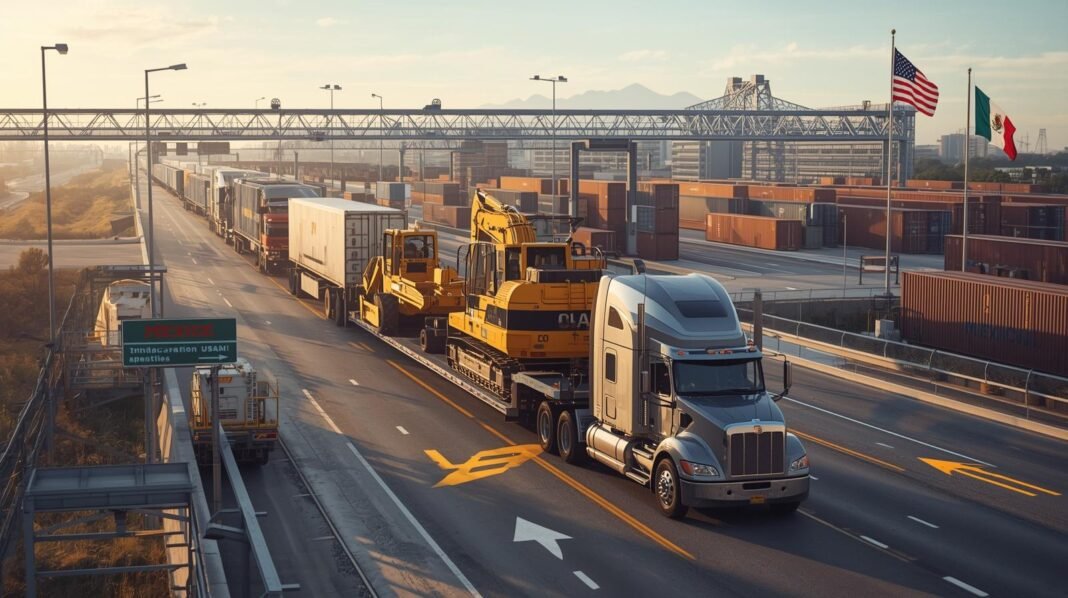

A bipartisan push in Washington is setting the stage for a potential overhaul of how agricultural machinery enters the United States market.
Two senators have formally called on the Commerce Department to launch a federal investigation into farm equipment imports manufactured in Mexico, naming John Deere, CNH Industrial, and Caterpillar as the primary targets and demanding that USMCA trade rules be tightened before the agreement comes up for review later this year.
Who Is Behind the Push
Senator Tammy Baldwin of Wisconsin and Senator Bernie Moreno of Ohio sent a letter to Commerce Secretary Howard Lutnick on March 26, 2026, urging him to initiate a Section 232 investigation under the Trade Expansion Act of 1962.
Section 232 allows the U.S. government to restrict imports on national security grounds, and the Trump administration has already used it to apply tariffs across sectors including steel, aluminum, automobiles, and timber.
The senators represent two of America’s most historically significant manufacturing states. Baldwin’s Wisconsin is home to CNH’s Racine facility, while Moreno’s Ohio has a deep industrial base with strong ties to the heavy equipment supply chain.
Their joint letter represents an unusual convergence across party lines, with Baldwin having been vocal in her criticism of broad tariff policies while both senators agree on the need for targeted relief in the agricultural and construction equipment sectors.
What the Senators Are Alleging
The core allegation is that John Deere, Case New Holland (CNH), and Caterpillar have systematically relocated production to Mexico to take advantage of significantly lower labor costs, then shipped finished agricultural implements and machinery back into the U.S. market under the duty-free terms of the USMCA.
The senators argue that this strategy has been executed while these same companies continued to pay out billions in stock buybacks and dividends to shareholders, even as they eliminated American manufacturing jobs.
“These companies should not be allowed to eliminate American jobs, pay Mexican workers poverty wages, and then ship products back to the U.S. for additional profit on the backs of our communities,” the senators wrote.
CNH’s actions in Racine were cited as a specific and documented example. The company laid off 222 workers at the Wisconsin plant in 2024 while shifting production to Mexico.
For farming communities in the Midwest that have long been connected to the supply chains of these manufacturers, such moves carry weight well beyond the factory floor.
Scope of the Requested Investigation
The senators asked for the probe to cover a comprehensive range of categories: agricultural implements, construction and mining equipment, forestry equipment, heavy machinery, parts, and derivatives.
For the agricultural machinery sector specifically, this would capture tractors, combines, planting equipment, tillage tools, sprayers, and the parts ecosystems that support them — all areas where Deere, CNH, and Caterpillar maintain major product lines.
If a Section 232 investigation concludes that these imports pose a threat to national security — a threshold that has been interpreted broadly by the current administration — the Commerce Department could recommend targeted tariffs on affected equipment categories.
The outcome would directly influence the price of new agricultural machinery for American farmers and the competitiveness of domestic manufacturing relative to Mexico-based production.
The USMCA Problem
A critical dimension of this issue is the structure of the USMCA itself. Unlike the steel and aluminum tariffs that already cover some equipment components, the USMCA currently permits heavy equipment manufactured in Mexico to enter the United States duty-free with no meaningful rule-of-origin requirements.
In practice, this means a tractor assembled in Mexico using largely imported components can cross the border without triggering any tariff.
The senators explicitly warned that Section 232 tariffs alone would not be sufficient to address the problem if the USMCA loophole remains in place.
They called on the Trump administration to address these shortcomings as part of the formal USMCA review scheduled for July 2026, framing the review as a once-in-a-generation opportunity to rebalance incentives back toward domestic production.
Timing and Political Context
The letter was submitted one day before President Trump was due to host the CEOs of John Deere and CNH at the White House for National Agriculture Day, making the political dimensions of the demand impossible to ignore.
Whether intentional or coincidental, the timing placed the offshoring allegations directly in front of the administration at a high-visibility event for the agricultural sector.
The Trump administration has shown a clear appetite for using Section 232 broadly.
Having already applied it to metals, autos, auto parts, timber, and furniture, and with pharmaceutical investigations under way, an extension to agricultural and construction machinery would represent a significant but consistent escalation of the administration’s trade enforcement approach.
What It Means for Farmers and Equipment Buyers
If the investigation proceeds and tariffs are ultimately imposed, American farmers shopping for new equipment would likely face higher sticker prices, particularly on models currently manufactured in Mexico. The effect would vary by product line and brand.
John Deere’s Mexican operations cover a significant portion of its tractor and combine production for North American markets, as does CNH’s Case IH and New Holland lineup.
The counterargument made by proponents of the investigation is that restoring production to the United States would eventually support a stronger domestic parts and service ecosystem, more stable supply chains, and better-paying jobs in manufacturing communities.
The senators argued that the heavy equipment industry has already received prior warnings and has failed to invest meaningfully in American workers despite them.
For now, the ball is in the Commerce Department’s court. None of the named companies or the Department had publicly responded at the time of reporting.
The USMCA review in July and the pace of the Section 232 decision will be the key indicators of whether this senatorial demand becomes a market-moving policy development in 2026.
Also Read
Is the John Deere 8RX 540 the Most Powerful Row-Crop Tractor Ever Built?
Mahindra Cuts Ties with Mitsubishi — Then Bets Big on North America

Martin is a writer at Agrimachinery Africa specializing in agricultural machinery, mechanization trends, and farm technology across Africa. His work focuses on tractors, harvesting equipment, irrigation systems, and emerging innovations helping farmers improve productivity and efficiency. Through in-depth industry coverage, he highlights technologies shaping the future of modern agriculture.