

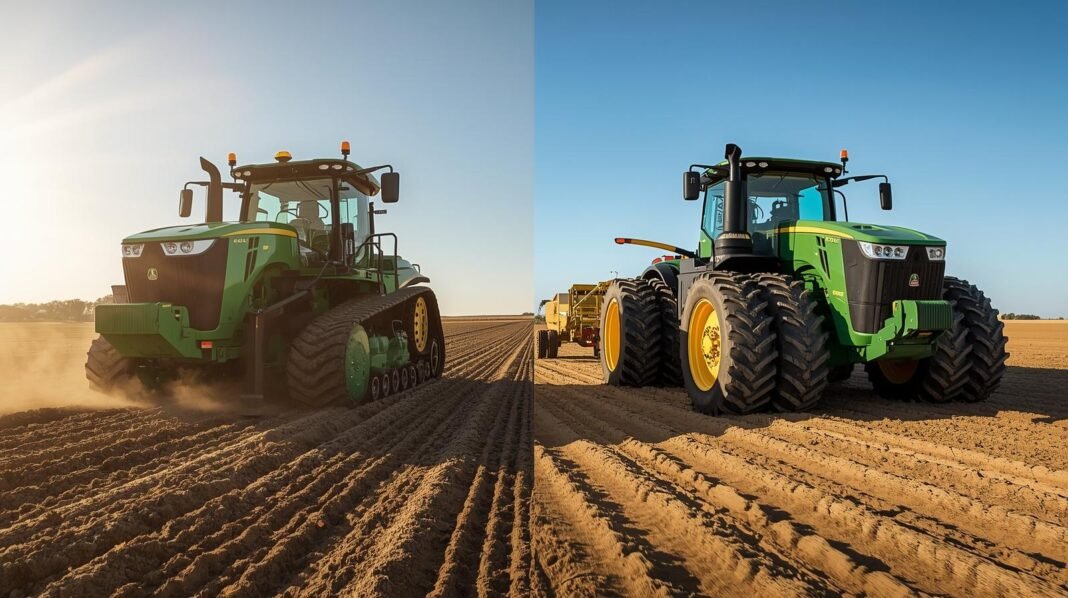

Few decisions carry more weight on a large arable operation than choosing between a tracked and a wheeled tractor.
The wrong call can mean lost days in the field, higher fuel bills, premature soil compaction, and a depreciation curve that catches you off guard at trade-in time.
Both technologies have matured dramatically over the past decade — rubber-track systems now account for a growing share of high-horsepower tractor sales, while tyre manufacturers have responded with IF- and VF-rated radials that push the limits of what a wheeled machine can do on soft ground.
So which platform genuinely performs better when the soil turns heavy?
The answer, as with most things in agriculture, is nuanced — but the data points to clear winners in specific scenarios.
Understanding the Fundamental Difference
The core engineering distinction between the two platforms comes down to how each distributes the machine’s weight across the soil surface.
A conventional wheeled tractor concentrates load onto four discrete tyre contact patches, while a tracked tractor spreads that same weight along a continuous rubber or steel belt stretched between a drive wheel and an idler. The result is a dramatically larger footprint — and a very different relationship with the ground beneath it.
Where a top-spec radial tyre on a large equal-wheel tractor — such as a Michelin AxioBib IF 800/70R38 — provides roughly 1.5 m² of contact area at field pressures, a tracked machine can deliver substantially more.
That additional contact area is the foundational argument for tracks in heavy-field conditions, but it is not the whole story.
Traction and Flotation in Heavy, Wet Soils
This is where tracked tractors hold their clearest advantage, and it is why they became standard equipment on large arable farms across northern Europe and the heavy clay belts of the American Midwest.
When soils are saturated or close to field capacity, a tracked machine’s lugs are planted firmly in the soil and push the undercarriage forward rather than relying on friction alone.
The practical result is dramatically lower slippage under load — field observations of two-track tractors running at 2–3% slip in conditions that would force a wheeled machine to park are well-documented among farmers.
Challenger, one of the leading manufacturers of rubber-belt tractors, notes that the larger contact area makes a significant difference in high-draft situations such as primary cultivations or towing a large seed drill on heavy soils.
Crucially, the tracked system is also simpler to set up for optimum performance: there are no tyre pressures to adjust or ballast strategies to calculate. The machine arrives at the headland ready to work.
Wheeled tractors can close the gap meaningfully with the right tyres and a Central Tyre Inflation System (CTIS).
inflation to as low as 6–7 psi in the field increases the contact patch and reduces peak soil stress, and modern VF-rated tyres can carry 40% more load at the same inflation pressure as a conventional radial — or the same load at 40% less pressure.
Research in Iowa found that tractors running tyres at 6–7 psi outperformed both over-inflated wheeled tractors and tracked machines on compaction metrics in certain conditions, underlining that tyre management is every bit as important as tyre technology.
Soil Compaction: Busting the Track Myth
One of the most persistent misconceptions in agricultural engineering is that tracks always cause less compaction than wheels. The science tells a more complicated story.
Firestone Ag, which has published peer-reviewed research with the American Society of Agricultural and Biological Engineers (ASABE), found that:
- When tyre inflation is below 20 psi, properly managed tyres transmit less contact pressure to the soil than tracks.
- Between 20 and 35 psi, wheeled and tracked systems are broadly comparable.
- Only above 35 psi — common in over-inflated road transport scenarios — do track systems gain a clear compaction advantage.
A Tekscan pressure mapping study comparing John Deere’s 9620R wheeled tractor against the 9620RX track tractor found the wheeled machine delivered 16% lower average soil contact pressure and 38% lower peak pressure than the tracked equivalent.
This counterintuitive result occurs because a track’s load is not spread evenly across its entire footprint — it concentrates beneath the bogie and idler wheels, creating high-pressure hot spots.
The absence of visible ruts has led many farmers to assume no compaction is occurring, but rutting and compaction are not the same thing, and wet soils will compact regardless of whether the machine uses wheels or tracks.
Fuel Efficiency: A Closer Race Than You Think
The University of Nebraska-Lincoln’s Tractor Test Lab conducted one of the most rigorous head-to-head fuel efficiency comparisons, pitting a Case Steiger 600 against a Case Steiger 600 QuadTrac across multiple surface and load conditions. The key findings:
- On hard surfaces (asphalt/concrete): the wheeled tractor delivered 17.52 hp-hours per gallon vs 16.70 for the tracked machine — a clear win for wheels.
- On dry wheat stubble at 21,000 lb drawbar load: the wheeled machine managed 14.79 hp-hr/gal vs 13.76 for tracks — still favourable for wheels.
- On tilled, moist ground at 21,000 lb: tracks edged ahead at 13.3 vs 12.71 hp-hr/gal.
- At heavier loads in wet conditions, the gap between the two narrowed further.
Separately, a John Deere comparison of the 9620R and 9620RX found the wheeled tractor consuming approximately 15% less fuel overall.
The reason is mechanical: a rubber track must bend tightly around drive components at least twice during each revolution, and the energy needed to flex a belt reinforced with steel cables is simply lost as heat.
This internal resistance reduces the net drawbar power available and burns fuel regardless of the field condition.
The takeaway is clear: in most field conditions, wheels have a fuel efficiency advantage. Tracks claw back that advantage only in the most demanding, heavy, wet-soil cultivation work — which is precisely where many farmers justify their purchase.
Versatility and Road Transport
If traction in wet fields is the tracked tractor’s ace card, versatility is the wheeled machine’s trump.
A rubber-track tractor is purpose-built for cultivation and drilling. It struggles on roads — many models are restricted to 25 mph or less, generate significant heat at sustained road speeds, and present a logistical challenge when fields are widely dispersed.
Farmers who need to shuttle between distant blocks may face real productivity losses or additional haulage costs.
Wheeled tractors, by contrast, handle grain carting, straw haulage, fertiliser spreading, and contract work with equal ability. A 300+ hp wheeled machine with CTIS can theoretically cover as many roles as two or three smaller tractors.
The Farmers Weekly notes that while a tracked tractor can be pressed into service on a grain chaser before post-harvest cultivation begins, it is really only in its element for tilling and drilling.
That operational narrowness is a real cost — and it is why many operations run a single track machine alongside a fleet of wheeled tractors rather than replacing the entire fleet.
One underappreciated advantage of tracked machines, however, is road width. A two-track or four-track tractor can be as narrow as 3 metres — significantly narrower than a large wheeled tractor fitted with dual tyres — making road travel less hazardous and eliminating the need for an escort in some regions.
Cost of Ownership: The Numbers Farmers Often Underestimate
Tracks command a 14–21% purchase price premium over comparable wheeled tractors, and the total cost of ownership diverges further over a machine’s working life.
Track system maintenance is genuinely more complex: correct track tension is critical to prevent premature wear; bogie wheels and idler wheels require regular greasing and eventual replacement; and rubber tracks average around 1,200 working hours before replacement is needed.
Exposing track steel cabling — through abrasive stubble or poorly maintained road edges — is the equivalent of seeing tyre cord and requires immediate action.
Wheeled tractor maintenance is simpler and supported by a far denser dealer and tyre supply network. A blowout in a remote field is inconvenient; a track failure can mean a lengthy wait for a specialist engineer.
As tracked machines accumulate hours and track components approach end of life, used values can fall sharply — a factor worth modelling carefully when calculating total cost of ownership over a 10–15 year horizon.
That said, well-maintained tracked tractors from manufacturers such as Case IH and Challenger have shown strong value retention at auction, and the resale premium can help offset the higher upfront cost for operations that trade regularly.
The Emerging Wildcard: Super Single Tyres
The competitive landscape shifted further with the introduction of ultra-wide single tyres — most notably the Goodyear LSW1250/35R46 and LSW1400/30R46.
These tyres are designed to match the flotation of a track system while retaining all the advantages of a wheeled machine: full road speed, lower mechanical losses, simplified maintenance, and greater operational flexibility.
Tyre industry commentators have noted a meaningful market trend away from tracks and toward super singles among large arable operators, and OEMs are actively evaluating these fitments for future model ranges.
Whether this disrupts the tracked tractor’s position in heavy-field work remains to be seen, but it underlines the fact that the technology gap is narrowing.
So Which Is Right for Your Operation?
There is no universal answer, but the following framework covers the most common scenarios:
- Heavy clay soils, frequent wet-weather working windows, large single-field operations: A tracked tractor justifies its premium. Flotation, traction, and the ability to work when wheeled machines cannot translate directly into harvested yield.
- Mixed operations with significant road travel, livestock haulage, or contracting work: A wheeled tractor — especially one equipped with CTIS and modern VF tyres — offers better all-round value.
- Large arable farms with dispersed fields: Consider a hybrid fleet — one high-horsepower track machine for primary cultivations and drilling, supported by wheeled tractors for all other tasks.
- Budget-constrained operations on moderately heavy soils: A wheeled tractor with proper tyre selection and inflation management can close much of the performance gap at a fraction of the cost.
Tracked tractors win outright in the specific conditions they were designed for — deep, wet, cohesive soils demanding maximum traction and flotation.
But the narrative that tracks universally outperform wheels on compaction, fuel efficiency, and total cost is not supported by the data.
Modern radial tyre technology, CTIS, and the emergence of super single fitments have significantly closed the performance gap, giving wheeled machines a compelling case in a wider range of conditions than ever before.
Ultimately, the best tractor is the one matched to your soil type, field layout, operational calendar, and budget — not the one with the most impressive specification sheet.
Invest time in honest self-assessment of your working conditions, total hours on heavy ground versus road, and the true cost of ownership across a machine’s full working life.
That analysis, rather than brand preference alone, will point you to the right platform.
Also Read
How Wide Tyres Help Reduce Soil Compaction in Modern Farming
Used agricultural tyres: The definitive guide to finding quality solutions

Martin is a writer at Agrimachinery Africa specializing in agricultural machinery, mechanization trends, and farm technology across Africa. His work focuses on tractors, harvesting equipment, irrigation systems, and emerging innovations helping farmers improve productivity and efficiency. Through in-depth industry coverage, he highlights technologies shaping the future of modern agriculture.