

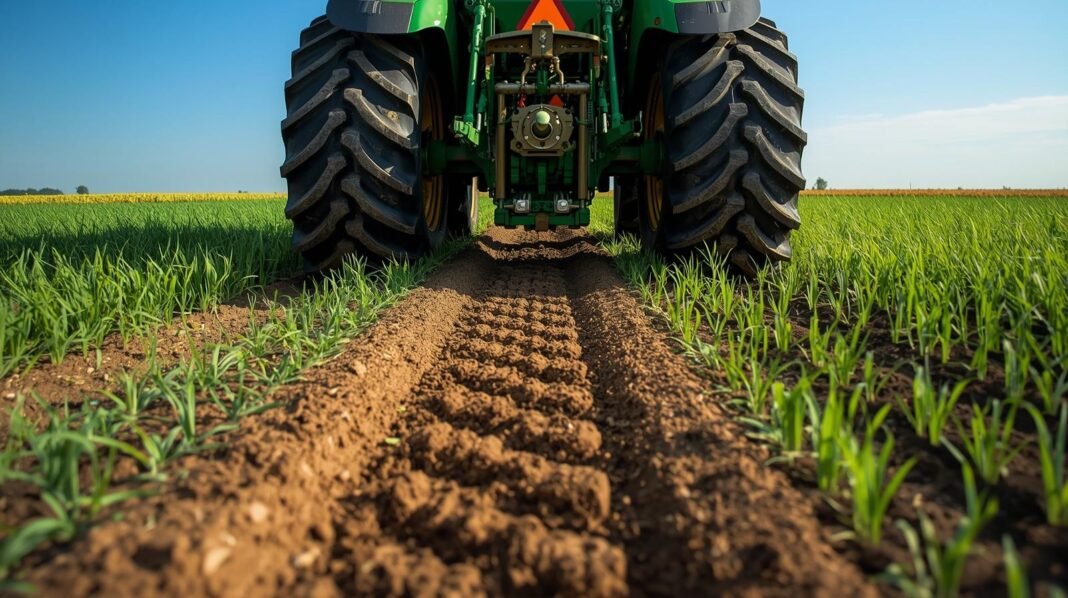

Every time a tractor rolls across a field, it leaves more than just tyre tracks. Invisible to the naked eye, the pressure exerted by heavy agricultural machinery compresses the soil beneath, squeezing out the air and water that crops depend on to thrive.
Soil compaction is one of the most damaging — and most underestimated — threats to modern agricultural productivity. The good news? One of the most effective weapons against it is already sitting under your tractor: the right set of wide tyres.
This article explores the science behind soil compaction, why tyre width matters more than many farmers realise, and how modern wide and ultra-flexion tyre technology is giving growers a practical, cost-effective route to healthier soils and higher yields.
What Is Soil Compaction and Why Does It Matter?
Soil compaction occurs when soil particles are pressed together, reducing the pore space between them.
These pores are not empty — they are filled with air and water, and they serve as the highway system through which plant roots travel, water drains, and beneficial microorganisms live.
When compaction crushes these channels, the consequences cascade rapidly through the entire farming system.
The key effects of compacted soil include:
- Reduced water infiltration, causing increased runoff, surface waterlogging, and erosion
- Poor root penetration, limiting a plant’s access to nutrients and moisture deeper in the profile
- Decreased soil aeration, which starves roots of oxygen and suppresses microbial activity
- Increased disease risk, as waterlogged and poorly aerated soil creates ideal conditions for pathogens
- Substantially reduced crop yields — a multi-state study found that deep compaction depressed corn and soybean yields by approximately 5% for over a decade after just a single compaction event
Compaction occurs in two zones. Surface compaction (the top 0–15 cm) is driven primarily by tyre inflation pressure and is the zone most influenced by tyre choice.
Subsoil compaction (15–60 cm and below) is driven largely by axle load and is far harder — sometimes impossible — to reverse without deep mechanical intervention. Getting tyre selection right is therefore most critical for protecting that vital upper soil layer.
The economic stakes are significant. Independent UK research from Adas estimates soil compaction damage costs between £600 and £1,200 per hectare — money spent on extra cultivations, fuel, remediation work, and lost yield potential.
With surveys suggesting 40–60% of UK soils are already in a moderate or degraded condition, the problem is industry-wide, not farm-specific.
The Physics of Pressure: Why Tyre Width Changes Everything
The relationship between tyre width and ground pressure is governed by straightforward physics: pressure equals force divided by area.
A tractor carrying a 4,000 kg rear axle load across a narrow tyre concentrates that enormous weight onto a small contact patch, driving intense pressure into the soil beneath.
Fit a wider tyre carrying the same load, and that force is spread across a much larger footprint — meaning each square centimetre of soil receives far less pressure.
Wide and large-volume tyres are engineered specifically to exploit this principle. Their purpose is to reduce ground pressure at the same load while providing equal or better traction, and to do so without altering the tractor’s overall rolling circumference or gearing.
In practical terms, this means a farmer can upgrade from standard tyres to wide-profile tyres without any drivetrain modifications — yet dramatically reduce the damage being done with every pass.
A wider tyre also produces a footprint that is longer and shallower rather than narrow and deep. This elongated contact patch distributes the load more like a caterpillar track than a knife blade, limiting both the depth and intensity of soil compression.
The result is less rutting, reduced structural damage to the upper soil horizon, and a field that requires less remediation work.
From Standard to Wide: A Practical Comparison
To put the numbers in context, consider a 200 hp tractor carrying a rear axle load of around 4,000 kg per tyre.
A conventional standard tyre running at field-appropriate pressures may exert 1.6 bar or more on the soil surface. Switch to a wide or large-volume tyre on the same axle — say, moving from a 480/70 R38 to a 600/65 R38 or 650/75 R38 — and that same load can be carried at pressures approaching 1.0 bar or below, a reduction of 30–40%.
The footprint grows, the ruts shrink, and the soil survives another season in better shape.
Manufacturers such as Michelin, Bridgestone, Continental, BKT, and CEAT now offer dedicated wide-volume series — names like OmniBib, MultiBib, MachXBib, and VT-Tractor — that pair increased width with strengthened casing construction.
These tyres are designed to hold their shape and load-carrying capacity even when run at reduced pressures, ensuring that the wider footprint is achieved without compromising durability or road performance.
IF and VF Tyres: Taking Wide Technology Further
Wide tyres are one part of the solution. Paired with Increased Flexion (IF) and Very High Flexion (VF) tyre technology, they become even more powerful tools for soil protection.
IF and VF tyres feature a reinforced single bead wire construction that allows the tyre sidewalls to flex far more than a conventional tyre.
This additional flex serves two purposes. First, it enables the tyre to carry significantly higher loads at the same inflation pressure — VF tyres can carry 40% more load than a comparable standard tyre at identical pressures.
Second, and more usefully for soil protection, it means the tyre can be run at dramatically lower pressures while carrying the same load.
VF tyres can operate at inflation pressures as low as 0.6–0.8 bar in field conditions, compared to 1.6 bar or more for standard tyres doing the same job.
That pressure reduction translates directly into a larger, flatter footprint and dramatically less soil stress.
Research by Harper Adams University in the UK, running from 2013 to 2017, demonstrated that VF tyre technology with properly optimised inflation pressures produced agronomic yield improvements of between 2% and 6% for key crops including wheat, corn, and soybeans.
Similar studies in Illinois and Brazil confirmed these findings. A 4% yield improvement across a large arable operation represents a genuinely meaningful return on a tyre investment.
A further advantage of VF tyres for sprayers and implements is that they eliminate the need to re-inflate between a full and empty tank.
Standard tyres must be inflated to handle the maximum loaded weight, which means they are over-pressured — and therefore more damaging — when the tank is half-full or empty. VF tyres have sufficient flex to carry the full load safely at a single low pressure throughout the entire operation.
The Compaction-Yield Connection: What the Research Shows
The scientific link between reduced soil compaction and improved crop performance is now well-established.
A comprehensive review published in the Journal of Biosystems Engineering found that over 20 years of field research consistently showed that lower tyre inflation pressure, wider tyre profiles, and reduced machinery weight improved soil structure, root development, and ultimately crop yield across diverse farming systems worldwide.
Crucially, research has shown that approximately 70–80% of compaction damage occurs on the very first pass of machinery across a field. After that first contact, the soil’s load-bearing capacity increases but its structure has already been disrupted.
This means that the right tyre setup is most valuable on the first pass — whether that is a tractor pulling a planter, a laden sprayer, or a grain cart following the combine at harvest.
The combine harvester deserves particular attention. Machines weighing between 25 and 40 tonnes — especially when the grain tank is full — are responsible for 50 to 85% of total field compaction across a cropping season, depending on soil type and moisture.
\Fitting combine headers and grain carts with wide flotation tyres, VF technology, or even dual-tyre configurations on heavily loaded axles is one of the highest-return investments a large arable farm can make.
Tyre Width vs. Tracks: Choosing the Right Solution
A common question is whether rubber tracks are preferable to wide tyres for compaction reduction.
The answer, as with most agronomic questions, is nuanced. Tracks do provide excellent flotation in very wet, muddy conditions and spread load across a longer contact area.
However, track machines are typically 20–30% heavier than their wheeled equivalents, and the load under the drive and idler wheels remains concentrated — tracks do not distribute weight uniformly.
Research from the University of Minnesota found that tractor tyres inflated to 6–7 psi (roughly 0.4–0.5 bar) ranked better for compaction management than tracked tractors in certain field comparisons.
Equally, a harvester fitted with 28-inch wide tyres inflated to 15 psi delivered minimal compaction in Ohio trials.
The conclusion is not that tracks are inferior, but that properly selected, wide, low-pressure tyres — particularly IF and VF variants — can match or outperform tracks in many real-world compaction scenarios, at considerably lower capital cost.
For deep subsoil compaction caused by very heavy axle loads, neither wide tyres nor tracks are a complete solution — reducing machine weight and axle loads through careful machinery specification remains essential.
But for the surface and upper subsoil compaction that wide tyres directly address, the evidence strongly supports investment in tyre width and low-pressure technology ahead of the heavier, more expensive track option.
Practical Steps for Farmers: Getting the Most from Wide Tyres
Switching to wider tyres is only effective if the wider footprint is actually achieved in the field. Here are the key practices to follow:
- Run the lowest safe inflation pressure for field operations. Many experts recommend staying below 10 psi (0.7 bar) for in-field work where tyre technology allows. Consult the tyre manufacturer’s load-pressure tables for your specific axle weight.
- Increase pressure for road transport. Running at field pressures on tarmac degrades tyre life rapidly and reduces handling. Central Tyre Inflation (CTI) systems automate this adjustment on the move.
- Avoid field operations on saturated soil. No tyre, however wide, can fully protect soil at or near field saturation point. If the field is too wet, the most effective tool is patience.
- Follow the same tracks where possible. Tramline or controlled traffic farming concentrates compaction to defined sacrifice zones and protects the rest of the field surface.
- Monitor with a penetrometer. A simple cone penetrometer measures soil resistance in the field and helps you see where compaction is occurring and at what depth — invaluable data for justifying tyre investments.
- Prioritise the heaviest machines. Combine harvesters, fully laden grain carts, and heavy sprayers cause the most damage. Upgrading the tyres on these machines delivers the largest compaction benefit.
Invest in Your Tyres, Invest in Your Soil
Soil is the single most valuable asset on any farm. It takes decades to build and only one wet harvest to degrade.
Wide tyres — especially when combined with IF or VF flexion technology and disciplined inflation management — are not merely a tyre purchasing decision.
They are a soil management decision, a yield protection decision, and increasingly, an environmental compliance decision as regulators in many countries begin to scrutinise machinery-induced soil degradation.
The investment case is compelling. Wider tyres reduce compaction on the first pass — when it matters most.
VF technology cuts field inflation pressures by up to 40%. Multi-year field trials show yield gains of 2–6% from optimised tyre technology alone. And the savings on remediation — fewer cultivations, less fuel, less subsoiler time — begin accumulating from the very first season.
Modern farming is under pressure from every direction: input costs, weather variability, environmental regulation, and margin squeeze.
Wide tyre technology is one of the rare solutions that simultaneously addresses soil health, productivity, fuel efficiency, and sustainability.
If your current tyre setup is leaving compaction damage in every field it enters, the cost of upgrading may be far lower than the cost of doing nothing.
Fitting your heaviest machines with wide, low-pressure tyres — particularly
VF-rated technology — is the most cost-effective single action to protect
your soil and maintain long-term yield potential.
Also Read
Top Ultra High-Horsepower Tractors Reshaping Global Agriculture
Used Combine Harvester for Sale: What Farmers Should Check Before Buying

Martin is a writer at Agrimachinery Africa specializing in agricultural machinery, mechanization trends, and farm technology across Africa. His work focuses on tractors, harvesting equipment, irrigation systems, and emerging innovations helping farmers improve productivity and efficiency. Through in-depth industry coverage, he highlights technologies shaping the future of modern agriculture.