


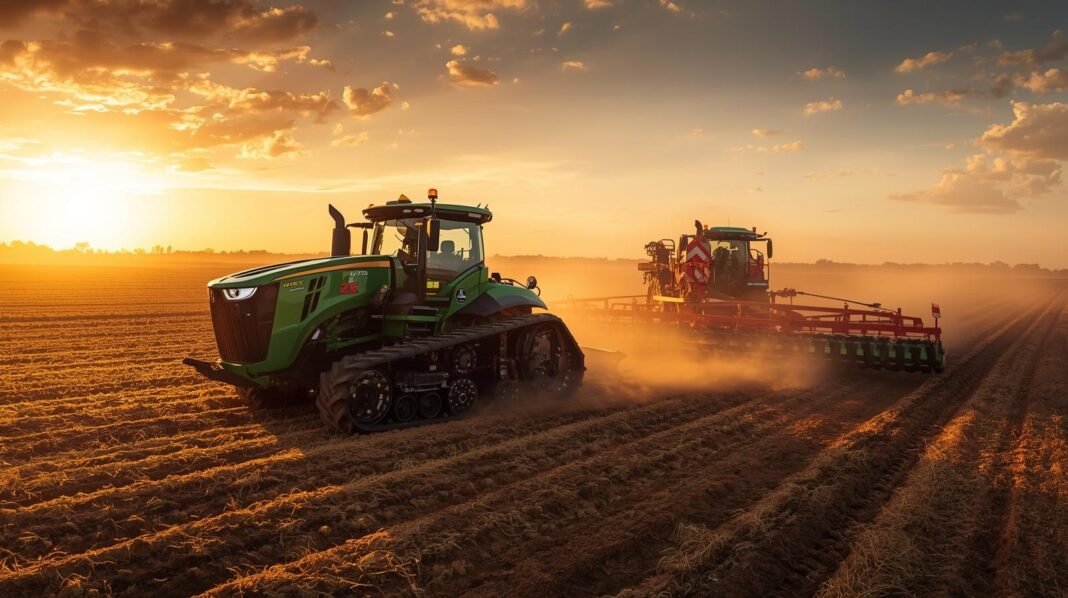

When the ground needs to turn in a single pass — across thousands of hectares, in shrinking weather windows, with fewer hands available — ultra high-horsepower tractors are no longer a luxury. They are the machinery of necessity.
Defined broadly as tractors rated at 400 horsepower and above, this elite class has exploded in capability over the past decade, with today’s flagship models pushing rated outputs beyond 800 hp and peak figures cresting 900 hp.
The companies building them — John Deere, Case IH, Fendt, New Holland, Versatile — are locked in one of the most technically sophisticated horsepower races in the history of farming.
This article profiles the most powerful production tractors available globally, examining their specifications, technologies, and the real-world economics that make them compelling choices for the world’s largest farming operations.
Why Ultra Horsepower Matters: The Case for Extreme Power
The argument for extreme horsepower is rooted in arithmetic. Modern farming operations — particularly in North America, Australia, Ukraine, and Brazil — frequently span several thousand hectares. Wider implements, faster field speeds, and fewer passes directly translate to lower cost per acre.
According to market analysts, mechanization enables plowing, sowing, and harvesting efficiency gains of 25 to 40 percent over manual alternatives, while advanced engines can reduce fuel consumption per hectare by up to 10 percent.
Labor shortages are accelerating this shift. In regions from the U.S. Corn Belt to the vast steppes of Eastern Europe, the pool of skilled farm operators is shrinking, making each machine — and each hour of optimal working conditions — more valuable.
Ultra high-horsepower tractors address this challenge by multiplying what a single operator can accomplish in a day, pulling wider implements, running at higher speed, and completing tasks that would otherwise require multiple smaller machines running simultaneously.
The global high-horsepower tractor market (typically defined as tractors above 250 HP) was valued at approximately USD 14.6 billion in 2024 and is projected to reach USD 23.6 billion by 2032, growing at a compound annual growth rate of 6.19 percent.
The broader agricultural tractor market, meanwhile, is on course to exceed USD 100 billion within the decade — a testament to how deeply mechanization has penetrated global food production.
1. John Deere 9RX 830 — The World’s Most Powerful Series-Production Tractor
No machine commands attention in modern agriculture quite like the John Deere 9RX 830. Unveiled at the 2024 Commodity Classic in Houston, Texas, it holds the title of the most powerful production tractor John Deere has ever built — and, at the time of writing, the most powerful series-production tractor in the world.
Specifications at a Glance
Rated horsepower: 830 hp | Peak horsepower: 913 hp | Engine: 18-litre JD18X inline-six | Torque: 4,234 Nm (3,123 lb-ft) | Transmission: e21 PowerShift or optional AutoPowr CVT | Track system: Four belts (30- or 36-inch options) | Maximum ballasted weight: 38,100 kg (84,000 lbs) | Price range: approximately USD 900,000 to $1.1 million
The 9RX 830 is built around the Stage V-compliant JD18X engine, a unit notable for operating without Diesel Exhaust Fluid (DEF) — relying instead on an Exhaust Gas Recirculation (EGR) system. For operators in remote regions, the elimination of AdBlue infrastructure is a practical advantage worth highlighting.
The four-track layout distributes the machine’s 25-tonne operating weight across a massive footprint, reducing ground pressure well below what many lighter wheeled tractors impose — a feature soil scientists and agronomists increasingly cite when arguing for track machines on prime arable land.
In the cab, operators find a fully digitized environment: a 12.8-inch G5 Plus CommandCenter, StarFire 7500 RTK receiver, JDLink telematics modem, AutoTrac automated steering, Section Control, and Variable Rate application technology.
The tractor ships as autonomy-ready, meaning John Deere’s second-generation autonomous kits — enabling 360-degree obstacle detection and remote monitoring via JDLink — can be fitted without major modifications.
In North America, a single 9RX 830 can pull a 24-row maize planter at 12 km/h; in Australia it drives 24-metre air seeders across paddocks that would take days longer with conventional equipment.
2. Case IH Steiger 785 Quadtrac — Tractor of the Year 2025
Case IH has long held a commanding presence in the ultra-high-horsepower segment, and the Steiger 785 Quadtrac — the newest and most powerful model in the Steiger lineup — underlines that heritage emphatically.
With a peak output of 853 horsepower, it sits directly behind the John Deere 9RX 830 in the production tractor rankings, and it carries the Tractor of the Year 2025 award in the HighPower Category, won at EIMA International 2024 in Bologna, Italy.
Case IH Steiger 715 Quadtrac — Proven Flagship
Before the 785 arrived, the Steiger 715 Quadtrac had redefined expectations in the segment. Rated at 715 hp with a peak output of 778 hp, its heart is the FPT Industrial C16 TST — a twin-stage turbine engine developed in direct collaboration with Case IH, delivering 15 percent more power than its predecessor. The fuel tank holds up to 520 gallons, maximizing field time between stops.
The Quadtrac system — now in its third decade of continuous development — uses four individually driven, positive-drive oscillating tracks.
The 2025 model year introduced a new heavy-duty suspended undercarriage, improving both operator comfort and weight distribution while boosting maximum roading speed to 26.5 mph.
AccuGuide auto-steering, AccuTurn autonomous headland management, and dual Pro 1200 displays complete a precision agriculture package designed for operations running the machine across multiple shifts and operators.
3. Fendt 1167 Vario MT — European Engineering at Its Peak
From AGCO’s German marque Fendt comes the 1167 Vario MT — the most powerful tractor in Fendt’s history, and the machine that has set the benchmark for European engineering sophistication in the super-high-horsepower class.
Rated at 664 hp continuous power, it is powered by a MAN six-cylinder engine displacing 16.2 litres, paired with Fendt’s legendary stepless Vario transmission.
What truly distinguishes the 1167 Vario MT from its rivals is the VarioDrive system, which distributes power independently between left and right tracks in real time, effectively eliminating slip and maximising tractive efficiency across uneven terrain.
The FendtONE control concept — encompassing three touchscreens, a freely assignable joystick, smartphone-style tile menus, and cloud connectivity — turns the cab into what Fendt describes as a digital workplace.
A particularly notable feature is TIM: Tractor Implement Management. Through TIM, a connected drill can actively control tractor speed to ensure optimal seed placement, removing human variability from one of the most precision-sensitive tasks in arable farming.
For operations focused on minimizing inputs while maximizing yield consistency, the 1167 Vario MT represents the current state of the art in European agricultural engineering.
The broader Fendt 1100 Vario MT Series spans four models from 511 to 673 hp, all powered by a 15.2-litre engine, giving large farming operations a genuine choice of power level within a consistent, familiar technology platform.
4. John Deere 9RX 620 and 9RX 770 — Tier Entry into the Four-Track World
Not every operation needs 830 rated horsepower. John Deere’s 9RX 620 (620 hp) and 9RX 770 (770 hp rated, 847 hp peak) serve as the entry and mid points to the four-track world, sharing the same chassis, hydraulics, and structural components as the flagship 830 model.
The 9RX 620 uses a proven Cummins QSX 15 engine and has become, in many markets, the first four-track tractor operators purchase — valued for its more moderate transport width, relatively lower price, and full access to John Deere’s smart farming ecosystem.
The 9RX 770 shares the new JD18X engine of the 830, with different mapping and fuel calibration.
Both models are capable of pulling 60-foot high-speed disks and are shipped as autonomy-ready platforms, forward-compatible with John Deere’s ongoing autonomous guidance systems.
5. Versatile 620 and 620DT — North American Heritage Power
Winnipeg-based Versatile occupies a distinctive position in the ultra-high-horsepower landscape.
Its wheeled 620 model delivers 616 hp through a Cummins X15 engine mated to a Caterpillar TA22 powershift transmission — a combination celebrated by North American farmers for mechanical simplicity and long-term durability.
The tracked DeltaTrack 620DT brings that same powertrain to a twin-track chassis for operations prioritising soil protection.
Versatile’s philosophy has always centred on straightforward, operator-serviceable engineering, and this distinguishes it from European and American rivals that increasingly embed deep software dependency into their drivetrain and precision ag systems.
For large grain and oilseed producers in the Canadian Prairies and the northern U.S., Versatile remains a compelling alternative to the dominant brands.
6. New Holland T9.700 — The Versatile Blue Giant
New Holland’s T9 Series represents CNH Industrial’s answer to the ultra high-horsepower challenge within its blue brand portfolio.
The T9.700 — the flagship — offers 645 hp from a cursor engine, available in both wheeled and tracked (T9.700 SmartTrax) configurations.
The T9 Series now ships with PLM Intelligence, New Holland’s suite of precision farming tools that encompasses auto-guidance, variable rate technology, fleet management, and connectivity with the Precision Land Management ecosystem.
For 2025, New Holland expanded T9 autonomy-compatible features, making its models capable of interfacing with third-party autonomous grain cart systems, a growing priority as labour-saving automation moves from the cab into the broader farmyard operation.
The Technology Race: Beyond Horsepower
Raw horsepower ratings, while headline-grabbing, tell only part of the story. The real competition among ultra-high-horsepower tractors is increasingly fought in the domains of precision guidance, telematics, autonomous operation, and data management.
All major producers now offer sub-inch RTK GPS guidance as either standard or optional equipment.
Autonomous headland turning — the ability of a tractor to reverse direction at the end of a field row without operator input — is available across John Deere, Case IH, and Fendt platforms, shaving meaningful time from each field pass.
John Deere’s second-generation autonomy kit, available as a retrofit for 2022 and newer 9R and 9RX tractors, brings 360-degree obstacle detection and enables unattended tillage operation on select field tasks — a development that has attracted significant attention from farm management companies running large-scale operations.
On the transmission front, continuously variable and stepless transmissions — Fendt’s Vario, John Deere’s AutoPowr, and New Holland’s Dual Command CVT — have matured into highly refined systems that maintain optimal engine load across variable terrain without driver intervention.
These transmissions work in concert with GPS and load-sensing hydraulics to ensure every litre of diesel is converted into effective field work rather than wasted in unnecessary gear changes or wheel spin.
Telematics platforms — JDLink, Case IH FieldOps, FendtONE — now allow fleet managers to monitor fuel consumption, idle time, fault codes, and field progress in real time from any connected device.
As farm operations scale and shift-based working becomes standard on flagship tractors, these data layers are no longer optional conveniences; they are operational necessities.
The Economics of Extreme Horsepower
The upfront cost of an ultra high-horsepower tractor is formidable. A John Deere 9RX 830 lists at approximately USD 1 million; a Fendt 1167 Vario MT at around EUR 650,000; a Case IH Steiger 715 Quadtrac at roughly USD 1.067 million. These are not figures that invite casual purchasing decisions.
Yet the economic case, spread across sufficient acreage, is compelling. Analysts suggest that on operations of 5,000 hectares or more, operating costs for a flagship four-track tractor land between USD 85 and USD 110 per hectare when calculated across a ten-year horizon — comparable to running three mid-size tractors with double the labour requirement.
Residual values on well-maintained track tractors remain robust beyond 10,000 operating hours, and manufacturer leasing programmes with strong buy-back provisions have made these machines accessible to a wider range of operations than ownership economics alone would suggest.
Some manufacturers now offer warranty packages covering up to 5,000 hours with no material cost contributions from the operator — a significant reduction in lifecycle financial uncertainty for what is often the most expensive single piece of equipment on a farm.
Global Market Outlook: Who Is Buying and Why
North America remains the home market for ultra-high-horsepower tractors, driven by Corn Belt operations averaging 600 hectares or more, where wider implements and labour productivity are the dominant decision factors.
John Deere reported an 18 percent year-over-year increase in high-horsepower tractor deliveries in recent fiscal years, capturing demand created by expansion in planter and combine widths that require greater drawbar pull.
Europe’s interest is shaped differently: Stage V emissions compliance, the European Green Deal’s target of a 25 percent reduction in agricultural emissions by 2030, and precision agriculture mandates are driving adoption of CVT-equipped, telematics-rich machines.
Germany and France jointly account for approximately 42 percent of European high-horsepower tractor shipments.
In the Southern Hemisphere, Australia’s vast grain-growing regions — where a single paddock can span what would be an entire farm in many European countries — represent some of the highest utilisation environments in the world for flagship tractors.
Ukrainian and Russian large-scale agricultural operations have historically been significant consumers of ultra-high-horsepower equipment, though geopolitical disruption has reshaped procurement patterns considerably since 2022.
Brazil’s expanding agricultural frontier, particularly in the Cerrado and Mato Grosso regions, is seeing increasing adoption of high-horsepower four-wheel drive and tracked machines as soybean and maize production scales to meet global demand. Latin America as a whole is emerging as one of the faster-growing markets for this equipment class.
Conclusion: Power with Purpose
The ultra high-horsepower tractor is not a vanity product. It is a calculated response to the compounding pressures of labour scarcity, input cost volatility, shrinking planting windows, and the relentless demand for more food from a finite amount of productive land.
The John Deere 9RX 830, Case IH Steiger 785 Quadtrac, Fendt 1167 Vario MT, Versatile 620DT, and New Holland T9.700 represent the current pinnacle of what production engineering can achieve in this space — machines that combine jaw-dropping power with sophisticated digital intelligence.
The horsepower race is far from over. Manufacturers are already integrating autonomous capabilities, hybrid powertrains, and AI-assisted precision agriculture into tractors that will make today’s flagships look conservative within a generation.
What will not change is the fundamental equation: in large-scale agriculture, time is the scarcest resource of all, and the machines that compress the most productive work into the fewest hours will continue to define the future of global food production.
Also Read
Top 10 Tractors of 2026: A Comprehensive Guide
Kenya’s Walking Tractor Revolution: Affordable Mechanization for Smallholder Farmers

Martin is a writer at Agrimachinery Africa specializing in agricultural machinery, mechanization trends, and farm technology across Africa. His work focuses on tractors, harvesting equipment, irrigation systems, and emerging innovations helping farmers improve productivity and efficiency. Through in-depth industry coverage, he highlights technologies shaping the future of modern agriculture.