


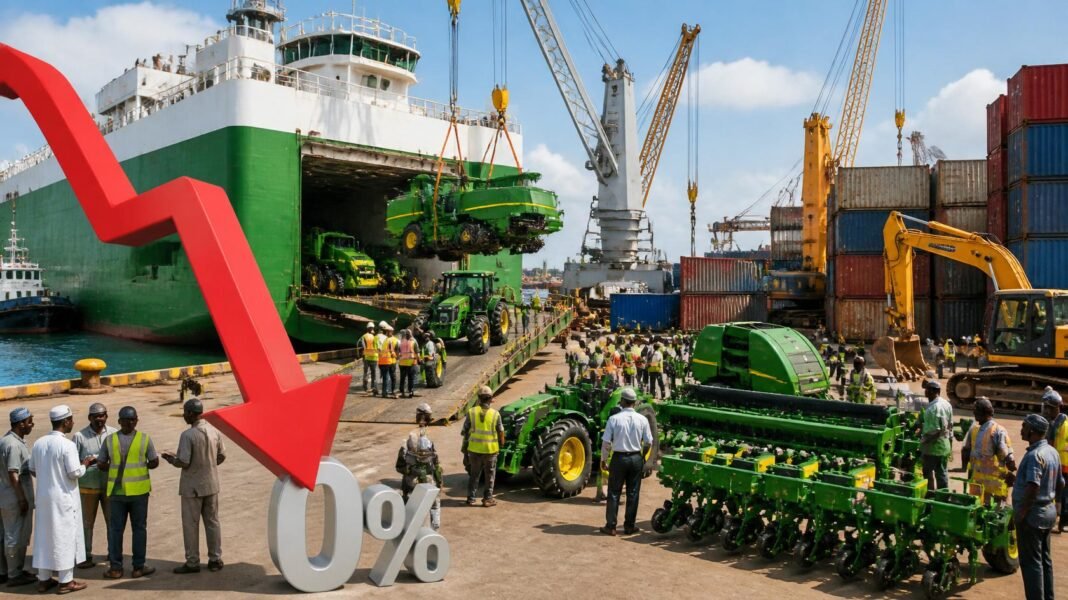

Lagos, July 2 2026-Nigeria has abolished import duties on agricultural and manufacturing machinery entirely, in what officials are calling one of the most sweeping overhauls of the country’s tariff regime in years.
The measure, which took effect on July 1, 2026, brings tractors, harvesters, planters, irrigation equipment and processing machinery into Nigeria under zero-duty terms for the first time — a move with direct implications for equipment dealers, mechanisation programmes and smallholder farmers across Africa‘s most populous nation.
The change forms part of the 2026 Fiscal Policy Measures and Tariff Amendments approved by Finance Minister and Coordinating Minister of the Economy Wale Edun, and implemented through a Nigeria Customs Service circular this week.
The reforms revise 127 tariff lines and replace the 2023 fiscal guidelines outright, with agricultural and manufacturing machinery, railway and tramway locomotives, and cargo ships above 500 tonnes among the categories moved to 0% duty.
From a Costly Import to a Zero-Duty Line
Until this month, imported farm machinery in Nigeria carried duty rates typically ranging from 5% to 20%, layered with additional levies, VAT and customs processing charges that could push effective landed costs well above the headline tariff.
Industry estimates put the landed cost of a 60-horsepower tractor at roughly $36,000 after duties — a figure equivalent to about 24 years of net farm income for a smallholder cultivating 1.5 hectares of maize, according to market analysis from Mordor Intelligence.
That cost gap has long been cited as the single biggest barrier to mechanisation in a country where tractor density sits at an estimated 2.3 units per 1,000 hectares of arable land, far below levels in more mechanised farming economies.
We are not importing dependency. We are building industrial capability.
— Agriculture Minister Abubakar Kyari, on Nigeria’s mechanisation drive
Kyari’s remark was made in the context of Nigeria’s Renewed Hope Agricultural Mechanisation Programme (RHAMP), the government’s parallel push to deploy tractors through service-based, lease-to-own models rather than direct sales — but it captures the broader policy logic now underpinning the duty removal: cheaper imported equipment in the short term, paired with domestic assembly capacity in the long term.
Officials have said a tractor assembly plant capable of producing 2,000 to 4,000 units annually is in the pipeline, alongside 36 mobile mechanisation service trucks and seven planned mega-service centres nationwide.
Part of a Wider Inflation-Fighting Package
The machinery exemption did not arrive in isolation. It sits inside a broader package first announced on April 1, 2026, when Nigeria set out plans to cut duties on food, vehicles and industrial inputs from July 1, as the Tinubu administration works to bring down inflation that peaked near 33% in December 2024 before easing to 15.06% by February.
Passenger vehicle duties fall from 70% to 40% under the same measures, new-vehicle import levies drop from 20% to 10%, and electric vehicles and mass-transit buses are now fully duty-exempt.
Bulk rice, raw sugar and palm oil also see reductions, though most of those cuts are calibrated rather than eliminated outright — machinery is one of the few categories to go to zero.
The reforms also introduce Supplementary Protection Measures, including a new Import Adjustment Tax across 192 tariff lines aimed at shielding sensitive domestic sectors even as headline duties fall.
That adjustment tax is explicitly temporary: it is set to decline annually from January 2027 and reach zero by 2036, in line with Nigeria’s regional trade commitments under the ECOWAS Common External Tariff framework.
| Category | Duty Before Apr 2026 | Duty From Jul 1, 2026 |
| Agricultural machinery (tractors, harvesters, planters, irrigation equipment — HS 84/85/90) | 5% – 20%, plus levies | 0% |
| Manufacturing machinery | 5% – 20%, plus levies | 0% |
| Fully built passenger vehicles | 70% | 40% |
| Electric vehicles & mass-transit buses | 20% | 0% |
| New vehicle import levy (Green Tax adjustment) | 20% | 10% |
Source: Nigeria Customs Service; 2026 Fiscal Policy Measures and Tariff Amendments; Presidency circular, April 14, 2026.
What It Means for Equipment Suppliers
For international manufacturers, the timing lands squarely on an already active market. Nigeria accounted for an estimated 38.6% of Africa’s agricultural tractor machinery sales in 2025, according to Mordor Intelligence, anchored partly by federal-subsidised loan programmes and partly by sheer scale of demand.
John Deere’s partnership with Hello Tractor already plans to deploy 10,000 tractors under pay-as-you-go terms, potentially servicing 9 million hectares and supporting an estimated 2 million jobs.
Massey Ferguson, CNH Industrial, Kubota and Mahindra all maintain active distribution networks in the country.
A zero-duty import line lowers the cost floor for all of them, and could accelerate the shift some manufacturers were already making toward completely knocked-down (CKD) local assembly.
It may also sharpen competition from Brazilian and Asian machinery exporters that have been expanding into West African markets on price.
With duty no longer a differentiator, competition is likely to shift further toward financing terms, after-sales service networks and spare-parts availability — areas where Nigeria’s fragmented dealer infrastructure has historically lagged demand.
How Nigeria Now Compares
The move brings Nigeria into closer alignment with several of its regional neighbours. Kenya already applies a zero-rate import duty on most farm machinery — including tractors, plows and harvesters — under the East African Community Common External Tariff, though importers there still face a 3.5% Import Declaration Fee and a 2% Railway Development Levy on top of the zero duty rate, plus 16% VAT further down the cost stack.
Nigeria’s own package includes similar residual charges, meaning “zero duty” will not translate to duty-free landed cost once VAT, the Green Tax surcharge and processing fees are applied — but the headline shift narrows a gap that has long made Nigerian machinery imports comparatively more expensive than those entering East Africa.
The Caveats
Analysts caution that tariff relief alone will not resolve Nigeria’s mechanisation shortfall. Naira volatility, foreign exchange access for importers, fragmented smallholder landholdings averaging 0.7 to 2.2 hectares, and a shortage of trained service technicians remain structural constraints regardless of the duty line.
A separate concern flagged by economic commentators this week: Nigeria’s manufacturing sector reported a 68.25% collapse in Company Income Tax payments in the first quarter of 2026 compared with a year earlier, a signal that industrial activity broadly remains under pressure even as fiscal measures aim to stimulate it.
Government officials maintain the intent is structural rather than short-term. Under the revised schedule, Import Adjustment Taxes are due to phase down annually from January 2027 toward full elimination by 2036, positioning the machinery exemption as an early move in a longer-run tariff liberalisation rather than an isolated inflation fix.
For equipment buyers and dealers, the more immediate question is how quickly Nigeria Customs applies the new codes at the ports — and whether savings on paper translate into lower showroom prices before the next planting season.
Also Read
Ghana Orders 1,840 Belarusian Farm Machines in Major Push to Modernize Agriculture
How Zoomlion Is Challenging Established Farm Equipment Brands Worldwide

Martin is a writer at Agrimachinery Africa specializing in agricultural machinery, mechanization trends, and farm technology across Africa. His work focuses on tractors, harvesting equipment, irrigation systems, and emerging innovations helping farmers improve productivity and efficiency. Through in-depth industry coverage, he highlights technologies shaping the future of modern agriculture.