


It is rare for a company to announce a strategic retreat and a strategic advance in the same breath.
Mahindra & Mahindra has done exactly that — and the agricultural equipment world is paying close attention.
Within the span of a single week in early March 2026, the Mumbai-based conglomerate confirmed it is winding down its long-standing Japanese joint venture — Mitsubishi Mahindra Agricultural Machinery (MAM) — while simultaneously unveiling a fresh wave of tractors designed to deepen its grip on the United States market.
The message, whether intentional or not, was unmistakable: Mahindra is not retreating. It is reloading.
The End of a Japanese Chapter
The Mitsubishi Mahindra Agricultural Machinery joint venture was, for many years, a symbol of the kind of East-meets-East industrial alliance that defined the globalization era.
MAM gave Mahindra access to Japanese engineering DNA and a foothold in Asia-Pacific markets; Mitsubishi gained exposure to Mahindra’s manufacturing scale and distribution reach.
But the numbers eventually told a harsher story. In the fiscal year ending March 2025, MAM recorded revenues of approximately ₹2,094 crore — a respectable top line — but posted a net loss of around ₹227 crore.
Its net worth had turned negative. Multiple rounds of restructuring failed to restore profitability, and after a thorough review of market conditions, demand patterns, and production economics, Mahindra concluded that the business could not be sustained on financially stable terms.
The formal wind-down will be measured, not abrupt. Research, development, production, and sales will cease by the first half of fiscal year 2026–27.
Critically, Mahindra has pledged that existing customers will not be abandoned — parts, warranty coverage, and service support will remain available for years to come, a reassurance aimed squarely at protecting dealer relationships and brand trust built over decades.
Mahindra is not treating the JV exit as a retreat. It is treating it as an opportunity to own its product line entirely.
Enter the OJA Platform
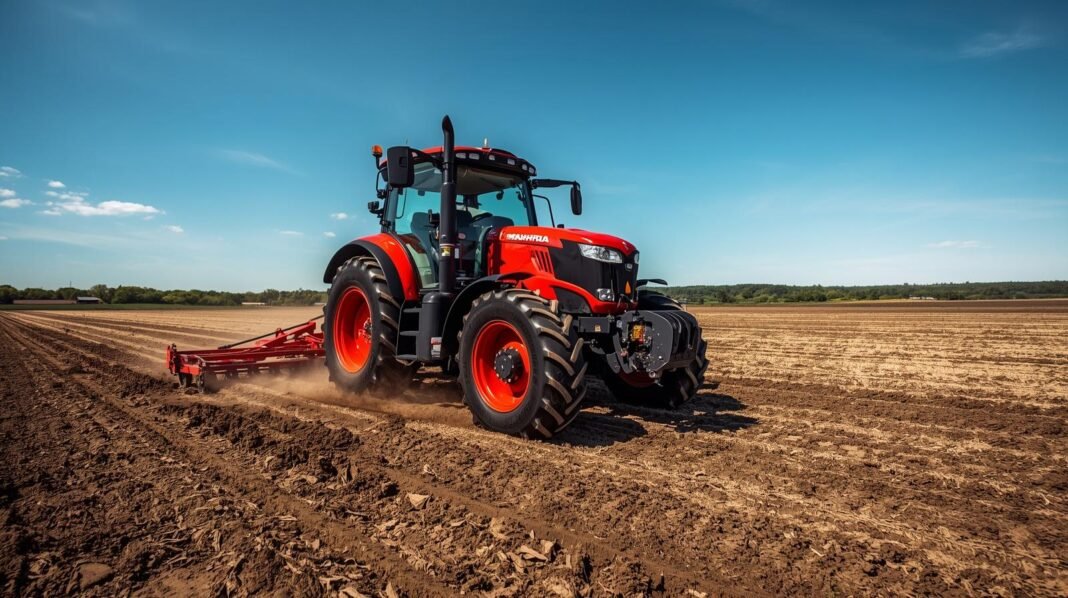
Announced at the National Farm Machinery Show in Louisville, Kentucky, Mahindra’s new tractor family is built on a platform the company calls Powered by OJA — a name drawn from the Sanskrit word Ojas, meaning energy and vitality.
It is an apt choice for a product line that is being positioned as a generational leap forward.
The initial rollout includes the 1100 series (20–26 HP subcompacts) and the 2100 series (23–26 HP compacts), offered in both cab and open-station configurations.
The 2126 compact cab variant arrives with air conditioning, a rear defrost function, and an enhanced 11-gallon-per-minute hydraulic pump that meaningfully increases lift capacity.
Perhaps most notably, the 1100 subcompact series is now backhoe-compatible — an unusual feature in the 20 HP class that Mahindra believes will set it apart in a crowded entry-level segment.
Woven throughout the new lineup is the OJA software platform, accessible via a smartphone app and designed to give operators an intuitive, connected cockpit experience.
For a company that has historically competed on durability and value, the move into smart-tractor territory signals that Mahindra is watching — and responding to — the digitization wave sweeping precision agriculture.
Reading the U.S. Buyer
Mahindra’s North American subsidiary, Mahindra Ag North America (MAGNA), headquartered in Texas, has framed the JV exit as a “well-planned and strategic decision” that reaffirms rather than undermines its commitment to the American market.
That framing is backed by data the company has clearly studied carefully.
Company analysis identifies two primary buyer personas in the U.S. compact tractor space: first-time rural property owners seeking capable, approachable machines, and buyers in their 50s and 60s with disposable income and an appetite for premium features.
Almost half of the U.S. tractor market sits below 20 HP, and roughly 70 percent of buyers in that band are purchasing their first tractor — a statistic that makes ease of use, connectivity, and brand confidence enormously important.
To ensure no gap opens in the portfolio as the MAM models are phased out, Mahindra has committed to new models spanning 26 to 70 HP — a range that covers the heart of North American compact and utility tractor demand.
The transition is being managed to be seamless for dealers and buyers alike.
What This Tells Us About Mahindra
Reading Mahindra’s two announcements together, a clear strategic logic emerges. The company is shedding a costly, structurally challenged partnership in a market where it could not achieve sustainable scale, while doubling down on North America — a market where it has built genuine brand equity over decades, particularly among rural landowners and hobby farmers.
Owning its platform outright, rather than sharing it with a partner, gives Mahindra full control over product roadmap, pricing, feature development, and brand narrative.
The OJA platform — with its emphasis on connectivity, modern cab comfort, and unexpected capability at entry-level horsepower — suggests the company is ready to compete not just on price, but on product.
Whether that ambition translates into market share gains against entrenched rivals like John Deere, Kubota, and Kioti remains to be seen. But the direction of travel is clear.
In a global agricultural equipment market defined by consolidation and complexity, Mahindra is choosing simplicity, focus, and ownership — and betting that North America will reward it.
Also Read
South Africa Fuel Restrictions Hit Farmers Hard as Harvest Season Approaches
Potato Industry Faces Structural Challenges as Producers Warn of Rising Risks

Martin is a writer at Agrimachinery Africa specializing in agricultural machinery, mechanization trends, and farm technology across Africa. His work focuses on tractors, harvesting equipment, irrigation systems, and emerging innovations helping farmers improve productivity and efficiency. Through in-depth industry coverage, he highlights technologies shaping the future of modern agriculture.