

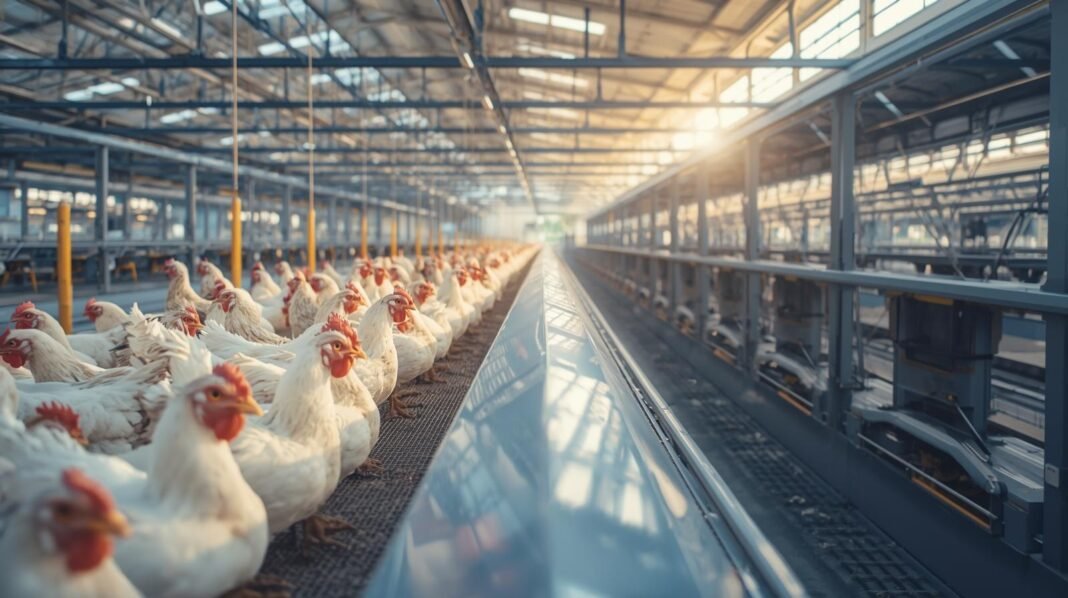

The global poultry equipment industry stands at a transformative crossroads as we approach 2026.
With the market projected to reach between $4.35 billion and $7.1 billion depending on segment analysis, suppliers are racing to innovate in response to mounting pressures around automation, animal welfare, and sustainability.
This comprehensive analysis identifies the key players shaping the industry and the technological trends that will define poultry farming in the years ahead.
Market Dynamics and Growth Projections
The poultry farming equipment market is experiencing robust expansion, with compound annual growth rates ranging from 3.78% to 12.20% across different segments through 2030.
Driving this growth is the surging global demand for affordable protein—poultry consumption reached 132.3 million tons in 2021 and continues climbing.
The watering and feeding systems segment alone commands a 22.5% market share, reflecting its critical role in maintaining flock health and productivity.
Asia-Pacific leads regional growth trajectories, while North America maintains technological leadership with a 27.6% revenue share.
However, the most dramatic changes are occurring in regulatory landscapes, particularly Europe’s planned phase-out of cage systems by 2027-2030, which is fundamentally reshaping equipment requirements worldwide.
Also Read:Game-changing innovations in egg collection and sorting systems
Leading Suppliers Driving Innovation
Big Dutchman International GmbH
Big Dutchman remains the industry’s innovation powerhouse, recently unveiling Barny, a groundbreaking robotic system that addresses floor egg collection—a persistent challenge in modern poultry operations.
During beta testing, Barny demonstrated the ability to reduce floor eggs by up to 75% by gently encouraging hens to use designated nesting areas.
The company’s FlexVey PUR conveyor system, featuring wear-resistant polyurethane construction, offers four to five times the longevity of conventional systems while operating more quietly and efficiently around curves and bends.
Their fully automated feeding and climate control systems exemplify the shift toward precision livestock farming, optimizing feed conversion ratios while maintaining ideal environmental conditions.
As labor shortages intensify globally, Big Dutchman’s automation solutions position them as an essential partner for commercial operations.
Vencomatic Group
Specializing in breeder housing, heating, and egg handling since 1983, Vencomatic Group has established itself through consistent innovation in cage-free systems.
Their Patio on-farm hatching system, which allows eggs to hatch in multi-tier compartments directly at production facilities, has achieved global adoption with 25 million bird placements worldwide.
This approach eliminates the stressful 1-2 day delay chicks typically experience between hatching and farm delivery, significantly improving early-life welfare and subsequent performance.
The company’s X-Treck system combines hatching and brooding phases on-farm, representing a paradigm shift in chick management.
Their recent acquisition of Van Gent Laying Nests strengthens their position in the broiler breeder sector.
The Prinzen Palletiser, capable of handling 40,000 eggs hourly, demonstrates Vencomatic’s commitment to scalable automation that addresses real operational bottlenecks.
Also Read: Optimizing poultry feed: Strategies for better yields and healthier birds
Petersime NV
As hatchery technology becomes increasingly sophisticated, Petersime stands out for its precision incubation systems.
In an industry where even small environmental variations can significantly impact hatch rates and chick quality, Petersime’s advanced climate control technologies ensure optimal conditions throughout the incubation period.
Their systems integrate seamlessly with data analytics platforms, enabling producers to track and optimize every aspect of the hatching process.
OFFICINE FACCO & C. Spa
FACCO’s strategic expansion through acquisitions, including the 2023 purchase of Sperotto, a leading broiler breeding systems manufacturer, demonstrates aggressive growth positioning.
Their LIBERA aviary system responds directly to the global trend toward cage-free production, offering multi-tier structures that comply with stringent EU animal welfare regulations while maintaining operational efficiency.
Tecno Poultry Equipment and Jansen Poultry Equipment
These manufacturers excel in modular, flexible systems adaptable to various production scales and regulatory requirements.
Tecno’s collaboration with Ingeniera Avcola on facilities designed specifically for free-range hens, such as the VS224 system accommodating 8,000 birds, showcases their responsiveness to evolving welfare standards.
Jansen’s focus on climate control and ventilation systems addresses the critical intersection of bird health, environmental management, and energy efficiency.
Also Read:Growth opportunities in Africa’s poultry industry: Trends and investments
Transformative Technology Trends for 2026
Artificial Intelligence and IoT Integration
The integration of AI-powered monitoring systems represents perhaps the most significant technological leap in poultry equipment.
Modern systems employ Internet of Things sensors to continuously track temperature, humidity, ammonia levels, CO2 concentrations, and flock behavior in real-time.
Recent research demonstrates that AI-enabled systems achieve over 90% accuracy in detecting health issues before they become visible to human observers.
Convolutional Neural Networks, particularly YOLOv8 architectures, excel at visual-based health detection, identifying conditions like bumblefoot and woody breast with unprecedented precision.
These systems analyze sound patterns—examining energy distribution, frequency, and amplitude of chicken vocalizations—to assess health through social and feeding behaviors. Edge-AI solutions reduce latency and cloud dependency, making on-site monitoring feasible even in low-connectivity rural environments.
Predictive analytics now forecast disease outbreaks based on weather patterns, historical data, and flock demographics, enabling proactive interventions that dramatically reduce mortality rates.
Some advanced systems can predict egg yield and feed consumption up to 10 days in advance, allowing farmers to optimize resource allocation and prevent wastage.
Smart Automation Systems
Fully automated IoT-based solutions now encompass every aspect of poultry operations. Automated feeding systems utilize precise sensors to monitor consumption patterns and adjust delivery accordingly, reducing feed waste by significant margins while ensuring optimal nutrition.
Robotic egg collection systems increase efficiency and reduce breakage rates, with some advanced models capable of sorting eggs by quality parameters in real-time.
Climate control has evolved from simple thermostats to sophisticated systems that automatically adjust ventilation, heating, cooling, and humidity based on continuous sensor feedback. Solar-powered and off-grid solutions are expanding access to automation in remote areas, while reducing operational costs and environmental impact.
Cage-Free and Welfare-Focused Equipment
The global transition toward cage-free systems continues accelerating. Europe’s regulatory timeline mandates complete phase-out of conventional cages by 2030, while major retailers and food chains worldwide have committed to cage-free sourcing within the next few years.
This shift drives demand for aviary systems, multi-tier structures with perches, dust-bathing areas, and nesting boxes that allow birds to express natural behaviors.
Research indicates cage-free systems reduce disabling pain by 63%, hurtful pain by 57%, and annoying pain by 70% compared to battery cages.
Modern aviary equipment features automatic egg collection from multiple levels, sophisticated manure management systems, and LED lighting optimized for bird welfare and productivity.
Compliance with international standards such as USDA certification, Certified Humane programs, and EU Directive 1999/74/EC has become non-negotiable for equipment manufacturers.
Sustainability and Circular Economy Solutions
Environmental pressures are driving innovation in waste management and resource efficiency.
Advanced manure management systems now transform poultry litter into biogas or fertilizer, reducing environmental impact while generating additional revenue streams. Studies suggest sustainable equipment could reduce environmental waste by 32% by 2026.
Energy-efficient tunnel fans, LED lighting systems, and precision ventilation reduce power consumption substantially.
Some manufacturers report efficiency gains of up to 19.7 CFM per watt in advanced tunnel fans. Water conservation technologies, including nipple drinking systems with minimal spillage and recirculation capabilities, address increasing concerns about water scarcity in poultry-intensive regions.
Enhanced Biosecurity Measures
Post-pandemic awareness has elevated biosecurity to a critical priority. Modern equipment incorporates UV sterilization for air and water systems, automated hygiene monitoring, and physical barriers that minimize pathogen transmission between flocks and zones.
AI-driven systems detect early disease outbreak signs, enabling rapid isolation and treatment before contagion spreads.
Automated documentation systems help producers maintain compliance with increasingly stringent food safety regulations, providing traceable records of environmental conditions, interventions, and outcomes throughout the production cycle.
Regional Variations and Market Dynamics
North America leads in automation adoption, driven by labor costs and technological infrastructure.
The region’s 3.5% annual growth rate reflects ongoing modernization of existing facilities and new construction incorporating latest innovations. European markets focus heavily on welfare compliance, with suppliers prioritizing equipment that meets or exceeds regulatory mandates.
Asia-Pacific, particularly China, India, and Southeast Asian nations, represents the fastest-growing market segment.
Rising middle-class populations, increasing protein consumption, and government initiatives supporting agricultural modernization create unprecedented demand.
Also Read: Integrating IoT in poultry houses: Monitoring and control for better outcomes
However, cost sensitivity remains higher than in developed markets, driving demand for scalable solutions that balance affordability with functionality.
African markets face unique challenges, with infrastructure limitations and capital constraints slowing adoption of advanced systems.
Yet the continent’s poultry production is projected to triple from 1.8 billion to 7.4 billion birds over the next two decades, creating enormous long-term opportunities for suppliers who can deliver appropriate technologies.
Challenges and Considerations
Despite promising growth trajectories, the industry faces significant headwinds. High initial investment costs deter smallholder farmers from adopting advanced equipment, even when long-term benefits are clear.
The transition from conventional to cage-free systems requires substantial capital expenditure for retrofitting or new construction.
Supply chain disruptions, particularly U.S. tariffs on poultry equipment components, force manufacturers to reconsider sourcing strategies, relocate production, or expand domestic partnerships. These adjustments create short-term volatility while potentially strengthening long-term resilience.
Digital literacy among farmers varies widely, particularly in developing regions where advanced systems may exceed operators’ technical capabilities. Successful suppliers increasingly provide comprehensive training, user-friendly interfaces, and robust technical support to bridge this gap.
Looking Ahead: Strategic Imperatives for 2026
As poultry equipment suppliers navigate this transformative period, several strategic imperatives emerge.
Investment in R&D for AI, IoT, and automation technologies will separate industry leaders from followers. Companies must balance innovation with affordability, developing scalable solutions accessible to diverse market segments.
Sustainability credentials will increasingly influence purchasing decisions as consumers, regulators, and investors demand environmental responsibility.
Suppliers who integrate circular economy principles, renewable energy, and resource efficiency into product design will capture premium market positioning.
Flexibility and modularity in equipment design allow producers to adapt systems as regulations evolve and markets shift. The ability to retrofit existing facilities cost-effectively extends market reach beyond new construction projects.
Strategic partnerships, acquisitions, and geographic expansion will accelerate market consolidation while enabling rapid technology transfer and market penetration. Suppliers who establish strong regional presences and distribution networks will dominate their territories.
Conclusion
The poultry equipment industry in 2026 will be defined by the successful integration of automation, animal welfare, and sustainability.
Leading suppliers like Big Dutchman, Vencomatic Group, Petersime, FACCO, Tecno, and Jansen are not merely responding to these trends—they are actively shaping the future of poultry production through bold innovation and strategic positioning.
As global protein demand continues its inexorable rise, the equipment that enables efficient, humane, and sustainable production becomes increasingly crucial.
Producers who partner with forward-thinking suppliers and embrace technological transformation will thrive in an industry that has never been more dynamic, challenging, or full of opportunity.
The future of poultry farming is automated, welfare-focused, and sustainable—and the suppliers profiled here are leading the way.
Also Read
From brooders to feeders: Essential poultry equipment for modern farmers
Revolutionizing poultry farming: The latest equipment and technologies
