

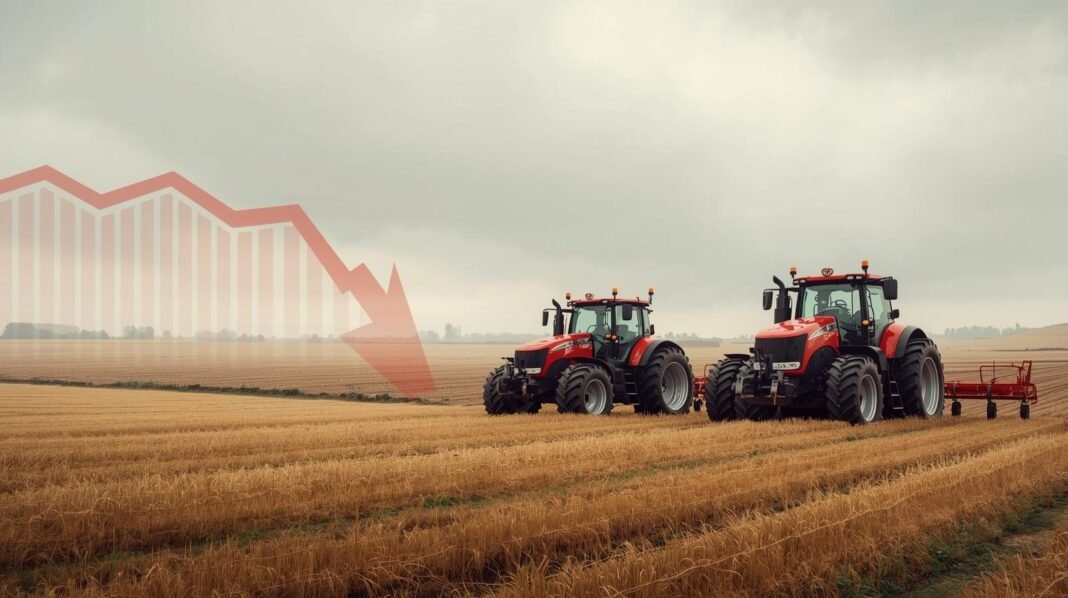

WISCONSIN | March 13, 2026: U.S. farmers continued to pump the brakes on equipment spending in February 2026, with total tractor sales dropping 12.2% compared to the same month a year ago, according to the latest data released by the Association of Equipment Manufacturers (AEM).
The figures underscore a cautious mood across American agriculture, as elevated input costs and uncertain commodity markets continue to weigh on purchasing decisions.
The decline was broad, spanning every major tractor horsepower category.
The largest segment by volume — tractors under 40 horsepower — fell 11.5% year-over-year, with 6,014 units sold in February compared to 6,792 in February 2025. Mid-range 40–100 HP tractors slipped 9.5%, from 3,024 to 2,738 units.
The most dramatic drop came at the top end of the market: high-horsepower tractors of 100 HP or more tumbled 25.8%, with just 904 units sold versus 1,218 a year earlier.
The one category to buck the trend was four-wheel-drive (4WD) tractors, which posted an 11.3% gain — climbing from 133 units in February 2025 to 148 units last month.
While modest in absolute numbers, the uptick suggests that larger farming operations investing in premium, high-capacity machines are still active buyers.
“Farmers remain focused on managing input costs while maximizing productivity. Despite current pressures, the long-term outlook for modernizing equipment fleets and adopting advanced agricultural technologies remains strong.” — Curt Blades, Senior Vice President, AEM
February 2026 U.S. Tractor Sales at a Glance
Source: Association of Equipment Manufacturers (AEM), March 2026
Year-to-Date Picture
Zooming out to the first two months of the year, the weakness in tractor sales is consistent. Through February 2026, total U.S. tractor sales stand at 18,587 units, an 8.7% decline from the 20,365 units sold over the same period of 2025.
The trend suggests this is not simply a one-month blip but a sustained softening in farmer demand for new iron.
The combine harvester segment tells a more nuanced story. While combine sales fell 12.6% in February alone, year-to-date numbers are actually running ahead of last year — up 15.4% through the first two months, with 322 units sold compared to 279 in early 2025. A strong January likely drove the favorable comparison.
What’s Driving the Slowdown?
The broader context is one of financial caution on the farm. After a multi-year run of relatively strong commodity prices and robust equipment purchases following the COVID-era supply shortages, U.S. agriculture is entering a more measured phase.
Corn, soybean, and wheat prices have softened from their peaks, while farm input costs — from fertilizer to fuel — remain elevated compared to pre-pandemic norms.
AEM’s Curt Blades acknowledged the caution while pointing to long-term durability in the market.
The organization noted that many farmers are choosing to service and hold existing equipment rather than trade up, a classic behavior during periods of margin compression.
Still, industry analysts remain cautiously optimistic about the second half of 2026. Pent-up replacement demand — particularly in the 100+ HP segment, where fleets have been aging — and the continued rollout of precision agriculture technology could help stabilize sales as the year progresses.
What to Watch
The next AEM monthly report, covering March 2026, will be closely watched. Spring planting season typically coincides with an uptick in equipment purchases as farmers assess field readiness.
Whether the spring selling season delivers a meaningful recovery — or confirms a deeper structural pullback — will be a key indicator for the agricultural equipment sector’s trajectory for the rest of the year.
Also Read
Mahindra Cuts Ties with Mitsubishi — Then Bets Big on North America
South Africa Fuel Restrictions Hit Farmers Hard as Harvest Season Approaches

Martin is a writer at Agrimachinery Africa specializing in agricultural machinery, mechanization trends, and farm technology across Africa. His work focuses on tractors, harvesting equipment, irrigation systems, and emerging innovations helping farmers improve productivity and efficiency. Through in-depth industry coverage, he highlights technologies shaping the future of modern agriculture.