



For decades, the global agricultural machinery industry has been dominated by a handful of well-established manufacturers with deep dealer networks, premium technologies, and loyal customer bases.
Brands such as John Deere, CNH Industrial, AGCO, Kubota, and CLAAS have long set the benchmark for tractors, harvesters, and precision farming equipment.
Today, however, a Chinese challenger is rapidly expanding its footprint and reshaping competitive dynamics.
Zoomlion Agriculture, the agricultural machinery arm of Zoomlion Heavy Industry Science & Technology, is leveraging innovation, localization, and strategic investment to position itself as a serious contender in markets across Asia, Africa, Latin America, and beyond.
A Global Strategy Beyond Exports
Unlike many manufacturers that rely primarily on exports, Zoomlion has adopted a strategy centered on building local operations in key overseas markets.
The company has established production facilities, business hubs, service centers, and spare-parts warehouses while expanding its dealer network across more than 170 countries.
According to the company’s 2026 first-quarter results, overseas operations now account for more than half of total revenue, reflecting the growing importance of international markets to its long-term growth strategy.
The company has also continued investing in localized manufacturing and supply chains in countries including Brazil, Hungary, Italy, Mexico, Türkiye, Germany, and the United States, helping improve responsiveness to regional customer needs and reducing exposure to trade disruptions.
Technology as a Competitive Weapon
One of Zoomlion’s strongest differentiators is its emphasis on intelligent and hybrid agricultural machinery.
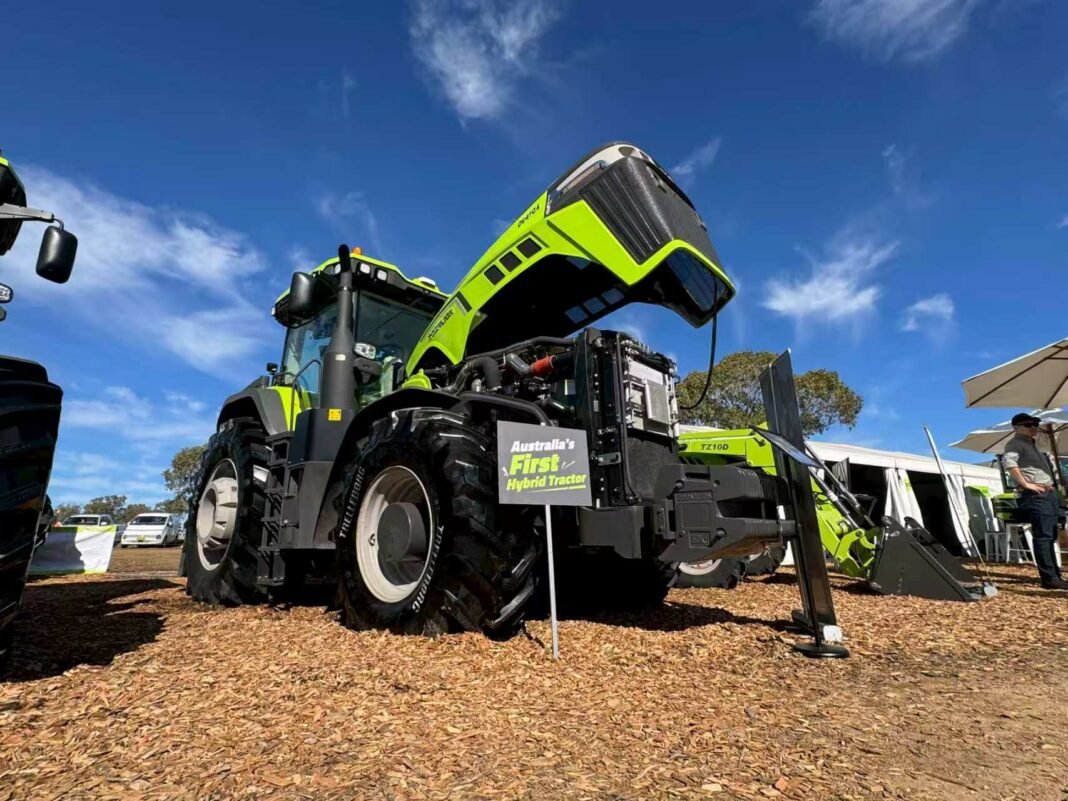
The company has increasingly showcased hybrid tractors equipped with proprietary electric-drive technologies designed to reduce fuel consumption while maintaining high power output for demanding field operations.
These machines are being marketed alongside intelligent harvesting systems, autonomous driving capabilities, and digital farm management solutions that align with the industry’s transition toward precision agriculture.
Rather than competing solely on price, Zoomlion is attempting to position itself as a provider of technologically advanced equipment capable of meeting the productivity and sustainability demands of modern farming.
Targeting Emerging Markets
While established Western manufacturers maintain strong positions in North America and Europe, Zoomlion has aggressively targeted emerging agricultural economies where mechanization rates continue to rise.
Africa represents a particularly significant opportunity. Many countries across the continent are seeking to improve food security through greater mechanization, creating demand for tractors, combine harvesters, irrigation solutions, and precision farming technologies.
Zoomlion has also expanded its visibility through participation in major agricultural exhibitions in South Africa, Brazil, Thailand, Türkiye, and other regions, using these events to demonstrate products tailored to local crops and farming conditions.
This localized approach enables the company to adapt machinery for specific markets rather than offering one-size-fits-all solutions.
Competing on Value
Cost competitiveness remains an important advantage.
Many farmers in developing economies face financial constraints that make premium-priced equipment difficult to justify.
Zoomlion aims to bridge this gap by offering machines with increasingly sophisticated features while maintaining competitive pricing relative to some established global brands.
Combined with financing options, expanded after-sales support, and growing spare-parts availability, this strategy has helped the company attract customers seeking a balance between affordability and modern technology.
Building Dealer and Service Networks
Success in agricultural machinery depends not only on manufacturing but also on reliable service.
Recognizing this, Zoomlion has invested heavily in overseas personnel, dealer development, technical support, and spare-parts logistics.
The company reports employing thousands of local staff internationally while continuing to expand service infrastructure designed to minimize equipment downtime during critical planting and harvesting seasons.
This focus addresses one of the traditional strengths enjoyed by incumbent manufacturers whose extensive dealer networks have historically created high barriers to entry.
Innovation for Crop-Specific Solutions
Another notable aspect of Zoomlion’s strategy is the development of machinery tailored to regional agricultural practices.
In Southeast Asia, for example, the company has introduced specialized sugarcane harvesting equipment designed for local planting conditions while integrating intelligent management systems and automation technologies.
Similar localization efforts can be seen across its expanding portfolio of tractors and harvesting equipment intended for different crops and operating environments.
Such product adaptation may prove increasingly valuable as governments encourage mechanization that reflects local agricultural realities rather than imported standards.
Challenges Remain
Despite its rapid expansion, Zoomlion still faces substantial obstacles.
Long-established manufacturers continue to benefit from decades of brand recognition, customer loyalty, and extensive dealer ecosystems in mature markets.
Farmers often make purchasing decisions based on proven reliability, resale value, and long-term service availability—areas where incumbent brands retain significant advantages.
In addition, regulatory requirements, emissions standards, and differing customer expectations across regions require continuous investment in product development and compliance.
A New Competitive Landscape
The rise of Zoomlion reflects a broader shift in the global agricultural machinery sector. Competition is no longer defined solely by traditional Western manufacturers but increasingly includes technologically ambitious companies from China that combine scale, innovation, and aggressive international expansion.
By investing in hybrid technologies, intelligent farming systems, localized production, and expanding global service networks, Zoomlion is steadily positioning itself as a credible alternative for farmers worldwide.
Whether it can match the market leadership of established industry giants remains to be seen, but its growing international presence suggests that the competitive landscape of agricultural mechanization is entering a new era.
For farmers, dealers, and policymakers alike, the emergence of Zoomlion offers both increased choice and fresh competition—factors that could accelerate innovation and improve access to modern agricultural technologies across many regions of the world.
Also Read
Ghana Orders 1,840 Belarusian Farm Machines in Major Push to Modernize Agriculture
Bridgestone Expands VT-TRACTOR Range with New XXL Tyres for High-Horsepower Farm Machinery

Martin is a writer at Agrimachinery Africa specializing in agricultural machinery, mechanization trends, and farm technology across Africa. His work focuses on tractors, harvesting equipment, irrigation systems, and emerging innovations helping farmers improve productivity and efficiency. Through in-depth industry coverage, he highlights technologies shaping the future of modern agriculture.