



By the Numbers
Financing
Deposit
Repayment
Tractors
Free insurance
Extended warranty
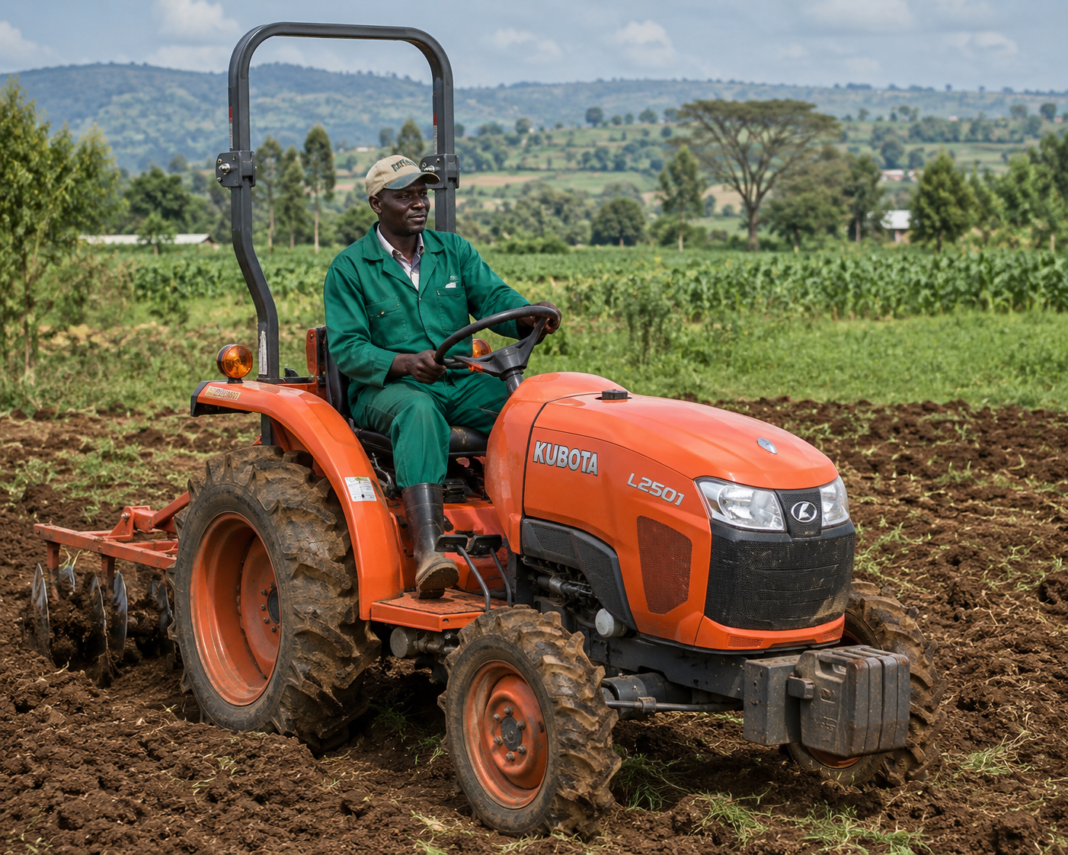
Kenya’s tractor market is getting a new financing push as Equity Bank partners with Car & General to make Kubota tractors more accessible to farmers, with financing of up to 90% of the machine’s purchase price.
The arrangement could be significant for Kenya’s farm mechanisation market because the cost of machinery remains one of the biggest barriers preventing small and medium-scale farmers from moving away from manual labour and expanding cultivated acreage.
Under the new financing package, farmers will be required to provide a 10% deposit, while Equity Bank will finance the remaining 90%, subject to credit appraisal and the bank’s internal processes.
Repayment can extend for up to five years, with payment structures designed around farming cycles.
That seasonal approach could prove particularly important in agriculture, where farmers often have limited cash flow between planting and harvest.
Financing Could Open the Door to Smaller Farmers
The availability of tractors is only one part of Kenya’s mechanisation challenge. For many farmers, the larger obstacle is finding the capital to purchase machinery.
A tractor can represent a substantial upfront investment, particularly for farmers who operate relatively small holdings.
The Equity-Car & General arrangement attempts to address that problem by shifting more of the purchase cost into structured financing.
According to Car & General Manager George Rubiri, farmers can make repayments monthly or seasonally depending on their harvesting cycles.
Equity Bank Head of Asset Finance Beatrice Nyambura said the financing has been structured around the realities of agricultural income.
The bank says both existing and non-Equity customers can apply, although financing remains subject to credit assessment.
For the Kenyan tractor market, that could broaden access beyond farmers who already have substantial capital available for machinery purchases.
Related Stories
Kubota Targets a Wide Range of Farm Applications
The tractors available through the arrangement start at 23 horsepower, putting the package within a segment that can serve smaller farms as well as farmers looking to establish tractor-hire businesses.
The machines can be used for activities including ploughing, spraying and transportation.
With compatible implements, they can also support minimum-tillage and zero-tillage operations, giving farmers options beyond conventional soil preparation.
This is increasingly important as agricultural mechanisation moves from simply replacing manual labour toward improving the efficiency of farm operations.
A tractor that can be fitted with different implements can potentially perform several functions throughout the production cycle.
Instead of purchasing separate machines for different tasks, farmers can use one tractor platform across multiple operations.
What the 90% Financing Means
Equity Bank says farmers can finance up to 90% of the cost of a Kubota tractor, leaving the farmer to provide a 10% deposit.
Example: KSh 3 million tractor
KSh 3,000,000
KSh 300,000
KSh 2,700,000
Illustration only: The KSh 3 million tractor price is an example and is not an advertised Kubota price. Actual financing, interest and repayment amounts will depend on the tractor purchased and the farmer’s credit assessment.
The Tractor Could Become More Than a Farm Machine
One of the more interesting aspects of the financing programme is the potential for tractor ownership to create a second source of income.
For farmers with sufficient local demand, a tractor does not necessarily have to be used exclusively on their own land.
It can also be hired out to neighbouring farmers during periods of high demand.
That model is already visible among Kenyan farmers.
Cecilia Moshiri, an agricultural teacher and Kubota owner, says her tractor has enabled her to cultivate previously difficult land while also generating income through ploughing services for neighbouring farmers.
This model could become increasingly important as Kenya looks to expand mechanisation without requiring every farmer to own a tractor.
A farmer-service model allows one machine to serve multiple farms.
For example, a tractor purchased by one farmer could provide land preparation services to several neighbouring farms during the planting season and then be used for transport or other operations at different times of the year.
For younger agricultural entrepreneurs, this creates another possible business opportunity: owning machinery and selling mechanisation services rather than relying solely on crop production.
“It helps me in getting income. I’m able to do a lot of ploughing for people and I’m able to get some income.”
— Cecilia Moshiri, Kubota tractor owner and agricultural teacher
Why Seasonal Repayment Matters
Traditional equipment financing can be difficult for agricultural businesses because monthly repayments do not always match farm income.
A farmer may spend heavily on inputs, labour and machinery during land preparation and planting, while the main income arrives months later at harvest.
A repayment structure that can accommodate these cycles could therefore make equipment financing more practical.
Equity says repayment periods can extend up to five years, while payment schedules can be structured around the crop cycle.
The exact repayment terms will depend on the individual farmer and the bank’s credit assessment, but the broader principle is important for agricultural machinery markets.
Financing products designed specifically around agricultural cash flow could help narrow the gap between the demand for mechanisation and farmers’ ability to purchase machinery.
More Than Just Tractor Financing
The package also includes several additional incentives.
Farmers purchasing qualifying Kubota tractors under the arrangement receive free insurance for the first year and a two-year extended warranty.
The programme also includes a TVS motorbike for every tractor purchased.
For subsequent years, farmers can access negotiated insurance premiums of up to 1.5%, according to Equity.
During August, buyers will also receive a GPS acreage calculator designed to help farmers determine the amount of land they can cultivate.
The GPS tool is particularly relevant because knowing the acreage a tractor can efficiently cover can help farmers make better decisions about machinery utilisation and farm-service opportunities.
For a farmer considering tractor ownership as a business, acreage measurement can also help estimate potential work volumes and revenue.
Why Kubota Matters in Kenya
Kubota’s presence in Kenya is particularly relevant to farmers looking for compact and versatile tractors that can handle multiple farm operations.
- Compact tractor options for smaller farms
- Multiple implement applications
- Suitable for ploughing, spraying and transport
- Support for minimum and zero-tillage practices
- Access through Car & General dealerships
Mechanisation Is About Productivity, Not Just Replacing Labour
Kenya’s mechanisation conversation has increasingly moved beyond the question of replacing manual labour.
The larger issue is how machinery can allow farmers to complete critical operations within narrower agricultural windows.
Land preparation, planting and spraying are time-sensitive activities. Delays can affect crop establishment and ultimately yields.
A tractor allows farmers to cover more land in less time and reduces dependence on manual labour.
That becomes particularly important where farms are expanding or where labour availability is becoming a constraint.
Equity Bank Head of Food and Agriculture Business George Macharia said greater access to mechanisation can help farmers increase productivity and incomes while creating opportunities for young people to provide tractor services to other farmers.
That service-provider model could become one of the most important pathways for mechanisation in smaller agricultural markets.
A Potential Boost for Kenya’s Tractor Market
The financing partnership comes at an interesting time for Kenya’s agricultural machinery market.
The country has a large base of smallholder farmers, but tractor ownership remains concentrated among larger farms, contractors and agricultural service providers.
Financing can potentially change that equation by allowing farmers to acquire equipment without paying the full purchase price upfront.
However, access to finance alone will not solve every mechanisation challenge.
Farmers also need access to appropriate implements, spare parts, maintenance services, trained operators and reliable dealer support.
The economics of ownership also depend heavily on tractor utilisation.
A machine that sits idle for much of the year can become an expensive asset, while a tractor that is used across several farms can generate substantially more value.
This is why tractor-hire and agricultural contracting businesses could play an increasingly important role in Kenya’s mechanisation market.
How Kenyan Farmers Can Apply
Farmers interested in the Kubota financing package can begin by visiting a Car & General dealership to identify a tractor model suited to their farming requirements and obtain a proforma invoice.
The farmer can then approach their nearest Equity Bank branch and apply for financing of up to 90% of the tractor’s cost.
The programme is available to both existing Equity customers and non-customers, subject to the bank’s credit appraisal and internal processes.
For farmers considering the investment, the key question should not simply be whether they can obtain financing.
It should be whether the tractor can generate enough value to justify the investment.
For a commercial farmer, that may come through increased acreage and faster field operations.
For a smaller farmer, the economics could improve significantly if the tractor is also used to provide ploughing, spraying, transport or other mechanisation services to neighbouring farms.
What Farmers Should Check Before Signing
Before committing to tractor financing, farmers should consider:
- Total tractor purchase price and required deposit
- Interest rate and total financing cost
- Monthly versus seasonal repayment options
- Insurance costs after the first year
- Warranty coverage and servicing requirements
- Availability and cost of spare parts
- Cost of implements needed for planned operations
- Expected annual tractor utilisation
- Potential income from tractor-hire services
The Bigger Opportunity for Agricultural Machinery
The Equity-Car & General arrangement highlights a broader issue facing Africa’s agricultural machinery sector: the next phase of mechanisation may depend as much on financing and business models as on tractor technology.
Manufacturers and dealers can make increasingly capable machines available, but farmers still need practical ways to acquire them.
Flexible agricultural finance could therefore become an important driver of tractor sales across Kenya and other African markets.
The emergence of tractor-service businesses could further accelerate adoption by allowing machinery to be shared across multiple farms.
For Kenya, the combination of smaller tractors, flexible financing and agricultural contracting could create a more accessible path toward mechanisation.
The immediate test will be whether farmers take up the financing package at scale.
If they do, the impact could extend beyond individual tractor sales — helping create a larger ecosystem of machinery owners, operators, dealers and farm-service businesses across the country.
Who Is This Financing For?
The package could be particularly relevant to:
- Small and medium-scale commercial farmers
- Farmers looking to expand cultivated acreage
- Young agricultural entrepreneurs
- Tractor-hire and mechanisation service operators
- Farmer groups and cooperatives
- Agricultural contractors providing services to neighbouring farms
The most important part of Kenya’s mechanisation story may not be the tractor itself. It is the financing model behind it. If seasonal repayment structures make machinery ownership viable for more farmers, the result could be greater tractor utilisation, more agricultural contracting businesses and faster adoption of mechanised farming.
Also Read

Martin is a writer at Agrimachinery Africa specializing in agricultural machinery, mechanization trends, and farm technology across Africa. His work focuses on tractors, harvesting equipment, irrigation systems, and emerging innovations helping farmers improve productivity and efficiency. Through in-depth industry coverage, he highlights technologies shaping the future of modern agriculture.