


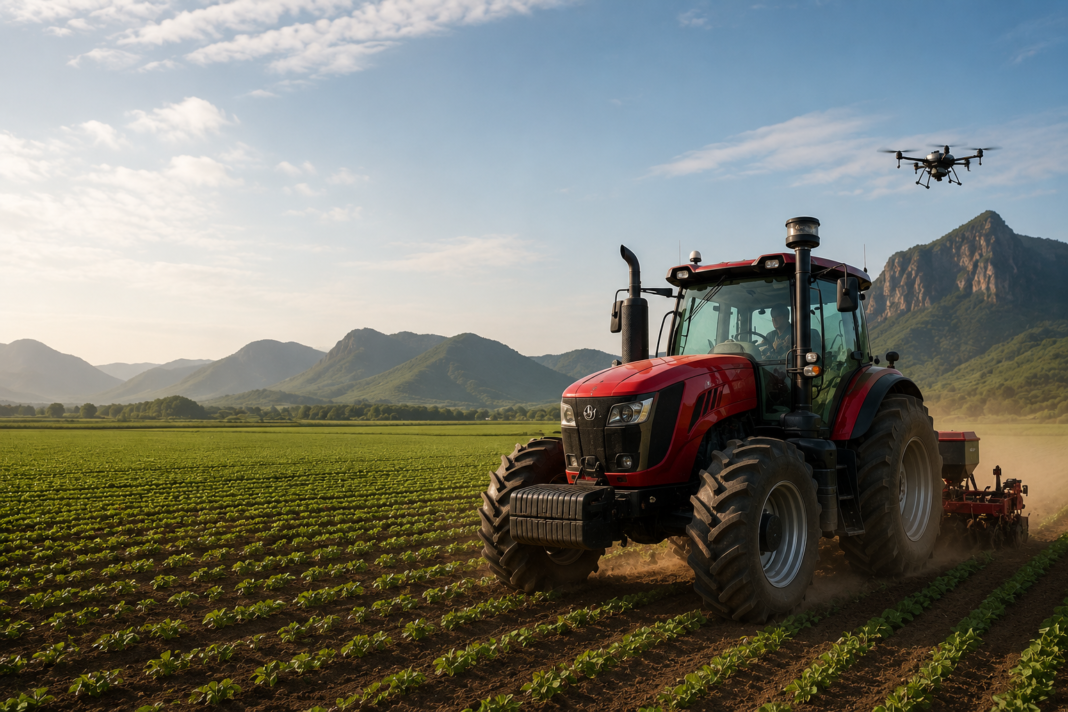

China’s agricultural machinery industry is undergoing a transformation that is becoming increasingly difficult to ignore.
The country’s machinery manufacturers have spent decades building their reputation around scale, affordability and the ability to produce tractors, harvesters and implements for markets where Western and Japanese equipment can be prohibitively expensive.
But China’s latest export push suggests the industry is moving into a different phase, one in which price remains important but is increasingly being combined with artificial intelligence, precision agriculture, autonomous driving, advanced powertrains and connected machinery.
The scale of the export boom provides the clearest starting point. China’s agricultural machinery exports reached 67.4 billion yuan, or about US$9.4 billion, in 2025, up 32.3% from the previous year.
The rapid growth has continued into 2026 as Chinese manufacturers expand into markets across Asia, Latin America, Africa and other emerging agricultural economies.
The numbers matter, but the more significant question is what China is now exporting. The country’s machinery industry is no longer simply sending low-cost tractors into international markets.
Increasingly, it is exporting machines equipped with satellite navigation, intelligent cockpits, automated steering, precision systems, high-horsepower powertrains and autonomous functions.
That creates a much more consequential story for global agriculture. China is attempting to move from being primarily a competitive machinery manufacturer to becoming a supplier of agricultural technology.
China’s Agricultural Machinery Transformation
| Indicator | Latest picture |
|---|---|
| Agricultural machinery exports | 67.4 billion yuan (about US$9.4 billion) in 2025 |
| Export growth | Up 32.3% year on year in 2025 |
| Tractor exports | 185,500 units, up 20.2% year on year |
| Tractor export value | 8.975 billion yuan, up 34.2% year on year |
| Traditional strength | Competitive tractors, harvesters, implements and other farm machinery |
| Technology shift | Precision agriculture, satellite navigation, intelligent controls and autonomous operation |
| Powertrain evolution | Continued development of high-horsepower, hybrid and electric machinery |
| Emerging equipment | Agricultural drones, autonomous machines and connected farm equipment |
| Industry direction | Moving from low-cost machinery toward higher-value, intelligent and integrated agricultural technology |
Source: China Customs data as reported by Xinhua and Chinese government sources.
Key takeaway: China’s agricultural machinery industry is moving beyond its
traditional low-cost positioning.
The country’s manufacturers are increasingly combining competitive manufacturing costs with high-horsepower equipment, BeiDou navigation, AI, autonomous driving, hybrid powertrains and agricultural robotics.
For Africa, the opportunity will depend not only on equipment prices but also on dealer support, spare parts, financing and local adaptation.
From Dongfanghong to intelligent machinery
Few companies illustrate that evolution better than First Tractor Company, part of YTO Group.
YTO’s history is closely connected to China’s mechanization drive and the famous Dongfanghong tractor.
The company’s earlier generations of machinery represented the industrialization of Chinese agriculture: replacing animal power and manual labour with affordable mechanical power.
Today, however, YTO describes its strategy very differently. The company says it is accelerating the upgrading of its products toward “high-end, intelligent, and green technologies,” while enhancing intelligent cockpits, navigation systems, automated headland management, precision operations and comprehensive operational monitoring.
That shift is significant precisely because YTO is not a technology startup. It is one of China’s established tractor manufacturers, meaning that the transition is taking place within the industry’s traditional machinery companies rather than only among new ag-tech entrants.
The tractor itself is changing from a machine that primarily provides mechanical power into a platform that combines power, electronics, software and data.
A modern tractor can determine its position through satellite navigation, automatically maintain a field path, monitor its own operation and communicate information to farm-management systems.
The implications are substantial because manufacturers are increasingly competing not just on horsepower and price, but on what the machine can do with the information it collects.
Related Articles
Explore more Agrimachinery Africa coverage on tractor brands, agricultural machinery and the changing farm equipment market in Africa.
BeiDou is helping bridge old and new machinery
China’s BeiDou Navigation Satellite System is an important part of this transformation.
Precision agriculture depends heavily on accurate positioning. When tractors can determine their location with high precision, they can follow predetermined routes, reduce overlaps and improve the consistency of planting, spraying and harvesting operations.
Chinese manufacturers are increasingly incorporating BeiDou positioning into agricultural machinery, including assisted and autonomous driving systems.
This also creates an important bridge between China’s existing machinery fleet and its emerging generation of smart equipment.
Farmers do not necessarily need to replace an entire fleet to begin adopting precision agriculture. Conventional tractors can be upgraded with navigation and automated steering systems, allowing older machines to become more productive without the capital cost of buying completely new autonomous equipment.
That approach could be particularly relevant in Africa, where farmers often operate mixed fleets and face significant financing constraints.
The path toward intelligent agriculture may therefore involve gradual upgrades rather than a wholesale replacement of existing machinery.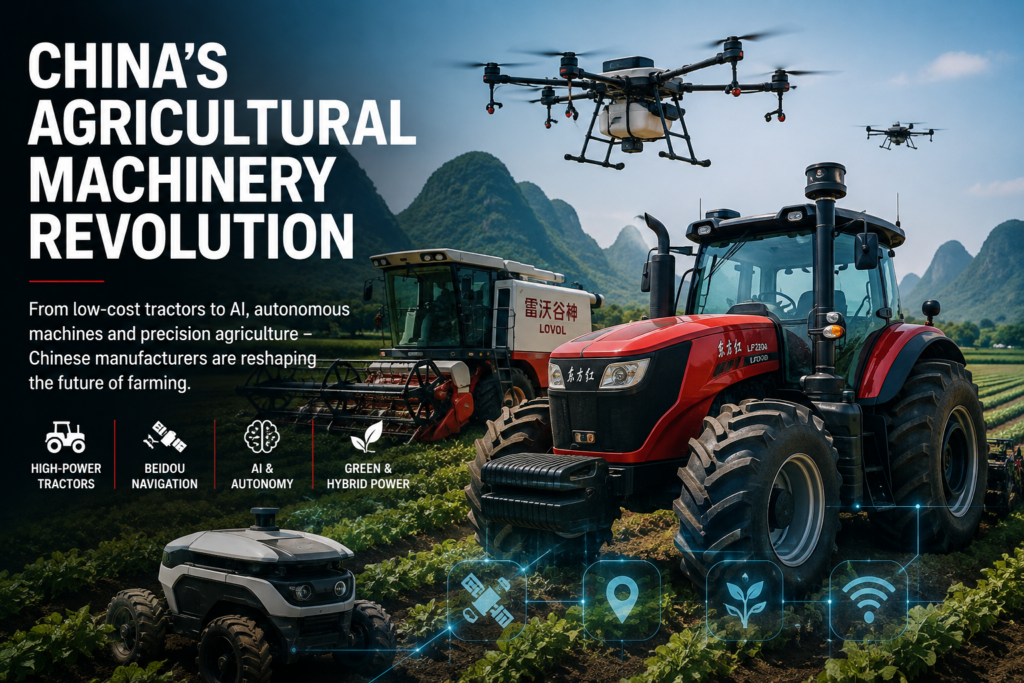
The rise of the AI-powered tractor
The more important technological change, however, is occurring as navigation, sensors, electronic controls and artificial intelligence are integrated into the same machine.
Weichai Lovol offers one of the clearest examples. At its 2026 global technology activities, the company presented a Smart Agriculture AI Model capable of creating a full-cycle “Monitor-Decide-Execute-Feedback” loop.
The system integrates engines, continuously variable transmission powertrains and autonomous-driving algorithms into a unified platform.
This represents a significant change in the way agricultural machinery is designed.
A conventional tractor primarily responds to instructions from an operator. A connected intelligent tractor can monitor its operating environment, process information, execute actions and feed the resulting data back into the system.
The commercial implications extend beyond autonomous driving. Such systems could eventually help machinery identify operating inefficiencies, support predictive maintenance and coordinate field operations with broader farm-management platforms.
In effect, the tractor becomes part of the farm’s information infrastructure.
That is where China’s broader technology ecosystem becomes important. Its agricultural machinery manufacturers can draw on developments in artificial intelligence, electronics, telecommunications, batteries, robotics and automotive engineering. Technologies developed for other industries can increasingly be adapted for agricultural applications.
Zoomlion brings heavy-industry expertise into farming
Zoomlion illustrates another dimension of China’s machinery strategy.
Better known globally for construction equipment, the company has been transferring expertise in hydraulics, electronic controls and automation into agricultural machinery.
Zoomlion has highlighted the development and batch deployment of drive-by-wire chassis control technology and auxiliary driving systems for agricultural machinery, alongside efforts to improve full-process autonomous operation.
The significance is broader than Zoomlion itself.
Agriculture is increasingly adopting technologies that have already been developed in construction, mining and other heavy industries.
Remote operation, machine control, sensors and autonomous systems are becoming common themes across industrial equipment.
Chinese manufacturers that operate across several of these sectors can potentially transfer technology between them, reducing the time and cost required to develop new agricultural applications.
This cross-industry convergence could become one of China’s strongest advantages as farm machinery becomes increasingly automated.
What Is Changing in Chinese Agricultural Machinery?
China’s agricultural machinery industry is moving beyond its traditional focus on affordable
mechanical equipment. Manufacturers are increasingly combining higher-powered machines with
digital technologies, automation and alternative powertrains, creating a more sophisticated
generation of farm equipment.
High-Horsepower Tractors
Chinese manufacturers are moving into larger and more sophisticated tractors, including
machines equipped with advanced transmissions, intelligent controls and improved operator
environments.
Precision Agriculture
BeiDou satellite positioning, automated steering and machine monitoring are allowing
conventional farm equipment to perform field operations with greater accuracy.
Artificial Intelligence
AI is moving machinery beyond simple automation by enabling machines to collect,
process and respond to operational and environmental data.
Autonomous Machinery
Autonomous driving systems, drive-by-wire controls and automated field operations are
becoming increasingly important areas of development for Chinese manufacturers.
Electric & Hybrid Equipment
Battery-electric and hybrid powertrains are emerging alongside conventional diesel
machinery, particularly in smaller tractors, specialized equipment and autonomous robots.
Drones & Agricultural Robots
Chinese companies are also developing drones and autonomous ground machines that can
perform specialized agricultural tasks without relying entirely on conventional tractors.
The bigger shift: Chinese agricultural machinery is increasingly becoming
a combination of mechanical engineering, software, electronics, satellite navigation and
automation rather than a purely mechanical product.
China is also redesigning the machine
Not every Chinese company is trying to make the conventional tractor more intelligent. Some are questioning whether the traditional tractor is the right platform for every agricultural task.
XAG, one of China’s prominent agricultural drone and robotics companies, has pursued lightweight electric and autonomous machines, including agricultural drones and ground robots.
Its approach is based on designing machines around autonomy and electric power from the beginning rather than trying to retrofit decades-old mechanical architectures.
This creates a potential leapfrog opportunity.
Agricultural drones can perform spraying operations without requiring large tractors to enter fields, while autonomous ground robots could eventually target applications in orchards, vegetable production and other environments where large machinery is inefficient.
For fragmented agricultural markets, this may be particularly important. Mechanization does not necessarily have to mean putting a large tractor on every farm.
Smaller autonomous machines, drones and specialized equipment could provide alternative routes toward higher productivity.
High horsepower remains part of the strategy
The rise of AI, drones and autonomous equipment should not obscure another important development: Chinese manufacturers are moving deeper into high-horsepower machinery.
Large tractors require sophisticated engines, transmissions, hydraulics, cooling systems and electronic controls.
China’s development of increasingly powerful machines therefore provides evidence that manufacturers are attempting to compete across the agricultural machinery spectrum rather than remaining concentrated in the low-cost segment.
YTO’s simultaneous emphasis on high-end machinery and intelligent systems illustrates this clearly. China is not abandoning the conventional tractor.
It is attempting to make the conventional tractor more powerful, more efficient and increasingly intelligent.
That distinction matters because the industry’s future is unlikely to be entirely autonomous or entirely electric.
Large diesel and hybrid machines will remain important for intensive agriculture, while electric tractors, robots and drones may expand in more specialized applications.
The competitive advantage may be integration
The most consequential development may ultimately be the integration of these technologies.
A future agricultural machine could combine BeiDou positioning, computer vision, artificial intelligence, autonomous steering, telematics and hybrid or electric propulsion.
Each technology already exists independently. The challenge is making them work together reliably and economically.
LOVOL’s “Monitor-Decide-Execute-Feedback” concept captures that transition. The machine becomes part of a continuous information loop rather than a standalone mechanical product.
That could eventually connect tractors, planters, harvesters, drones and farm-management software into a single operating system for the farm.
At that point, manufacturers are no longer competing only on the specifications of individual machines. They are competing on the effectiveness of the ecosystem surrounding those machines.
Why Africa matters
This shift could have significant consequences for Africa, where agricultural mechanization remains a major opportunity but where farmers face very different economic and operating conditions from those in North America or Western Europe.
Large commercial farms may require high-horsepower tractors and sophisticated precision systems, while smaller producers may need compact tractors, drones, irrigation equipment and specialized machinery.
Price will remain important, but it will not be sufficient. African buyers will increasingly have to consider parts availability, financing, technician training, dealer coverage, fuel consumption and resale value alongside the machine’s technological capabilities.
That is also where China’s international expansion will face its biggest test.
A sophisticated tractor is of limited value if spare parts take months to arrive or local technicians cannot repair its electronic systems. Chinese manufacturers therefore need to build the distribution and service infrastructure around their equipment if the current export boom is to develop into lasting market share.
The opportunity is nevertheless considerable. China’s ability to manufacture machines across different price and power categories could allow its companies to address Africa’s highly diverse agricultural landscape.
If manufacturers can combine competitive pricing with reliable support and technologies that genuinely solve local farming problems, Chinese machinery could become increasingly influential in the continent’s next phase of mechanization.
From low-cost machinery to agricultural technology
China’s agricultural machinery revolution should therefore not be understood simply as a story about cheaper tractors.
The export boom shows that Chinese manufacturers are gaining ground internationally, but the more important development is the technological direction of that expansion.
YTO is moving toward high-end intelligent machinery; LOVOL is integrating AI with engines, transmissions and autonomous-driving systems; Zoomlion is bringing drive-by-wire and automation technologies into agriculture; and companies such as XAG are developing entirely new categories of electric and autonomous machines.
Together, these developments suggest that China’s machinery industry is moving further up the agricultural technology value chain.
The transition will not automatically make Chinese manufacturers leaders of global agricultural machinery.
John Deere, CNH, AGCO, Kubota and other established companies retain enormous advantages in dealer networks, installed machinery populations, precision-agriculture platforms and customer relationships.
But China does not need to replace those companies everywhere to reshape the market. If its manufacturers can combine manufacturing scale, competitive pricing and increasingly sophisticated technology, they can capture significant opportunities in the rapidly mechanizing economies of Asia, Africa and Latin America.
For Africa, that could be particularly consequential. The next stage of mechanization will not simply involve putting more tractors into fields; it will increasingly involve determining which combinations of machinery, automation and digital technology can raise productivity without making equipment financially inaccessible.
China is positioning itself to compete for that market.
Its biggest achievement may therefore not be producing an affordable tractor, but learning how to surround that tractor with the technologies that make modern agriculture more precise, automated and connected.
If Chinese manufacturers can match that technological progress with reliable after-sales networks and equipment adapted to local conditions, the country’s agricultural machinery export boom could become something much larger: the emergence of China as a major global supplier of the technology systems that will shape the next generation of farming.
China vs Established Agricultural Machinery Manufacturers
Chinese manufacturers are becoming more competitive, but the global market is not simply a
contest between low-cost Chinese equipment and established Western brands. Each side has
different strengths.
Chinese manufacturers
- Competitive manufacturing costs
- Rapid product development
- Growing AI and automation capabilities
- Strong electronics and battery ecosystem
- Broad range of machinery and price points
Established manufacturers
- Extensive dealer networks
- Large installed equipment base
- Established financing and support systems
- Mature precision-agriculture platforms
- Long-standing farmer relationships
The key point: China does not need to displace John Deere, CNH or AGCO
globally to reshape the market. Capturing significant share in rapidly mechanizing markets
across Africa, Asia and Latin America could be enough to change the competitive landscape.
Also Read
- 7 Best Agriculture Monitoring Systems for Farms in 2026
- Valtra Tractor Dealers in Africa: 12 Countries, Contacts and Buyer Guide (2026)
- How Zoomlion Is Challenging Established Farm Equipment Brands Worldwide

Martin is a writer at Agrimachinery Africa specializing in agricultural machinery, mechanization trends, and farm technology across Africa. His work focuses on tractors, harvesting equipment, irrigation systems, and emerging innovations helping farmers improve productivity and efficiency. Through in-depth industry coverage, he highlights technologies shaping the future of modern agriculture.