


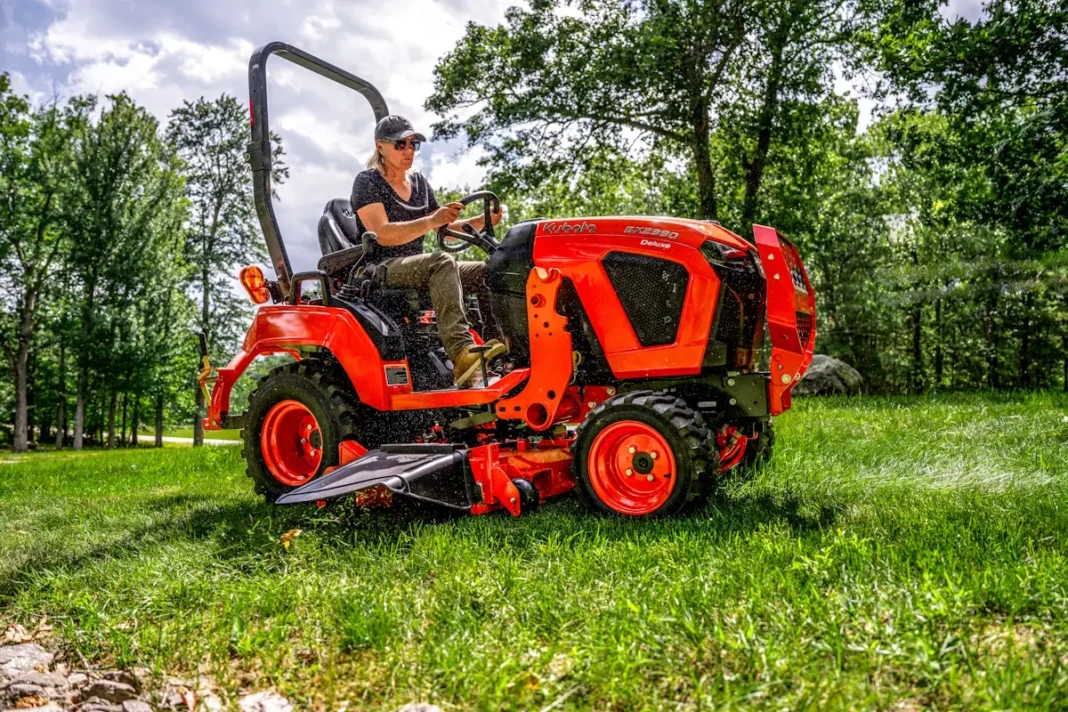

Kubota’s unveiling of its new BX90 Series in the United States has highlighted a part of the tractor market that could have wider relevance for Africa: the compact, multi-purpose machine.
The five-model range spans from 19.3 to 23.9 gross horsepower and combines loader, mower and implement capabilities in a redesigned sub-compact platform.
While Kubota’s announcement is currently focused on the U.S. market, the BX90 raises a broader question for African agriculture: where could smaller, versatile tractors fit into the continent’s smallholder mechanisation needs?
A new generation of compact tractors
Kubota introduced its original BX Series in 2000, positioning the range as one of the machines that helped establish the sub-compact tractor category.
Twenty-six years later, the company says the BX90 represents a complete platform redesign. The new range comprises the BX2190, BX2390 Deluxe and BX2690 Premium, alongside backhoe-equipped BX2390S and BX2690S Premium models.
According to Kubota, the new series has been developed around three areas: loader capability, mower performance and operator comfort.
The machines are scheduled to become available through authorised Kubota dealerships from early 2027.
“The BX90 Series was designed around what today’s property owners value most: productivity, comfort, and choice,” said Matt McDonald, Senior Product Operations Manager at Kubota Tractor Corporation.
“From intuitive side-by-side HST pedals to enhanced loader and mower systems, every improvement is intended to help customers accomplish more with ease,” McDonald added.
That emphasis on versatility is particularly relevant when considering the challenges facing agricultural mechanisation in Africa.
Africa does not need just one type of tractor
Agricultural mechanisation across Africa is often discussed in terms of increasing tractor numbers and expanding access to machinery.
But the continent’s farming systems are highly diverse. Large commercial farms may require high-horsepower tractors, combines and specialised equipment, while smaller producers may need machines suited to much smaller areas and a wider range of daily tasks.
For a smallholder farmer, the most useful tractor is not necessarily the machine with the highest horsepower.
It could instead be a machine that can handle several appropriate jobs throughout the year, including light tillage, transport, mowing, spraying, material handling, livestock-farm maintenance or other operations depending on the available implements.
This is where the BX90 becomes an interesting example of the direction of the compact tractor market.
Related Articles
South Africa’s Wheat Crossroads: Can Farmers Still Afford the Machinery They Need?
Titan ForestEDGE Targets the Toughest Ground as Forestry Machinery Faces Rising Operating Costs
Fendt Debuts 1100 Vario MT Gen2, Momentum 80-Foot Planter and 300 Vario Gen5 in First US Global Launch
Why the 20-horsepower segment matters
The BX90 lineup starts with the 19.3-gross-horsepower BX2190 and rises to the 23.9-gross-horsepower BX2690 Premium.
These machines are not intended to replace larger agricultural tractors performing demanding field operations across hundreds or thousands of hectares.
Their potential relevance lies in a different category of work where manoeuvrability, versatility and the ability to use different implements can be more important than outright pulling capacity.
For African agriculture, that could include smaller horticultural operations, orchards, livestock farms, nurseries, market gardens and mixed farming enterprises, provided the tractor and implements are suited to the particular application.
More than just a tractor
One of the most significant aspects of the BX90 is that Kubota is developing it as a platform rather than simply a tractor.
The BX90’s redesigned LA355 and LA405 loaders provide lift capacities of up to 721 and 904 pounds respectively. Kubota says the BX2390 and BX2690 also benefit from increased hydraulic flow and pressure, quicker cycle times and improved response at lower engine speeds.
The range also introduces 54-inch and 60-inch welded-steel mower decks, with options including drive-over capability and Kubota’s Swift-Mount auto-coupling technology.
For African smallholder mechanisation, this broader approach is important. A tractor becomes more economically useful when it can be matched with several suitable implements and used for multiple operations.
The implement question
The tractor itself is only one part of the mechanisation equation.
A compact machine operating without suitable implements, spare parts and technical support may have limited practical value. The surrounding machinery ecosystem can therefore be just as important as the tractor’s headline specifications.
For smaller farms, potentially useful applications could include rotary tillage, spraying, mowing, trailer work, produce movement, livestock-farm maintenance and selected horticultural operations.
The exact applications will depend on local soil conditions, farm sizes, terrain, implements and operating requirements.
That means the question for Africa is not simply how many compact tractors can be imported. It is whether farmers can obtain the tractor, implements, financing and support system needed to make the machine productive.
A tractor does not necessarily have to be privately owned
There is another model that could make smaller machinery relevant to African agriculture: machinery services.
A farmer cultivating a relatively small area may find it difficult to justify owning a tractor outright if it is only required for a limited number of hours each season.
A compact tractor could instead be operated by a contractor, cooperative, farmer organisation or machinery-service provider serving several farms.
Under such a model, the important measure becomes machine utilisation.
A tractor capable of carrying out different jobs for different customers could potentially generate more working hours than a machine restricted to one operation or one farm.
The economics will matter
The availability of a compact tractor does not automatically solve the mechanisation challenge.
Purchase price, financing, fuel, maintenance, spare parts and operator availability all influence whether machinery can generate sufficient value for its owner.
Dealer coverage is also critical.
A farmer or contractor investing in machinery needs confidence that routine service, replacement parts and technical assistance will be accessible when required.
This becomes particularly important as machinery moves beyond major commercial farming regions into smaller agricultural communities.
Kubota is also adding more technology
The BX90 is not simply about making a small tractor more capable mechanically.
The BX2690 Premium introduces an electronically controlled engine, full-colour LCD display, programmable engine-speed settings and joystick-integrated throttle-up functionality.
Kubota says the latter allows operators to access preset engine speeds during loader operations, providing additional hydraulic response and engine power when required.
McDonald said the Premium model brings “modern displays, programmable settings, and advanced controls traditionally associated with larger tractors” into the BX platform.
The development points to a broader trend in agricultural machinery: digital and electronic features are increasingly moving down from larger tractors into smaller equipment.
Could this matter for African smallholders?
The BX90 should not currently be presented as an African smallholder tractor.
Kubota’s September 29 announcement was issued by Kubota Tractor Corporation in Texas, and the company says the new series will become available through authorised dealerships beginning in early 2027.
There is no indication in the announcement that the BX90 has been launched as an Africa-specific product.
Its significance for Africa is therefore more conceptual.
The machine demonstrates how manufacturers are trying to make smaller tractors increasingly versatile, comfortable and capable rather than treating compact equipment simply as scaled-down versions of conventional farm tractors.
That approach could be relevant to a continent where agricultural producers operate across extremely different scales.
Smallholder mechanisation needs more than horsepower
Africa’s mechanisation challenge cannot be solved by horsepower alone.
Large commercial farms will continue to need high-capacity tractors and harvesting equipment, while smaller producers require machinery that reflects the scale and economics of their operations.
For some farmers, that could mean smaller tractors working with carefully selected implements.
For others, machinery services may provide a more practical route to mechanisation than individual ownership.
The key is matching the machine to the task and ensuring that the economic model surrounding it works.
The bigger lesson from the BX90
Kubota’s new BX90 may or may not eventually become widely available across African markets. Its direct impact on African agriculture will depend on factors including product availability, pricing, dealer support, implements and local market requirements.
But the launch raises a broader issue for the continent’s mechanisation industry.
The future of smallholder mechanisation may not simply be about putting more tractors into farmers’ hands. It could increasingly be about providing appropriately sized, versatile machines that can generate useful work across multiple agricultural activities.
In that sense, the BX90 is worth watching as an example of how the global compact tractor market is evolving.
For Africa, the bigger question is whether manufacturers and agricultural businesses can develop the machinery, implement networks, financing models and service systems needed to turn that versatility into productive machine-hours on small farms.
Also Read
- Fendt Debuts 1100 Vario MT Gen2, Momentum 80-Foot Planter and 300 Vario Gen5 in First US Global Launch
- Inside Tanzania’s 10-Year Agricultural Mechanization Plan
- Top Tractor and Agricultural Machinery Exporters from the UAE to Africa

Martin is a writer at Agrimachinery Africa specializing in agricultural machinery, mechanization trends, and farm technology across Africa. His work focuses on tractors, harvesting equipment, irrigation systems, and emerging innovations helping farmers improve productivity and efficiency. Through in-depth industry coverage, he highlights technologies shaping the future of modern agriculture.