


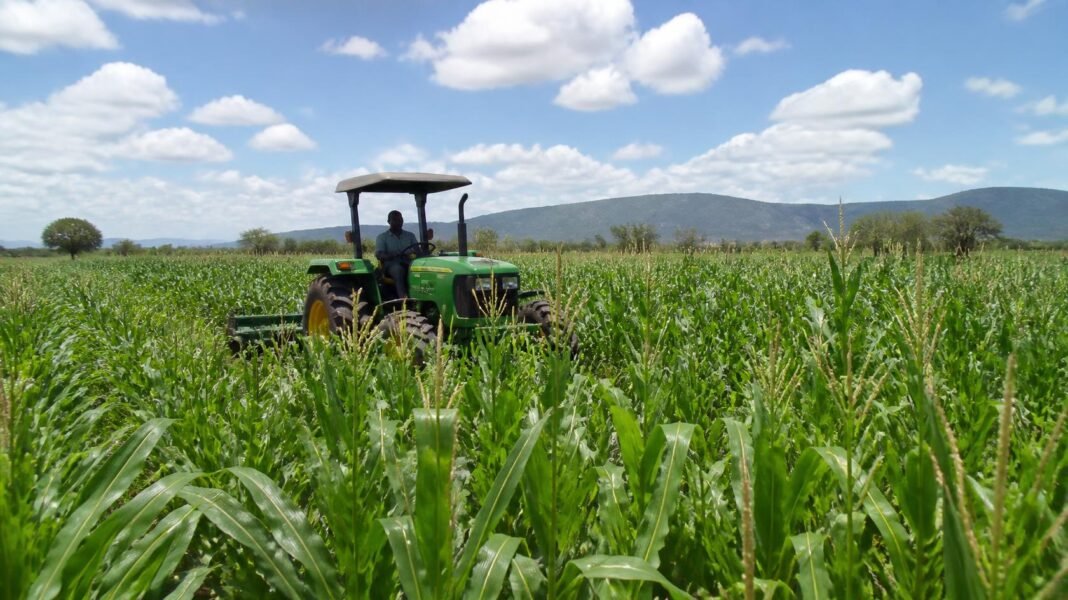

When Tanzania unveiled its 10-year agricultural mechanization plan in February 2026, the headline number was easy to spot: 10,000 tractors.
But looking at the target in isolation risks missing the bigger story.
Tanzania is not simply planning to put another 10,000 tractors into farmers’ sheds.
Its wider mechanization strategy points towards a different agricultural machinery market — one increasingly built around machinery-service businesses, shared equipment, professional operators, stronger dealer networks and greater access to mechanized services.That distinction matters.
For international tractor and implement manufacturers looking at Africa, Tanzania could become a market where the opportunity lies not only in selling machines to farmers, but also in supplying the businesses and institutions that will make those machines accessible to farmers.
A 10-year target with a much bigger ambition
Tanzania’s National Agricultural Mechanization Strategy 2026–2036 sets out a long-term framework for increasing the use of machinery in agricultural production.
The government has targeted 10,000 tractors and 1,000 integrated agricultural mechanization service centres during the strategy period.
The second number may ultimately prove just as important as the first.
Africa’s machinery challenge has never been purely about the number of tractors available.
Ownership is often concentrated among commercial farms and relatively well-capitalised operators, while many small and medium-sized farmers struggle to justify the cost of owning a tractor that may be needed intensively for only a short period of the agricultural calendar.
A machinery-service model changes the economics.
Instead of every farmer needing to own a tractor, one machine can work across dozens or potentially hundreds of farms.
This turns agricultural machinery from an ownership product into a service business.
And that could be one of the most significant implications of Tanzania’s strategy.
Tanzania already has a growing machinery market
The 10,000-tractor ambition should also be viewed against the country’s recent progress.
Tanzania’s agricultural mechanization has been accelerating.
Government data shows that the area cultivated using tractors rose from approximately 1.85 million hectares in 2019/20 to 4.35 million hectares in 2023/24.
That is a remarkable increase in only four years.
The machinery fleet has also expanded. In 2023/24, Tanzania recorded more than 25,600 large tractors and 15,600 small tractors in operation, according to the Ministry of Agriculture.
Imports have been significant as well. Tanzania imported 4,125 small tractors in 2023/24, compared with 1,999 the previous year. Large tractor imports reached 2,484 units.
These numbers suggest that Tanzania is already developing into a substantial tractor market.
The new strategy is therefore an acceleration of an existing transition rather than the beginning of mechanization.
Related Articles
- John Deere’s 2026 Outlook Signals a Possible Turning Point for the Global Farm Machinery Market
- Africa Doesn’t Lack Farmers Who Want Modern Equipment — It Lacks a Way to Finance Them
- South Africa’s Next Farm Machinery Cycle Will Be Driven by Intensification, Not More Land
- U.S. Tractor Sales Fall 10.9% in July as North American Farm Machinery Market Remains Under Pressure
Mechanization as a response to climate pressure
Tanzania’s push for greater mechanization is also taking place against a changing climate. Increasingly unpredictable weather is making agricultural production more difficult, adding another reason for the country to improve the speed and efficiency of farm operations.
Prime Minister Mwigulu Nchemba has pointed to the growing pressure on agriculture, saying that “climate change, including droughts, floods and changes in rainfall patterns, continues to reduce agricultural production and increase the risk of food insecurity.”
That makes mechanization more than a question of replacing manual labour. Faster land preparation, timely planting and more efficient harvesting can give farmers greater flexibility when weather conditions create shorter or less predictable production windows.
The challenge, however, is ensuring that the machinery reaching farmers is suited to these changing conditions. For Tanzania, the next decade will therefore be about not only increasing the number of tractors in the country, but also ensuring that farmers can access the right machinery at the right time.
Despite the growth, mechanization remains far from universal.
Tanzania’s mechanization strategy estimates that in 2024 around 44% of cultivated land was still powered by hand hoes, while draught animals accounted for another 30%. Tractors accounted for approximately 26%.
That tells manufacturers something important.
There is still a very large potential market, but it is not necessarily a market for one type of tractor.
The equipment required by a farmer cultivating a few hectares will be different from what is needed by a large commercial agricultural operation.
Tanzania’s geographical and agricultural diversity reinforces this point.
Some areas have already developed significant tractor use, while others continue to rely heavily on animal traction and manual labour.
The market therefore has room for small tractors, medium-horsepower machines and larger agricultural tractors, alongside specialised equipment.
Tanzania Mechanization by the Numbers
The real opportunity could be the 1,000 service centres
If the 10,000 tractors represent the hardware component of the plan, the proposed 1,000 mechanization service centres represent the infrastructure needed to make that hardware useful.
This is where Tanzania’s strategy becomes particularly interesting.
A tractor only creates agricultural value when it is working.
A machine sitting idle because its owner cannot find work for it, cannot obtain spare parts or cannot afford repairs contributes little to mechanization.
A professional machinery centre, by contrast, can potentially coordinate equipment, operators, maintenance and demand.
A farmer could request land preparation, planting, spraying or harvesting services without purchasing the equipment required to perform the operation.
This creates a much larger addressable market.
A manufacturer supplying one machinery-service operator could effectively gain access to many farms through that operator.
That is a fundamentally different sales proposition from selling individual tractors one farmer at a time.
Tanzania may need more than tractors
The language surrounding mechanization often focuses heavily on tractors.
But Tanzania’s machinery opportunity extends much further.
Once tractors become more widely available, farmers need implements to use them productively.
That creates potential demand for:
- Ploughs
- Disc harrows
- Rippers
- Cultivators
- Planters and seeders
- Fertilizer spreaders
- Sprayers
- Trailers
- Harvesting equipment
- Hay and forage machinery
- Rice-production equipment
- Post-harvest machinery
This is particularly important because increasing tractor numbers without increasing implement availability can create an imbalance.
A tractor is a power unit. The agricultural operation depends on what is attached to it.
For manufacturers entering Tanzania, therefore, the more interesting commercial proposition may be a complete mechanization package rather than a tractor-only strategy.
Rice, maize and other crops could drive equipment demand
Tanzania’s crop mix also creates opportunities for specialised machinery.
The country is a major producer of maize, rice, cassava, beans and other crops, while commercial agriculture includes sugar, tea, coffee and other export-oriented production.
Different crops require different machinery systems.
Rice production, for example, creates demand for specialised land preparation, planting, harvesting and post-harvest equipment.
Maize production can support markets for planters, fertiliser application equipment, harvesting machinery and grain-handling systems.
This means manufacturers with strong crop-specific equipment portfolios may find opportunities beyond the traditional tractor market.
The financing problem cannot be ignored
There is, however, a major question hanging over the strategy:
Who will pay for the machinery?
Adding 10,000 tractors over ten years sounds manageable when spread across a decade. But tractors remain expensive capital assets, particularly for farmers with limited access to credit.
This is why machinery financing could become one of the defining factors in Tanzania’s mechanization programme.
Banks, leasing companies, government-backed financing programmes, dealers and manufacturers could all play a role.
The machinery-service model offers another route.
Rather than financing a tractor for every farmer, financing can be concentrated among machinery-service operators who generate income by hiring out equipment.
That could make machinery investment more commercially viable.
It also creates a potential new customer segment for banks and equipment-finance companies: the agricultural machinery entrepreneur.
After-sales service may become a competitive advantage
As Tanzania’s machinery population grows, another market will expand alongside it — aftermarket support.
Every additional tractor represents a future requirement for filters, tyres, lubricants, hydraulic components, electrical parts, engine components and technical service.
For manufacturers, this means that establishing a strong presence in Tanzania cannot end at the point of sale.
A dealer with tractors but weak parts availability may struggle to retain customers.
Conversely, manufacturers that build dependable parts and service networks can develop long-term relationships with machinery owners.
This could become particularly important for the 1,000 service centres.
Fleet operators will be highly sensitive to downtime. If a tractor is generating revenue by providing services to farmers, every day it remains out of operation can represent lost income.
For these customers, uptime could matter as much as the initial purchase price.
The opportunity for local industry
Tanzania’s mechanization drive could also stimulate activity beyond imported machinery.
As the machinery fleet expands, demand should grow for local repair workshops, fabricators, spare-parts distributors, mechanics, operators and agricultural engineering services.
There could also be opportunities for local assembly.
Tanzania has already attracted interest from international tractor manufacturers exploring local assembly opportunities.
If such investments develop, the country’s expanding machinery market could provide the volume required to support a more localised equipment industry.
That would change the structure of the market.
Instead of Tanzania being primarily an importer of finished agricultural machinery, it could gradually develop into a regional production and service base.
What international manufacturers should watch
For global machinery manufacturers, Tanzania’s 10-year strategy presents an opportunity — but it also presents a test of market strategy.
The companies best positioned to benefit may not simply be those with the lowest-priced tractors.
They are likely to be companies that can answer several practical questions.
- Can they provide financing?
- Can they supply spare parts quickly?
- Can they train operators and technicians?
- Can they support machinery-service businesses?
- Can their machines handle Tanzania’s different farming environments?
- Can they offer implements alongside tractors?
- Can they build a dealer network capable of supporting machines outside the major cities?
These questions will become increasingly important as the machinery fleet expands.
The next decade will be about access, not just ownership
Tanzania’s 10,000-tractor target is easy to interpret as a procurement story.
It is better understood as an access story.
The fundamental objective of mechanization is not to increase the number of tractors sitting in the country. It is to increase the amount of agricultural work that can be performed mechanically.
That requires machines to be available when farmers need them.
It requires operators.
It requires financing.
It requires spare parts.
It requires maintenance.
And it requires a business model that allows machinery owners to make a return on their investment.
This is why the combination of 10,000 tractors and 1,000 machinery-service centres is potentially more significant than either target on its own.
Tanzania’s machinery market is entering its next phase
Seven months after the strategy was unveiled, the important question is no longer simply whether Tanzania wants more tractors.
The direction is already clear.
The country wants to move from a farming system heavily dependent on human labour and animal power towards one in which mechanized operations become increasingly accessible to farmers.
The scale of the remaining gap means the transition will not happen overnight.
But the combination of rising tractor use, growing machinery imports, government policy and a planned expansion of machinery-service infrastructure creates a market that international equipment manufacturers will find increasingly difficult to ignore.
The 10,000 tractors are therefore only the visible part of Tanzania’s 10-year mechanization story.
Behind them lies a potentially much larger market for implements, harvesting equipment, parts, maintenance, financing, digital fleet management, operator training and machinery services.
For Tanzania, the challenge is turning the strategy into productive machines working in farmers’ fields.
For machinery manufacturers, the opportunity is to become part of the ecosystem that makes that transformation possible.
Source of the Tractors
Although Tanzania has not publicly identified a single supplier for the 10,000 tractors targeted under its 10-year mechanization plan, Belarus has already emerged as a potential source of equipment.
Tanzania has an established relationship with Belarusian tractor manufacturer Minsk Tractor Works (MTZ).
In July 2025, a Tanzanian delegation led by former Prime Minister Kassim Majaliwa visited MTZ in Minsk, where the two sides discussed potential areas for expanded industrial and agricultural machinery cooperation.
MTZ said it had already supplied around 140 tractors to Tanzania and indicated that further commercial contracts could follow.
The manufacturer also reported particular interest from Tanzania in tractors in the 80–150 hp range, a segment that could suit many of the country’s farming operations and machinery-service businesses.
The Belarusian manufacturer is therefore worth watching as Tanzania moves to implement its mechanization strategy. However, there is no indication that the 10,000-tractor target has been allocated to MTZ.
The eventual supply could involve multiple manufacturers, depending on procurement decisions, financing arrangements, tractor specifications and the requirements of different farming regions.
For manufacturers competing for a share of Tanzania’s expanding machinery market, the Belarus connection provides an early indication that the race to supply the country’s next generation of agricultural equipment is already taking shape.
What Manufacturers Should Watch
- Government machinery procurement
- Development of the 1,000 service centres
- Tractor financing programmes
- Local assembly investments
- Dealer-network expansion
- Demand for 80–150 hp tractors
- Implement and harvesting-equipment demand
- Spare-parts and after-sales infrastructure
Also Read
- Africa Doesn’t Lack Farmers Who Want Modern Equipment — It Lacks a Way to Finance Them
- John Deere’s 2026 Outlook Signals a Possible Turning Point for the Global Farm Machinery Market
- South Africa’s Next Farm Machinery Cycle Will Be Driven by Intensification, Not More Land

Martin is a writer at Agrimachinery Africa specializing in agricultural machinery, mechanization trends, and farm technology across Africa. His work focuses on tractors, harvesting equipment, irrigation systems, and emerging innovations helping farmers improve productivity and efficiency. Through in-depth industry coverage, he highlights technologies shaping the future of modern agriculture.