



The latest U.S. Department of Agriculture (USDA) milk production data arrives at an important moment for Africa’s dairy industry.
The United States produced 20.1 billion pounds of milk in July 2026, up 2.2% from a year earlier, while Kenya has emerged as Africa’s largest milk producer after annual output climbed to about 5.5 billion litres.
Two very different dairy systems are therefore expanding production, but the more important question for Africa is what it will take to make the next phase of growth more productive, efficient and profitable.
The U.S. figures illustrate what decades of investment in genetics, nutrition, infrastructure, technology and farm machinery can produce at scale.
USDA reported approximately 9.71 million milk cows in July, with average production of 2,075 pounds per cow during the month.
Meanwhile, USDA’s 2026 forecast puts total U.S. milk production at approximately 236.6 billion pounds, demonstrating the enormous scale of the country’s dairy production system.
Kenya’s story is different, but increasingly important. National milk production has risen from about 4.6 billion litres to more than 5.5 billion litres, while the country has overtaken Egypt to become Africa’s largest milk producer.
Estimates place Kenya’s total cattle population at around 22 million head, with approximately 3.3 million to 4.3 million cattle specifically associated with dairy production.
That difference in scale should not obscure the more important issue. The question facing Kenya and much of Africa is no longer simply how to produce more milk.
It is how to increase the amount of milk and income generated from existing dairy resources, while keeping production costs under control. That is where machinery, finance and farm productivity increasingly intersect.
Kenya’s dairy industry is entering a new phase
Kenya’s rise to roughly 5.5 billion litres of annual milk production represents a major expansion of the country’s dairy economy.
Production has increased substantially from the approximately 4.64 billion litres recorded in 2021, indicating that the sector has already demonstrated an ability to grow rapidly.
But national production figures can conceal what is happening at farm level. Estimates put the average milk yield of a lactating cow in Kenya at around 7–10 litres per day.
That figure varies considerably according to genetics, nutrition, management, breed, animal health and farm conditions, but it provides a useful indication of the productivity challenge facing the sector.
The significance is that Kenya does not necessarily need to build its future dairy industry simply by adding more cows.
Raising productivity from the animals already in the dairy system could potentially allow farmers to increase output while limiting additional demands for feed, land, labour and water.
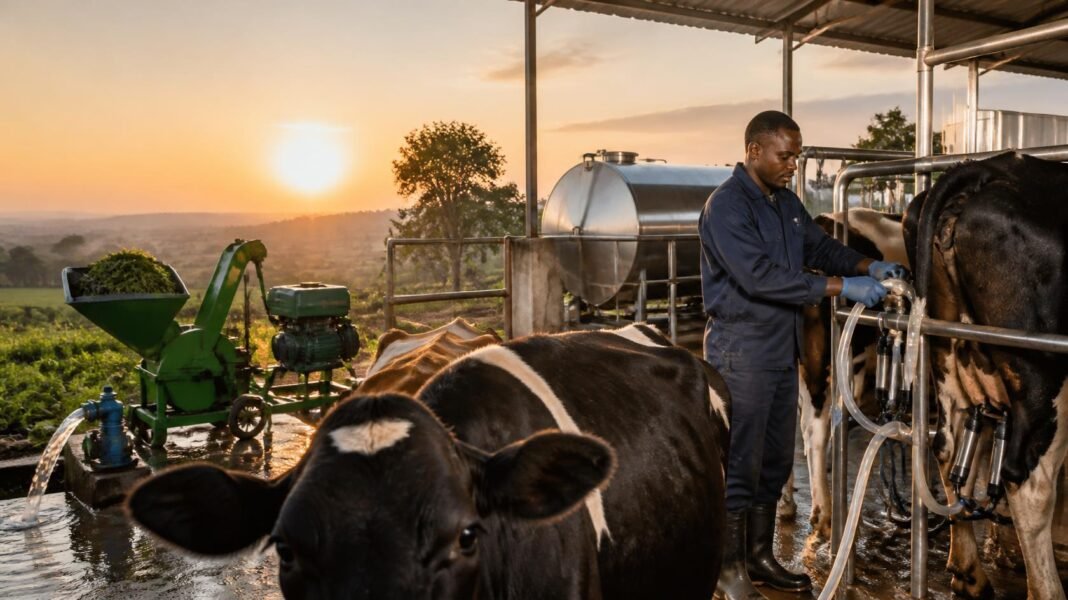
This makes the machinery question much more interesting. A machine that reduces feed-preparation labour, improves milking efficiency, provides reliable water or protects milk quality can potentially contribute to higher productivity without requiring the farmer to dramatically expand the herd.
20.1B lb
5.5B+ L
7–10 L/day
22M
The USDA numbers reveal a different productivity equation
The value of the USDA Milk Production report is that it separates several elements that determine national milk output.
It reports the number of milk cows, production per cow and total milk production, allowing analysts to determine whether changes in output are being driven by herd numbers, individual-animal productivity or both.
In July 2026, the U.S. had approximately 9.71 million milk cows, while total milk production reached 20.1 billion pounds. Average production was 2,075 pounds per cow for the month, with production across the 24 major milk-producing states reaching about 19.4 billion pounds.
The U.S. dairy system has achieved this scale through a combination of factors rather than machinery alone. Genetics, specialised nutrition, animal health, farm management, large-scale infrastructure and capital investment have all contributed to increasing output per animal and per farm.
USDA’s longer-term data illustrates the transformation. U.S. milk production increased from approximately 170.8 billion pounds in 2004 to 225.9 billion pounds in 2024, while average annual production per cow increased from about 18,960 pounds to 24,178 pounds.
Africa does not need to reproduce this model. But it can learn from the underlying principle: dairy productivity is determined by the efficiency of the entire production system surrounding the animal.
Africa may already have an important cost advantage
The case for appropriate mechanisation becomes even more interesting when international dairy production costs are considered.
Milk SA’s Lacto Data June 2026 publication compares milk-production costs across 174 dairy farms in 55 countries.
The analysis found that 12% of the farms had production costs of US$30 or less per 100 kilograms of solid-corrected milk, with the low-cost farms predominantly located in Africa and Serbia.
A further 71% of the farms recorded production costs between US$30 and US$60 per 100 kilograms of solid-corrected milk, while 17% were at US$60 or above.
That finding challenges the assumption that Africa must simply copy highly capitalised Western dairy systems to become competitive. Some African farms are already operating among the lower-cost producers in the international comparison.
The strategic challenge is therefore different: how can African dairy producers improve productivity without eliminating the cost advantages they already possess?
That is where targeted mechanisation becomes more attractive than indiscriminate automation.
The machinery behind every litre of milk
Feed preparation is one of the clearest areas where equipment can make a difference. Cutting and chopping forage manually requires significant labour, particularly when herd sizes increase.
A properly sized chaff cutter or forage-processing machine can reduce that workload and allow farmers to prepare feed more efficiently.
The same principle applies to milking. Manual milking can remain perfectly practical for very small herds, but labour requirements increase as herd size and milk volumes grow.
Appropriately sized milking equipment can reduce physical labour and improve consistency, although the economics depend on herd size, electricity availability, maintenance and operator skills.
Water is another important part of the equation. Dairy animals require reliable water supplies, while cleaning milking equipment and maintaining hygienic facilities also consume significant amounts of water.
Pumps and other water systems can reduce the labour required to move water and improve reliability.
Milk cooling and handling may be equally important as Kenya’s industry becomes increasingly focused on quality.
Equipment that allows farmers or collection centres to cool milk rapidly can help preserve quality and reduce deterioration between production and processing.
This changes the definition of dairy mechanisation. The objective is not simply to replace human labour with machines. It is to reduce bottlenecks, improve consistency and protect the economic value of milk.
The productivity gap is also a financing gap
The equipment required to address many of these bottlenecks already exists. The problem is that many farmers cannot necessarily afford to purchase it outright.
This creates a fundamental mismatch. The farmer pays for the equipment today, but the financial benefits arrive gradually through reduced labour costs, improved milk production, better quality or additional revenue.
A farmer producing 7–10 litres per lactating cow per day may understand the value of a machine but still struggle to justify a large upfront capital expenditure.
Conventional lending can make the problem worse where borrowers lack traditional collateral or extensive financial records.
The result is that machinery can remain economically attractive but financially inaccessible.
This is where dairy machinery finance could become a major opportunity.
The machine could become a financed productivity asset
Instead of treating machinery simply as another agricultural purchase, financial institutions could evaluate equipment according to the economic value it is expected to generate.
A chaff cutter, for example, could reduce the amount of labour required to prepare feed. A milking machine could save time and potentially allow a farmer to handle a larger herd.
A pump could reduce water-collection labour. A cooling system could protect milk quality and reduce losses.
The financial product could therefore be structured around the productive life of the equipment rather than requiring the farmer to pay the entire cost upfront.
The concept is straightforward: finance the asset, align repayment with dairy cash flow, and support the machine throughout its working life.
This also creates an opportunity for machinery manufacturers and dealers. Equipment sales could increasingly be bundled with financing, servicing, spare parts and operator training.
protect milk quality and make productive equipment easier to finance.
Three models could accelerate adoption
The first model is individual equipment finance. A farmer could obtain financing through a bank, SACCO or agricultural lender and purchase a machine directly from a dealer, with repayments spread over an appropriate period.
The second is cooperative machinery ownership.
A dairy cooperative could finance equipment that is too expensive for individual smallholders and then provide access to members through a shared-service or pay-per-use model.
Forage equipment, tractors and larger feed-processing machines could be particularly suitable.
The third could be dairy-linked machinery finance. Dairy processors, cooperatives or farmer organisations already have relationships with milk suppliers and may have records of regular milk deliveries.
That recurring income could potentially form part of the information used by lenders to structure equipment finance.
Such a model could change the question from:
“Can the farmer afford the machine?”
to:
“Can the machine generate enough economic value for the farmer to repay the machine over time?”
That is a fundamentally different approach to agricultural equipment finance.
Could dairy processors become machinery-finance gateways?
Dairy processors and cooperatives could have a particularly important role in this emerging model because they sit between farmers and the market.
A processor may already know how much milk a farmer delivers each month and how consistently that supply is maintained. That information could potentially help financial institutions better understand the cash flow characteristics of a dairy business.
A machinery-finance programme could then connect four participants: the farmer, the dairy organisation, the financial institution and the machinery supplier.
The machinery company supplies and services the equipment. The lender provides financing. The dairy organisation provides a relationship with the farmer and potentially useful production information.
The farmer uses the equipment to improve the business and repays the financing from dairy income.
The model becomes even stronger when technical support is included. A machine that breaks down without access to spare parts or trained technicians can quickly become a stranded asset. Finance, machinery and after-sales service therefore need to be considered as one system.
Uses equipment to improve productivity.
Provides equipment, parts and service.
Finances the productive asset.
Connects farmers, markets and milk income.
Kenya’s 5.5-billion-litre market creates scale
Kenya’s emergence as Africa’s largest milk producer creates a substantial potential market for this model.
With annual production now exceeding 5.5 billion litres, the country’s dairy economy represents a significant opportunity for machinery manufacturers, financial institutions, SACCOs, cooperatives and agricultural-service providers.
The opportunity is also much broader than tractors. Compact milking systems, chaff cutters, forage machinery, pumps, milk coolers, feed mixers and milk-handling equipment can all play a role in improving productivity.
The most successful equipment, however, may not necessarily be the most sophisticated. It will be equipment that matches the farmer’s herd size, power availability, maintenance capacity and ability to generate a return on investment.
That creates an opportunity for machinery manufacturers to develop products specifically around African dairy economics rather than simply adapting equipment designed for much larger farms.
Quality could become the next machinery market
Kenya’s dairy sector is also moving toward greater emphasis on milk quality rather than volume alone.
The government has been pushing quality-based milk payment, with factors such as butterfat, protein, bacterial counts and contamination increasingly important to the value of milk. This shift could create additional demand for equipment that improves hygiene, cooling and milk handling.
That means the machinery opportunity could move beyond increasing litres produced.
A farmer who produces 100 litres of milk but loses quality through poor handling may not capture the full economic value of that production.
Equipment that helps preserve quality can therefore create value without necessarily increasing the number of cows or the amount of milk produced.
Mechanisation could consequently become part of Kenya’s quality strategy as well as its productivity strategy.
Africa should not copy the American dairy model
The U.S. provides an impressive example of what investment in dairy productivity can achieve, but Africa should be careful about copying the structure of American dairy farming.
A large U.S. dairy operation with hundreds or thousands of cows can justify machinery and infrastructure investments that would make little economic sense for a smallholder with five or ten animals.
Africa’s opportunity is to develop a more flexible model.
Small farmers may need simple machines that remove one labour bottleneck, while larger commercial farms require sophisticated equipment and automation. Cooperatives can bridge the gap by allowing farmers to share expensive machinery.
This suggests that African mechanisation will probably be incremental rather than transformational overnight.
A farmer might begin with a chaff cutter, then invest in a water pump, later acquire a milking machine and eventually participate in cooperative forage machinery. Each investment removes another constraint.
The next 800 million litres could be harder
Kenya’s increase from approximately 4.6 billion to more than 5.5 billion litres demonstrates that the industry can expand rapidly. But the next major increase may require a different strategy.
Adding more cattle creates additional demand for land, feed, water, labour and animal-health services. Increasing productivity per animal and improving the efficiency of farm operations could offer a more sustainable route to continued growth.
The reported 7–10 litres per lactating cow per day provides an important starting point for thinking about this opportunity.
Even modest improvements in productivity across millions of dairy animals could have significant implications for national milk production.
But those improvements require more than genetics and feed. They require farmers to have access to the infrastructure and equipment that allow better production practices to be implemented consistently.
That is why finance matters.
2030 Outlook: From machinery sales to productivity systems
By 2030, Africa’s dairy machinery market could increasingly move away from simple equipment sales toward integrated productivity systems.
Farmers could acquire equipment through leasing or asset finance. Cooperatives could operate shared machinery fleets. Dairy processors could partner with lenders to facilitate equipment finance.
Machinery manufacturers could bundle servicing, spare parts and training into financing packages.
The most successful companies may therefore not be those that simply sell the most machines.
They may be those that can demonstrate exactly how a machine improves the economics of milk production.
For financiers, this creates a new agricultural lending opportunity. For dairy organisations, it creates a potential pathway to improve both supply and quality. For machinery manufacturers, it opens a much larger addressable market than the traditional commercial-farm customer.
Africa’s dairy opportunity is bigger than more cows
The USDA’s July 2026 figures show a U.S. dairy industry producing 20.1 billion pounds of milk in a single month, supported by 9.71 million milk cows and average monthly production of 2,075 pounds per cow.
Kenya’s dairy industry is operating on a completely different scale and structure, but its trajectory is increasingly significant.
Annual milk production has climbed to more than 5.5 billion litres, the country has overtaken Egypt as Africa’s largest milk producer, and estimates put its dairy cattle population between 3.3 million and 4.3 million head within a total cattle population of roughly 22 million.
At the same time, Lacto Data’s international comparison shows that some African farms are already among the world’s lower-cost milk producers.
That means Africa does not necessarily need to pursue the most capital-intensive model available.
it may be financing the machines that make every cow more productive.
It needs to find ways of using technology to increase productivity while protecting cost competitiveness.
The next dairy productivity revolution may therefore not begin with a new breed of cow.
It may begin with a machine — and a financing model that puts that machine within the farmer’s reach.
Kenya has already demonstrated that it can become Africa’s largest milk producer. The next challenge is more ambitious: turning that production scale into higher productivity, better milk quality and stronger farm-level returns.
For Africa’s machinery industry, that could represent one of the continent’s most overlooked agricultural opportunities.
For financial institutions, it could represent a new class of productive agricultural assets.
And for dairy farmers, the difference between producing more milk and earning more from every cow may increasingly come down to whether the right machine is available — and whether they can finance it.
Also Read
- Milking Technology: How Smart Systems Are Transforming Modern Dairy Farming
- Top 10 Milking Technology Companies in the World (2026)
- SPACE 2026 to Spotlight Water as a Critical Resource for the Future of Livestock Farming

Martin is a writer at Agrimachinery Africa specializing in agricultural machinery, mechanization trends, and farm technology across Africa. His work focuses on tractors, harvesting equipment, irrigation systems, and emerging innovations helping farmers improve productivity and efficiency. Through in-depth industry coverage, he highlights technologies shaping the future of modern agriculture.