



John Deere is increasingly seeing 2026 not as another difficult year for agricultural equipment, but as a potential turning point.
The company’s latest results, released on August 20, point to an agricultural machinery market that remains uneven but may be moving toward the end of its current downturn.
Deere reported third-quarter net income of $1.379 billion, up from $1.289 billion a year earlier, while worldwide net sales and revenues rose 5% to $12.608 billion.
More significant for the machinery industry, however, is what Deere expects next.
The company now forecasts fiscal 2026 net income of between $4.75 billion and $5.00 billion, while CEO John C.
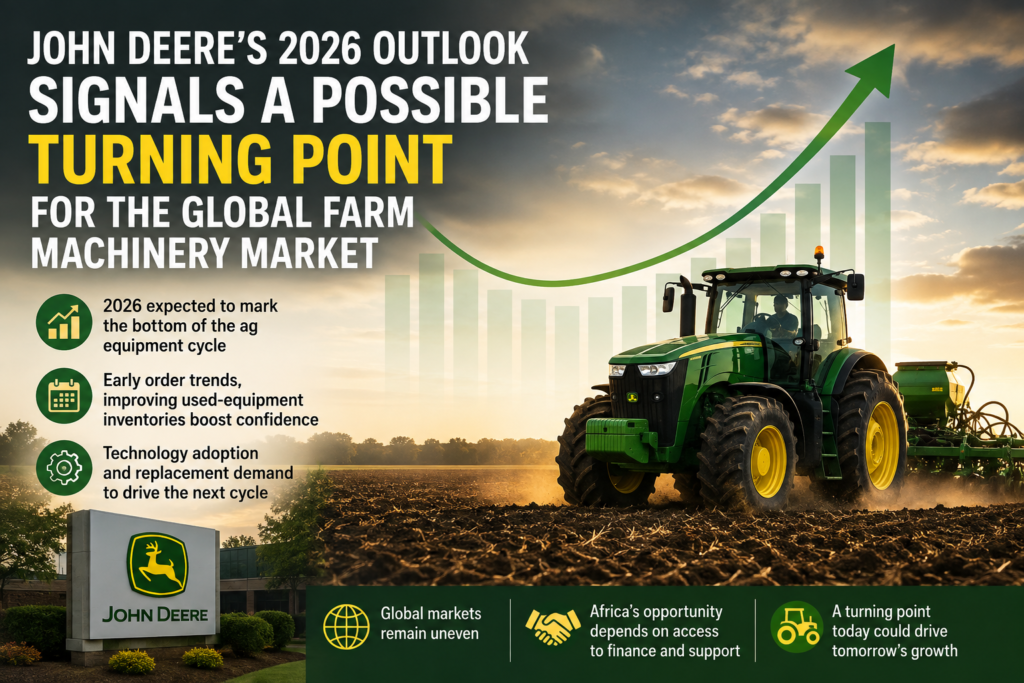
May said Deere continues to believe that 2026 will mark the bottom of the current agricultural equipment cycle.
That does not mean farm machinery demand is suddenly returning to boom conditions.
It suggests something more important: the industry may be approaching the point where deferred equipment purchases, improving inventories and investment in newer technology begin to support the next replacement cycle.
Deere Sees Evidence of a Cycle Turning
Agricultural equipment is highly cyclical. Farmers tend to increase machinery investment when commodity prices, farm income and financing conditions are favourable, but postpone purchases when margins tighten.
That creates a lag between a downturn in farm economics and the eventual impact on equipment manufacturers.
Deere says three developments are particularly encouraging: early order programme trends, improving used-equipment inventories and increased customer adoption of advanced technologies.
The used-equipment market is particularly important.
When farmers delay buying new tractors and combines, older machines remain in service for longer.
Eventually, however, the replacement decision becomes difficult to postpone, particularly for large commercial operations where equipment downtime can have significant financial consequences.
This dynamic means the bottom of a machinery cycle does not necessarily produce an immediate surge in sales.
It can instead mark the point where purchasing decisions stop deteriorating and begin building toward the next cycle.
Related Stories
The Recovery Will Not Be Uniform
Deere’s outlook should not be interpreted as evidence that every agricultural market is recovering at the same speed.
May specifically pointed to relatively stable U.S. market conditions alongside softer conditions in Brazil and Europe.
That distinction matters because the global farm machinery market is not a single market.
A large grain producer in the United States has very different machinery economics from a Brazilian soybean farmer, a European mixed farm or a commercial operation in Africa.
Commodity prices, interest rates, farm sizes, currency movements, government policies and access to finance can all change the timing of machinery purchases.
This makes the idea of a “bottom” more useful as an industry-cycle indicator than as a universal forecast of immediate sales growth.
Technology Could Change the Next Replacement Cycle
There is another important difference between the next machinery cycle and previous ones: farmers are increasingly being asked to justify equipment purchases not simply through horsepower or capacity, but through productivity.
Precision agriculture, automation, connectivity and machine data are becoming part of the investment equation.
That creates an interesting dynamic for manufacturers such as Deere.
A farmer replacing an old tractor may not simply be buying a newer version of the same machine. The purchase can provide access to guidance systems, data connectivity, automation and other technologies designed to improve how the entire farming operation is managed.
For manufacturers, that makes the technology installed on a machine increasingly important to the value proposition.
What Does the Turning Point Mean for Africa?
This is where Deere’s outlook becomes particularly interesting for African agriculture.
A global machinery recovery does not automatically translate into a rapid increase in equipment purchases across African markets.
In many parts of the continent, the bigger constraint is not necessarily the absence of machinery demand. It is the ability of farmers and agricultural businesses to finance machinery.
In an interview with Agrimachinery Africa, Kip Eideberg, Senior Vice President of Government and Industry Relations at the Association of Equipment Manufacturers, highlighted the issue directly:
“For African farmers the high upfront cost of equipment and limited access to affordable credit remain major barriers to modernization.”
That means Africa could enter the next global machinery cycle from a very different position.
While mature markets may be focused on replacing relatively recent equipment and upgrading to more advanced technology, many African agricultural economies still have significant unmet demand for basic mechanization.
The opportunity is therefore potentially larger than simply selling the newest tractors.
Africa’s Machinery Opportunity Is About Access
For African farmers, the critical question may be whether the next global machinery cycle produces equipment that is financially accessible, not merely technologically advanced.
That could increase the importance of smaller tractors, used equipment, machinery leasing, contract farming services and dealer-supported financing.
It also creates opportunities for manufacturers that can adapt products and financing models to local operating conditions.
A sophisticated 300-horsepower tractor may be highly productive on a large commercial farm, but it is not necessarily the machine that unlocks mechanization for a smaller agricultural enterprise.
The same principle applies to precision technology. Digital agriculture can create measurable efficiency gains, but farmers first need an economically viable pathway to acquire the equipment and technology.
A Cycle Bottom Is Not the Same as a Boom
Deere’s announcement therefore deserves attention beyond its quarterly financial performance.
The company is effectively signalling that the agricultural equipment industry may be moving from correction toward stabilization.
If 2026 does prove to be the bottom, the next phase could be driven by replacement demand that has accumulated during the downturn, improving used-equipment conditions and growing demand for machines equipped with productivity-enhancing technology.
But several risks remain. Deere itself points to factors including farm income, commodity prices, interest rates, trade policy, tariffs, currency movements and customer demand as variables that could alter the outlook.
For Africa, the story is even more nuanced.
The continent does not need to wait for a global machinery boom to demonstrate its mechanization potential.
Its challenge is creating the financial and commercial systems that allow farmers to participate when machinery becomes available.
If Deere is right that 2026 represents the bottom of the current cycle, the next question for Africa will not simply be whether the global farm machinery market recovers.
It will be whether African farmers can access enough capital, machinery and support to participate in the recovery.
That could determine whether the next global equipment cycle becomes merely a recovery for manufacturers—or a genuine opportunity to accelerate agricultural mechanization across Africa.
Also Read

Martin is a writer at Agrimachinery Africa specializing in agricultural machinery, mechanization trends, and farm technology across Africa. His work focuses on tractors, harvesting equipment, irrigation systems, and emerging innovations helping farmers improve productivity and efficiency. Through in-depth industry coverage, he highlights technologies shaping the future of modern agriculture.