



The North American agricultural machinery market is still under pressure, but the latest sales data suggests something more nuanced than a simple collapse in equipment demand.
U.S. agricultural tractor sales fell 10.9% in July 2026 from a year earlier, while combine sales declined 5.3%, according to the Association of Equipment Manufacturers (AEM).
In Canada, tractor sales fell 7.8% and combine sales dropped 10.8% over the same period.
The July figures extend a difficult year for equipment manufacturers and dealers.
But beneath the headline declines is a more important signal: farmers appear to be becoming increasingly selective about where they commit capital.
That distinction matters for machinery manufacturers, dealers and exporters—and increasingly for Africa, where the machinery market is driven by a very different stage of agricultural mechanisation.
July confirms that the North American equipment cycle is still weak
The July results did not come out of nowhere.
AEM reported a 21.6% year-on-year decline in U.S. tractor sales in May, accompanied by a 56.1% fall in combine sales.
In June, the tractor decline moderated to 18.4%, while combine sales unexpectedly moved into positive territory, increasing 3.9% year over year.
July therefore brought another decline, but the pace of contraction in tractors was less severe than in May and June.
The progression is revealing:
| Month | U.S. tractor sales | U.S. combine sales |
|---|---|---|
| May 2026 | -21.6% | -56.1% |
| June 2026 | -18.4% | +3.9% |
| July 2026 | -10.9% | -5.3% |
The pattern does not describe a market moving in a straight line downward. Instead, it points to a market in which purchasing decisions are being delayed, reconsidered and made selectively.
That is consistent with AEM’s latest assessment. Curt Blades, AEM senior vice president, said the July data reflected “continued softness” as farmers and equipment manufacturers navigate persistent economic uncertainty.
He also stressed the importance of clear and consistent policy direction for farmers making investment decisions.
In other words, the issue is not necessarily that farmers no longer need machinery. It is that the timing and economics of purchasing new machinery have become more difficult to justify.
Canada provides an even clearer picture
The Canadian data supplied by AEM adds an important layer to the North American story because it breaks tractor sales down by horsepower.
In July, Canadian sales of 2WD tractors below 40 hp fell 8.6%, while the 40–100 hp segment dropped 12.6%.
But sales of tractors above 100 hp increased 4.9%.
That is a striking divergence.
Year to date, the same pattern is even clearer. Canadian sales of tractors below 40 hp were down 13.3%, while 40–100 hp tractors declined 4.8%. By contrast, 100+ hp tractors were 6.2% higher than during the comparable period of 2025.
The wider Canadian market looked like this:
| Equipment segment | July 2026 YoY | 2026 YTD YoY |
|---|---|---|
| Under 40 hp tractors | -8.6% | -13.3% |
| 40–100 hp tractors | -12.6% | -4.8% |
| 100+ hp tractors | +4.9% | +6.2% |
| Total 2WD tractors | -7.5% | -8.9% |
| 4WD tractors | -25.0% | -22.6% |
| Total tractors | -7.8% | -9.6% |
| Self-propelled combines | -10.8% | -1.9% |
Source: AEM Canada Ag Tractor and Combine Report, July 2026.
The 100+ hp result deserves particular attention.
It would be wrong to conclude from the data alone that farmers are deliberately abandoning smaller tractors in favour of high-horsepower machines. AEM does not make that claim in the report.
However, the divergence is consistent with a market in which productivity-focused investments may be holding up better than discretionary or lower-utilisation equipment purchases.
For a large commercial farming operation, a high-horsepower tractor can represent field capacity, timeliness and the ability to cover more hectares during critical planting or harvesting windows.
When margins are under pressure, those productivity benefits can become more—not less—important.
That is an inference from the sales pattern rather than an explanation supplied by AEM, but it is precisely the kind of distinction worth watching.
The combine market is also sending a mixed signal
Combines tell a similar story of volatility.
Canadian combine sales fell 10.8% in July, but the year-to-date decline was only 1.9%.
The U.S. market has been equally uneven. After the extraordinary 56.1% decline in May, U.S. combine sales recovered into positive territory in June before falling 5.3% in July.
That volatility matters because combine purchases are often highly seasonal and influenced by harvest timing, fleet replacement requirements and individual farm investment cycles.
AEM itself cautions that its Canadian monthly data should be interpreted carefully because of the seasonal nature of the equipment industry.
The association describes the figures as preliminary retail sales derived from manufacturer reporting, with data subject to revision.
The right conclusion, therefore, is not that farmers have suddenly stopped buying combines.
It is that the market has become less predictable.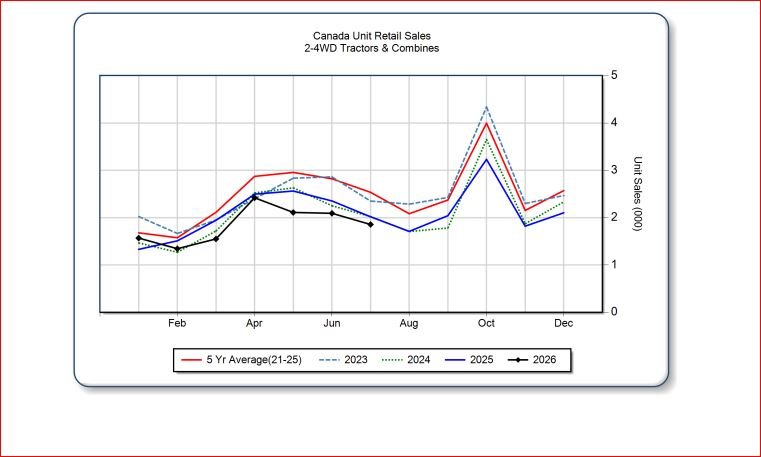
What is driving the caution?
AEM’s July statement points directly to persistent economic uncertainty.
That matters because machinery is one of the largest capital commitments on a farm. A producer can postpone the replacement of a tractor for another season if the existing machine remains operational. The same logic can apply to combines and other expensive equipment.
AEM’s monthly data throughout 2026 has repeatedly reflected softness in the agricultural equipment market. In April, for example, both U.S. and Canadian tractor sales were down 11.3% year over year, with AEM citing lingering challenges and uncertainty in the agricultural economy.
The result is a market where replacement cycles can stretch.
This is important for manufacturers. A farmer who delays a purchase has not necessarily disappeared from the market. That potential customer may simply move the transaction from 2026 to 2027—or opt for a different machine, a used unit or a repair of existing equipment.
For dealers, that makes inventory management particularly important.
For manufacturers, it raises a different question: which products will farmers continue to prioritise when budgets tighten?
The real signal: farmers are becoming selective
The Canadian horsepower data may provide one of the clearest answers.
Total tractor sales were down 7.8% in July, but 100+ hp tractors increased 4.9%. Four-wheel-drive tractor sales, meanwhile, fell 25%.
This does not mean that high-horsepower machinery is immune to the downturn. Nor does it establish why individual farmers made those purchasing decisions.
But it does show that the headline tractor number conceals substantial differences inside the market.
That is increasingly important for machinery companies.
A manufacturer with a broad portfolio spanning compact tractors, utility tractors, high-horsepower row-crop machines, combines and precision agriculture technologies could experience very different levels of demand across its product lines.
The same applies to dealers.
A weak overall market does not necessarily mean every category is equally weak.
Why this matters for Africa
This is where the North American numbers become particularly relevant to African agricultural machinery markets.
Africa is not at the same stage of mechanisation as the United States or Canada.
In mature North American markets, equipment purchases are largely connected to replacement, fleet optimisation, productivity upgrades and technology adoption.
Across much of Africa, the bigger opportunity remains mechanisation expansion: getting tractors, planters, harvesters, irrigation equipment and other machinery into farming systems that remain under-mechanised.
That difference means a 10.9% decline in U.S. tractor sales should not automatically be interpreted as a negative forecast for Africa.
African machinery demand is driven by a different combination of factors, including farm size, access to finance, government mechanisation programmes, contractor markets, food-production investment, import policies and the availability of affordable machinery.
In fact, a prolonged slowdown in mature equipment markets could eventually create opportunities for emerging markets.
Could a weaker North American market push manufacturers toward emerging markets?
This is one of the questions Agrimachinery Africa will be watching.
When mature markets become harder to grow, manufacturers naturally have greater incentives to pursue markets where mechanisation penetration remains low and long-term equipment demand has room to expand.
That does not mean Africa will immediately absorb machinery displaced from North America. Agricultural machinery is highly specialised, and equipment specifications, financing structures, dealer networks and operating conditions differ substantially between markets.
But manufacturers with globally competitive products may increasingly look at Africa as part of their growth strategy.
That could benefit African buyers in several ways.
Greater competition could encourage manufacturers to expand dealer networks. It could increase financing partnerships. It could bring more tractor models into African markets. It could also intensify competition between established Western brands and increasingly aggressive manufacturers from China and India.
For African distributors, meanwhile, a changing global equipment cycle could create opportunities to source machinery more competitively.
The bigger question is what happens next
July’s data should therefore be viewed less as a standalone sales report and more as another signal in a broader equipment cycle.
The immediate indicators to watch are straightforward.
First, U.S. tractor sales. If the year-on-year decline continues to narrow through the second half of 2026, the market may be moving toward stabilisation. If declines widen again, manufacturers and dealers could face a longer replacement-cycle slowdown.
Second, Canadian high-horsepower demand. The 100+ hp segment is one of the most interesting parts of the July report. Whether its 6.2% year-to-date growth can be sustained will provide an important indication of where commercial farm investment remains strongest.
Third, combines. The sharp month-to-month swings in U.S. combine sales demonstrate why several months of data are needed before drawing firm conclusions.
Fourth, manufacturer strategy. A prolonged slowdown in North America could make international markets increasingly important to manufacturers seeking growth.
And that last point matters greatly for Africa.
Africa may be watching the downturn differently
The North American agricultural machinery market is showing clear signs of softness, but the deeper story is not simply about fewer tractors leaving dealer lots.
It is about how farmers allocate capital when uncertainty rises.
The Canadian numbers are particularly instructive. Total tractor sales are down, yet the 100+ hp segment is growing.
Combine sales are down sharply in July but only marginally year to date. The U.S. tractor market is contracting, but the pace of decline has moderated from May to July.
This is a market becoming more selective rather than one moving uniformly in one direction.
For manufacturers, that means product mix, productivity and customer economics will matter increasingly.
For dealers, it means understanding which segments remain resilient.
And for Africa, it creates a potentially important strategic window.
The continent’s machinery market is still characterised by enormous unmet mechanisation demand. If manufacturers begin looking more aggressively beyond mature markets for growth, African distributors and farmers could find themselves with a wider choice of equipment, brands and business models.
The July AEM data does not prove that this shift is already happening.
But it provides another reason to watch it closely.
The North American machinery market may be cooling. Africa’s mechanisation opportunity, however, remains much larger than the sales numbers from mature markets might suggest.
Also Read
- U.S. Agricultural Machinery Prices Rise 2.6% Over the Year as Equipment Costs Edge Higher
- Brazil’s Precision Agriculture Market Has a Technology Problem — But Not the One You Might Expect
- Economist Says Nigeria Needs One Million Tractors to Modernise Agriculture

Martin is a writer at Agrimachinery Africa specializing in agricultural machinery, mechanization trends, and farm technology across Africa. His work focuses on tractors, harvesting equipment, irrigation systems, and emerging innovations helping farmers improve productivity and efficiency. Through in-depth industry coverage, he highlights technologies shaping the future of modern agriculture.