


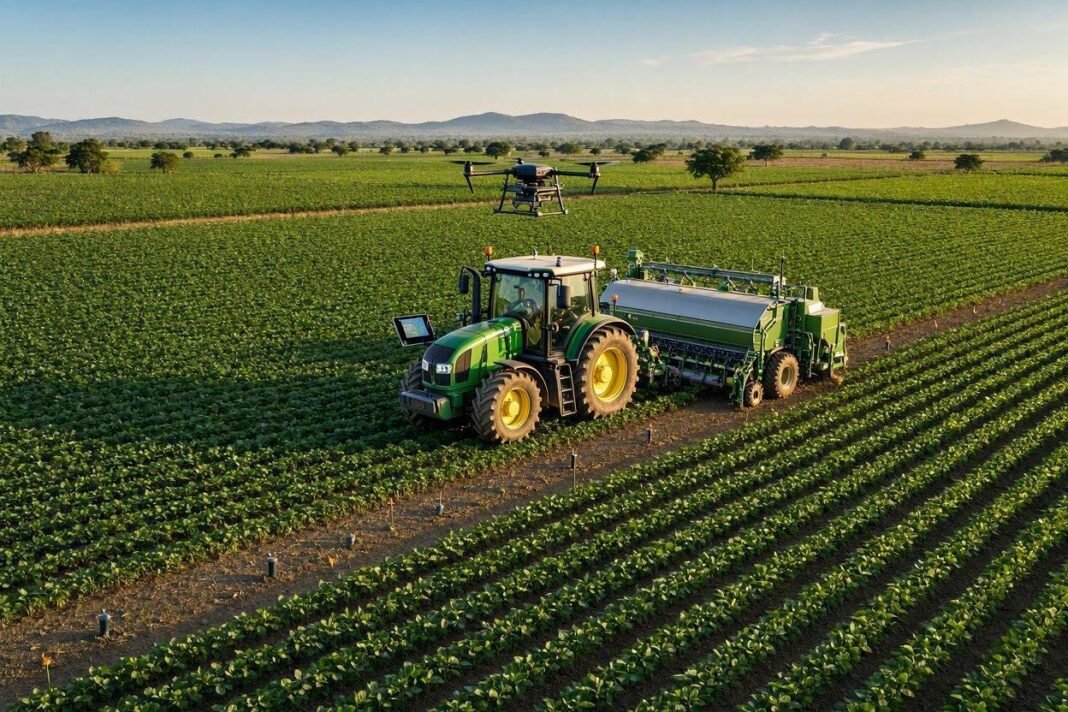

Brazil has little to prove when it comes to agricultural scale.It is one of the world’s major producers and exporters of soybeans, sugarcane, coffee, beef and other agricultural commodities.
Its farms range from highly mechanised corporate operations to smaller and more specialised producers.
Yet that scale has not translated into universal adoption of precision agriculture.
A new industry report from Topcon Agriculture, titled From barriers to progress: Accelerating the adoption of technology by Brazilian farmers, examines why technology adoption remains uneven and what needs to change if precision agriculture is to move from a tool used by leading farms to a mainstream component of Brazilian agricultural production.
Released on July 14, the report brings together contributions from agricultural researchers, farmers and industry studies.
Its central message is important for the machinery industry: the next growth opportunity in precision agriculture may not come from selling increasingly sophisticated technology to farms that already have it, but from removing the barriers preventing a much larger group of farmers from adopting it.
MARKET INTELLIGENCE
Market: Brazil precision agriculture
Key adoption technologies: Automatic steering, GNSS guidance, variable-rate application, field mapping and connected machinery
Major barriers: Cost, uncertain ROI, rural connectivity, technical complexity, interoperability, financing and training
Emerging opportunity: Modular, lower-cost precision systems that can be expanded as farmers see returns
Strategic shift: From premium technology for large farms toward scalable technology for a much broader agricultural market
Brazil has already demonstrated the value of precision agriculture
The case for precision agriculture is no longer particularly difficult to make on Brazil’s largest farms.
Automatic guidance, machine control, variable-rate planting and fertilisation and other precision technologies can improve the accuracy of field operations while reducing unnecessary overlaps and helping farmers manage inputs more efficiently.
Topcon says technologies such as automatic steering and variable-rate systems have the potential to save millions of operating hours and thousands of litres and tonnes of inputs, ranging from fuel to fertiliser.
The more interesting question, therefore, is not whether precision agriculture works.
It is who can afford to use it, who can operate it and whether the economic return is sufficiently clear to justify the investment.
That distinction is critical.
A technology can be technically successful but commercially unsuccessful if the farmer cannot justify its upfront cost, does not have reliable connectivity, cannot integrate it with existing machinery or lacks the skills needed to convert the data into better decisions.
That is where Brazil’s adoption challenge becomes particularly interesting.
The precision agriculture market is moving beyond the biggest farms
Precision agriculture was initially associated with large, highly mechanised farms because these operations could spread the cost of technology across large cultivated areas.
That created a natural adoption pattern.
The largest farms bought advanced equipment first. Smaller and medium-sized operations waited.
But the technology market is changing.
Topcon says advances in technology are making precision solutions more accessible to farms of different sizes and types, including livestock, horticultural and fruit operations. Lower-cost systems can now provide a starting point for farmers who previously could not justify a sophisticated precision-agriculture investment.
This is potentially one of the most important developments in the Brazilian market.
The industry’s growth is no longer necessarily dependent on convincing a large farm to buy a more advanced system.
It can increasingly come from selling simpler systems to thousands of farms that previously bought nothing.
That creates a much larger addressable market.
Related Market Intelligence
The real barrier is the economics of adoption
For machinery manufacturers and precision-technology companies, this changes the product strategy.
Farmers do not necessarily need the most technologically advanced solution available. They need a solution whose economic value makes sense for their particular operation.
That means precision technology has to be evaluated alongside the machinery it is being installed on, the size of the farm, the crops being produced, labour costs and expected savings in fuel and inputs.
Topcon’s own industry commentary makes this point explicitly.
Doug Schmuland, senior director and global OEM coordinator at Topcon Agriculture, argues:
“The primary consideration is that it needs to solve the farmer’s problem.”
That may sound obvious, but it represents a significant shift in how the precision-agriculture market needs to sell technology.
Farmers are not necessarily buying GPS, sensors or automation.
They are buying less overlap, fewer wasted inputs, lower fuel consumption, better machine utilisation, more accurate planting and better information about their fields.
The technology is simply the mechanism through which those benefits are delivered.
ROI could become the industry’s most important sales tool
This is where Brazil’s market could enter its next stage.
For a large farm, a sophisticated precision system can be justified by the scale of the operation. But for smaller and medium-sized farms, the economics are more sensitive.
Topcon’s Antonio Marzia makes the problem particularly clear in the company’s discussion of lower-cost precision systems. A farmer spending tens of thousands of dollars on a tractor cannot necessarily justify spending a similar amount on precision technology for that tractor.
The technology therefore has to be proportional to the value of the machine and the economics of the operation.
This creates an opening for modular systems.
Instead of requiring farmers to purchase an entire precision-agriculture ecosystem at once, manufacturers can offer a basic entry point and allow farmers to add capabilities over time.
That model reduces the initial financial barrier and potentially increases lifetime revenue for technology suppliers.
It also changes the competitive landscape.
The winning technology may not be the one with the greatest number of features.
It may be the one that gives a farmer a clear first return and an easy path to upgrade.
Brazilian farmers are already seeing the value of data
The report includes an important perspective from João Pierobon, a farmer in São Paulo.
He explains that one of the major benefits precision agriculture provides his operation is better information about how the farm is actually operating.
“One of the main pieces of information we now obtain through precision agriculture is accurate data on operating time, input use, and the exact area planted on the farm.”
That quotation illustrates an important transition in agriculture.
Precision agriculture is not simply about making a tractor drive straighter.
It is about turning field operations into measurable data.
Once farmers know exactly how long a machine operated, how much input was used and how much land was covered, they have a much stronger basis for calculating costs and improving future operations.
This is also where precision agriculture begins to connect with artificial intelligence.
AI cannot create much value from a farm that has no reliable operational data.
But once machines are generating structured information about planting, spraying, fertilising, harvesting and machine performance, that data can become the foundation for increasingly sophisticated analytics.
Connectivity remains a structural barrier
There is, however, a major problem with the industry’s vision of a fully connected farm.
The farm has to be connected for many digital technologies to work at their full potential.
Topcon’s report identifies rural connectivity as one of the areas requiring greater investment if technology adoption is to expand. The company argues that wider adoption will require collaboration between industry, government agencies and research institutions, including investment in rural connectivity infrastructure.
This is not a minor technical issue.
A farm can have modern machinery, sensors and software, but weak connectivity can restrict how effectively information moves between machines, platforms and decision-makers.
That makes connectivity part of the agricultural machinery market itself.
For equipment manufacturers, the implication is increasingly clear: machines cannot be designed in isolation from the communications infrastructure surrounding them.
Satellite connectivity, cellular networks, local wireless systems and technologies capable of operating with limited connectivity are therefore likely to become increasingly important parts of the agricultural technology ecosystem.
Interoperability could determine who wins the next market
There is another barrier that is less visible but equally important: farmers rarely operate a single-brand machinery ecosystem.
A farm may have tractors, planters, sprayers, harvesters and implements from different manufacturers.
If precision systems work only inside one proprietary ecosystem, the farmer faces higher switching costs and potentially has to duplicate technology.
That can slow adoption.
Topcon has increasingly positioned interoperability as a route to wider adoption, arguing that precision systems should work across different equipment and machine sizes. Its agricultural technology portfolio includes systems designed to integrate with existing machinery rather than requiring farmers to replace their entire fleet.
This is strategically important.
The future precision-agriculture market is unlikely to be won simply by whoever sells the most advanced tractor.
It may be won by whoever can connect the most machinery.
That distinction opens opportunities for technology suppliers that sit between equipment brands, rather than depending entirely on a single machinery manufacturer.
Simplicity is becoming a competitive advantage
Precision agriculture has historically suffered from a perception that it is complicated.
Multiple displays, sensors, correction services, software platforms and data formats can create a substantial learning curve.
That matters because the technology ultimately has to be used by people operating machines under real field conditions.
Topcon’s own research and product strategy increasingly emphasise simpler systems.
At Agrishow 2026, the company introduced the XR-1P modular GNSS receiver and expanded its Value Line portfolio, explicitly positioning these products as ways to make precision agriculture more accessible. Bruno Lucio, Topcon Agriculture’s director for Latin America, said:
“Precision agriculture does not have to be complex or expensive to generate value.”
That is more than a product statement.
It is an indication of where the market is going.
The first generation of precision agriculture competed largely on accuracy and capability.
The next generation may compete increasingly on ease of installation, ease of use, compatibility and cost.
From autosteer to AI: the technology adoption ladder
Automatic steering provides an interesting example of how this transition can occur.
A farmer does not need to jump directly from conventional machinery to an autonomous tractor.
There is an adoption ladder.
First comes machine guidance.
Then automatic steering.
Then field mapping and operational data.
Then variable-rate applications.
Then machine-to-machine connectivity and analytics.
And eventually, increasingly autonomous equipment.
Topcon describes autosteer as a bridge toward more advanced AI-enabled and autonomous agricultural systems. The company argues that the data collected through guidance and mapping can eventually feed agricultural-management and AI systems.
This suggests that the current market for relatively simple precision products could be much more strategically important than it appears.
A low-cost guidance system is not necessarily the end product.
It can become the entry point into a much larger technology ecosystem.
Brazil’s next precision-agriculture opportunity is therefore wider than hardware
The market intelligence emerging from the report points to a broader conclusion.
Brazil does not appear to have a technology shortage.
It has an adoption and integration challenge.
The country already has sophisticated agricultural machinery, strong agricultural research institutions, major commercial farms and a large technology ecosystem.
The question is how to move precision agriculture from the leading edge of Brazilian agribusiness into the mainstream.
That requires several pieces to move together:
| Barrier | Why It Matters | Market Opportunity |
|---|---|---|
| High upfront cost | Smaller and medium-sized farms may struggle to justify sophisticated systems. | Lower-cost and modular precision systems. |
| Unclear ROI | Farmers need measurable savings rather than technology for its own sake. | Products built around fuel, labour and input savings. |
| Rural connectivity | Weak connectivity can limit connected machinery and data services. | Satellite, cellular and offline-capable agricultural technology. |
| Technology complexity | Complex systems increase training and implementation requirements. | Simpler interfaces and easier installation. |
| Mixed machinery fleets | Farmers often operate equipment from multiple manufacturers. | Interoperable and brand-neutral systems. |
| Skills & support | Farmers need training to convert machine data into useful decisions. | Dealer networks, training and agricultural technology services. |
The report therefore makes an important argument for collaboration. No single technology provider can solve all of these barriers alone.
Equipment manufacturers, technology companies, connectivity providers, financial institutions, dealers, governments and farmers will increasingly need to work together to make precision agriculture commercially viable at scale.
The opportunity is not simply to sell more sensors, software or connected machinery. It is to build an integrated agricultural technology ecosystem in which farmers can adopt technology incrementally, finance it sustainably and translate data into measurable improvements in productivity, efficiency and profitability.
Topcon says broader adoption will require stronger cooperation among industry stakeholders, government agencies and research institutions, particularly around financing, connectivity, education and technical support.
That is significant because no equipment manufacturer can solve all of these problems alone.
What Brazil’s experience means for Africa
The Brazilian experience deserves attention far beyond Brazil.
Many African agricultural markets face an even larger version of the adoption challenge.
Farm sizes are often smaller, machinery fleets can be mixed and older, access to agricultural finance is constrained, rural connectivity remains uneven and technical support networks are still developing.
That does not mean precision agriculture is irrelevant to Africa.
It means the Brazilian model of adoption should not simply be copied.
The lesson is to start with technologies that solve an immediate economic problem.
For some farmers, that could be affordable GNSS guidance.
For others, it could be variable-rate application, digital field mapping, remote sensing or machine monitoring.
The important point is that the technology must fit the economics of the farm.
This is precisely why the movement toward modular and scalable precision systems is worth watching.
A farmer does not necessarily need an autonomous tractor on day one.
They may need a relatively affordable guidance system that reduces overlap and fuel consumption.
Once that technology demonstrates its value, the farmer has a reason to adopt the next layer.That creates a technology adoption pathway rather than a technology leap.
The bigger market opportunity is democratization
Topcon’s report ultimately points toward a transformation in the precision-agriculture business model.
The first phase of precision agriculture was dominated by early adopters and large farms.
The next phase is likely to be about democratisation.
That means lower-cost equipment, modular systems, interoperability, better financing, stronger dealer support and technology that delivers value without requiring farmers to become data scientists.
The companies that understand this shift could access a far larger market.
And the opportunity extends beyond hardware.
As more machines become connected and more farms begin generating operational data, demand should also increase for software, analytics, connectivity, data services, technical support and eventually AI-driven decision tools.
In other words, the biggest opportunity in Brazilian precision agriculture may not be selling more sophisticated machines to the farms that already use precision technology.
It may be bringing the next million hectares—or millions of hectares—into the digital agricultural economy.
That is why the most important message from Topcon’s report is not that precision agriculture is technically capable of doing more.The industry already knows that.
The real challenge is making precision agriculture economically compelling, technically accessible and operationally simple enough for a much broader population of farmers to adopt.
Brazil’s next agricultural technology race may therefore be less about who has the smartest machine.
It may be about who can make smart farming affordable enough to become mainstream.
Market Intelligence
For agricultural machinery manufacturers, technology companies and investors, Brazil offers a useful early indicator of where the global precision-agriculture market is heading: from premium technology for large farms toward scalable technology for the broader agricultural economy.
That shift could prove particularly important in emerging markets, where affordability, connectivity and technical support are likely to determine adoption as much as the underlying technology itself.
AGRIMACHINERY AFRICA VERDICT
Brazil’s next precision-agriculture opportunity is unlikely to be driven simply by increasingly sophisticated technology. The bigger opportunity is making existing technology easier to finance, easier to operate and easier to justify economically.
For machinery manufacturers, the message is clear: the winning precision system may not be the one with the most features, but the one that delivers a measurable return and gives farmers a simple path to upgrade.
Also Read
- How Agricultural Machinery Is Powering Europe’s Biomass Energy Revolution—and What Africa Can Learn
- op Chinese Tractor Brands Making Big Inroads in Africa
- Dealer Guide: Top Massey Ferguson Dealers in Africa (2026)

Martin is a writer at Agrimachinery Africa specializing in agricultural machinery, mechanization trends, and farm technology across Africa. His work focuses on tractors, harvesting equipment, irrigation systems, and emerging innovations helping farmers improve productivity and efficiency. Through in-depth industry coverage, he highlights technologies shaping the future of modern agriculture.