


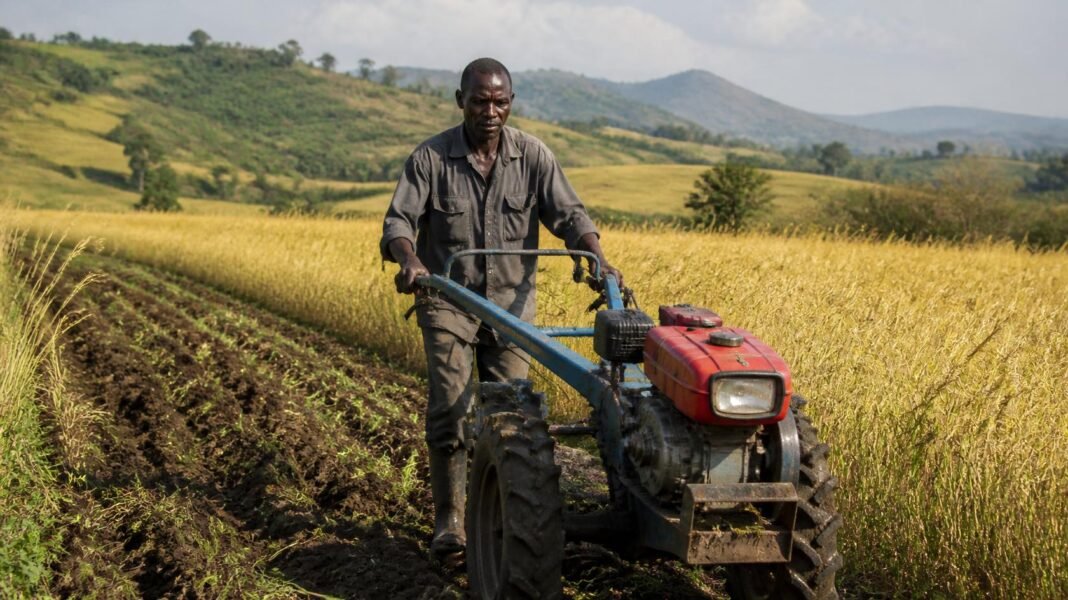

Ask anyone who sells agricultural machinery in Africa what’s holding the market back, and you’ll rarely hear “farmers don’t want tractors.”
You’ll hear about deposits farmers can’t raise, loan terms that don’t match a harvest cycle, and lenders who won’t finance equipment they aren’t confident they could repossess if a loan goes bad.
That gap between real demand and a financial system that can’t safely meet it is, according to the Association of Equipment Manufacturers (AEM), the single biggest obstacle to mechanizing agriculture across the continent.
It’s also a solvable one, says Kip Senior Vice President of Government and Industry Relations at AEM.
Speaking after the release of AEM’s 2026 report on the economic impact of the U.S. equipment manufacturing industry, Eideberg laid out a case that should matter to every policymaker, financier, and equipment dealer operating in African markets: the technology to lift agricultural productivity already exists and is scaling.
What’s missing in many emerging markets is the financial infrastructure to get it into farmers’ hands.
By the Numbers
- U.S. equipment mfg. jobs
2.2M - Total U.S. output/sales
$902B - Contribution to U.S. GDP
$415B - Agriculture’s share of industry
35% - Ag sector ripple-effect sales
$237B - Ag sector GDP contribution
$109.3B - Cost to ratify MAC Protocol
$0
What a $415 Billion Industry Can Teach Africa
AEM’s newly released report, produced with S&P Global Market Intelligence, puts hard numbers behind the U.S. equipment manufacturing industry’s footprint: 2.2 million jobs across all 50 states, $902 billion in total output, and $415 billion contributed annually to U.S. GDP.
Agriculture equipment alone accounts for 35% of that industry, generating an estimated $237 billion in total sales activity once direct, indirect, and induced effects are combined.
Behind those numbers sits a lesson Eideberg believes is transferable to any market trying to build a modern equipment sector, including Africa’s. Success, he says, depends on much more than manufacturers alone.
The U.S. industry thrives because it is supported by a broad network of suppliers, dealers, financiers, technology providers, training institutions, and skilled workers, all operating within a stable and predictable business environment, Eideberg explains, and AEM’s research shows that this surrounding ecosystem generates as much economic activity as the manufacturers themselves.
That framing matters because it reorients the conversation. Discussions about mechanizing African agriculture often start and end with equipment — which tractors, which brands, which local assembly plants.
But according to Eideberg, the equipment itself is the smallest part of the story; indirect and induced impacts, the suppliers, the dealer networks, the technicians, the financing arms, account for a substantial share of the U.S. industry’s overall economic contribution, and that supporting ecosystem is exactly what tends to be thinnest in emerging markets.
Manufacturers, Eideberg notes, are more likely to invest where there is regulatory certainty, access to financing, strong infrastructure, legal transparency, and open, competitive markets. He’s equally direct about what he believes doesn’t work.
Long-term competitiveness, he argues, is built through partnership between government and the private sector rather than through market-distorting policies such as forced localization, tariff and non-tariff trade barriers, or weak intellectual property protections.
For African governments weighing whether to mandate local assembly requirements or protect domestic manufacturers behind tariff walls as a shortcut to industrial development, it’s a pointed caution from an organization that represents the manufacturers those policies are meant to attract.
The Missing Middle: Suppliers, Dealers, and Financiers
Ask what actually determines whether a piece of equipment reaches a farmer’s field, and Eideberg points past the factory gate entirely.
Suppliers provide the components and materials, dealers connect customers with equipment and after-sales service, technicians keep machinery running, and financial institutions help customers access the capital required to purchase it in the first place, he says.
Strip out any one link in that chain and the equipment doesn’t move, no matter how strong demand is.
Financing is where Eideberg’s argument sharpens into something close to a diagnosis of Africa’s specific problem. Mining, agricultural, and construction equipment are high-value capital assets, he points out, and that is precisely what makes financing so critical.
In many developing markets, he says, demand exists, but purchases are constrained by limited access to credit, high financing costs, and legal uncertainty surrounding collateral and asset recovery.

For African farmers, the high upfront cost of equipment and limited access to affordable credit remain major barriers to modernization.
Senior Vice President of Government and Industry Relations, AEM
That last phrase, legal uncertainty surrounding collateral and asset recovery, is worth sitting with. It’s not simply that African farmers and contractors are poor or that interest rates are high, though both are often true.
It’s that lenders in many African jurisdictions cannot be confident that if a borrower defaults, they can actually recover the tractor, excavator, or harvester that secured the loan. Repossession processes can be slow, contested, or effectively unenforceable.
Faced with that uncertainty, banks and equipment-finance companies respond the way lenders everywhere respond to unpriceable risk: they lend less, they lend at higher cost, or they don’t lend at all.
The result is a market where the demand side and the supply side of the equipment trade are both healthy — farmers want machinery, manufacturers and dealers want to sell it — but the financial plumbing connecting them is broken.
It’s a distinctly different problem from the one usually assumed, and it points to a distinctly different set of solutions.
Related Stories
- South Africa’s Next Farm Machinery Cycle Will Be Driven by Intensification, Not More Land
- U.S. Tractor Sales Fall 10.9% in July as North American Farm Machinery Market Remains Under Pressure
- Brazil’s Precision Agriculture Market Has a Technology Problem — But Not the One You Might Expect
- Economist Says Nigeria Needs One Million Tractors to Modernise Agriculture
Why AEM Is Backing the MAC Protocol
Asked what policy would do the most to change that picture, Eideberg doesn’t hesitate: ratification of the MAC Protocol, formally the Mining, Agriculture and Construction Equipment Protocol, an international commercial treaty designed specifically to de-risk equipment financing.
The Protocol, he explains, establishes a clear and transparent legal framework that protects creditors when financing agricultural, construction, and mining equipment.
By providing defined remedies in the event of default, including repossession, sale, leasing, and export of equipment, it reduces lending risk and increases confidence among financial institutions, Eideberg says, adding that those protections are underpinned by an international electronic registry that records security interests in equipment, giving lenders a transparent, searchable record of who has a claim on a given machine, the kind of legal clarity that’s often simply absent in domestic frameworks.
The mechanism by which this is supposed to help ordinary farmers is straightforward, even if it operates a step removed from the field.
When a lender knows it has an enforceable, internationally recognized right to repossess and resell equipment in the event of default, it can afford to offer better terms.
For many African farmers and businesses, Eideberg says, the high upfront cost of equipment and limited access to affordable credit remain major barriers to modernization, and by reducing financing risk, the MAC Protocol can encourage lenders to offer longer loan terms, lower financing costs, and more flexible leasing arrangements.
Notably, Eideberg frames adoption of the Protocol as close to a free policy win for African governments.
There is no cost for African governments to ratify the MAC Protocol, he stresses, and doing so would boost agricultural productivity across the continent while helping to combat food insecurity and the environmental degradation caused by unsustainable agricultural practices.
For treasuries and ministries of agriculture weighing competing priorities and limited budgets, a treaty ratification that costs nothing but could unlock private lending is a rare combination.
The knock-on effects Eideberg describes extend beyond individual farm loans.
Beyond improving equipment access, he says, adoption of the MAC Protocol can support the growth of domestic manufacturing and machinery-support industries: as demand for equipment increases, countries can attract investment in local assembly operations, component manufacturing, maintenance services, dealer networks, and skilled workforce development.
In other words, fixing the financing bottleneck doesn’t just move more tractors, it’s a precondition for the dealer networks, technician training programs, and local supply chains that AEM’s own U.S. data shows generate the bulk of an equipment industry’s economic value.
What Modern Equipment Actually Does for a Farmer
It’s worth being concrete about what’s being financed, because the case for the MAC Protocol is really a case for getting a specific set of technologies into more hands.
Eideberg describes a suite of tools that go well beyond horsepower.
Modern equipment technologies, he says, put data in the hands of farmers to better utilize the land already under cultivation; from preparation and planning to seeding and harvest, that data allows farmers to read soil moisture, texture, and temperature so they can make informed decisions on how and when to apply necessary inputs.
Auto-guidance systems, he notes, reduce overlap, avoid soil compaction, and prevent skipped field passes, while variable-rate technologies use sensors on equipment and attachments to map a farmer’s field so operators can visualize and optimize where certain areas need more, or less, seed, water, and fertilizer.
The pitch here is productivity gains without a corresponding expansion of farmland, a critical distinction in a continent where much of the highest-quality agricultural land is already under cultivation, and where expanding into new land carries real environmental cost.
At its core, Eideberg says, modern equipment can drastically improve agricultural land already under cultivation without relying solely on generational knowledge passed down from one farmer to the next about how to optimize each piece of land.
Importantly, he’s careful to note that this isn’t an all-or-nothing proposition requiring African farmers to leap straight to fully autonomous, sensor-laden machinery.
These technologies can scale up or down depending on the sophistication of the application and equipment, he says, and retrofits, interoperable technologies, and scalable equipment options can allow farmers to adopt solutions that fit their operation, crop, geography, and capital constraints.
A smallholder in Kenya’s Rift Valley and a large-scale commercial farm in South Africa‘s Free State don’t need the same equipment package; the technology stack, in Eideberg’s telling, is designed to meet farmers where their capital and operations actually are.
A Growth Market, If the Financing Follows
Eideberg is unambiguous that AEM sees Africa as a genuine long-term opportunity rather than a charity case.
The continent, he says, represents a significant long-term growth opportunity for equipment manufacturing due to its growing population, expanding infrastructure needs, and demand for improved productivity across the mining, construction, and agriculture sectors.
He believes many African markets already have strong underlying demand for modern equipment, with investment constrained primarily by financing challenges and legal uncertainty, the same diagnosis, restated as an opportunity rather than a problem.
As that demand is unlocked, Eideberg expects the ecosystem to mature in a fairly predictable sequence, with opportunities emerging for greater local assembly, regional supply chains, dealer development, service networks, and workforce training programs.
He also points to a role for deeper partnership between multinational manufacturers and local firms to build distribution, maintenance, and technical support capacity, the kind of on-the-ground presence that turns a one-off equipment sale into a durable, serviceable asset for a farmer or contractor.
Zooming out, Eideberg situates the African opportunity within a broader global pattern. Emerging markets everywhere face significant pressures, he says: population growth, climate change, environmental degradation, and disruptions in global supply chains are all increasing the need to grow more food with fewer inputs.
Precision agriculture, in his telling, is not a luxury add-on for wealthy farmers but a response to that pressure, a way to scale production safely and efficiently by making better use of the land already under cultivation.
He points to AEM’s own Benefits of Precision Ag study as evidence that higher productivity does not have to come at the expense of local environments, since technologies that optimize seed, water, fertilizer, and fuel use can raise output while cutting waste.
The Bottom Line for Africa’s Agricultural Machinery Market
Strip away the policy language, and Eideberg’s argument reduces to something fairly simple: the equipment exists, the demand exists, and the productivity case is proven in mature markets, but none of it reaches African farmers without a financial system willing and able to lend against it.
That’s not a manufacturing problem or a demand problem.
It’s a legal and financial infrastructure problem, and one that AEM argues has an unusually cheap fix in the form of a treaty that costs governments nothing to ratify.
For dealers, financiers, and manufacturers watching Africa’s agricultural machinery market, the message is that the next major unlock for the sector may not come from a new product launch or a new assembly plant, but from a signature on an international registry.
Whether African governments move to ratify the MAC Protocol, and how quickly lenders respond if they do, will be one of the more consequential storylines to watch across the continent’s equipment markets in the years ahead.
This interview was conducted with Kip Eideberg, Senior Vice President of Government and Industry Relations at the Association of Equipment Manufacturers (AEM), following the release of AEM’s 2026 report on the economic impact of the U.S. equipment manufacturing industry, produced in partnership with S&P Global Market Intelligence.
Also Read
- Why Farm Machinery Makers Are Turning Sustainability into a Profit Strategy
- Kenya’s Tractor Market Gets a Financing Boost as Equity Bank Offers 90% Funding for Kubota Machines
- South Africa’s Next Farm Machinery Cycle Will Be Driven by Intensification, Not More Land

Martin is a writer at Agrimachinery Africa specializing in agricultural machinery, mechanization trends, and farm technology across Africa. His work focuses on tractors, harvesting equipment, irrigation systems, and emerging innovations helping farmers improve productivity and efficiency. Through in-depth industry coverage, he highlights technologies shaping the future of modern agriculture.