


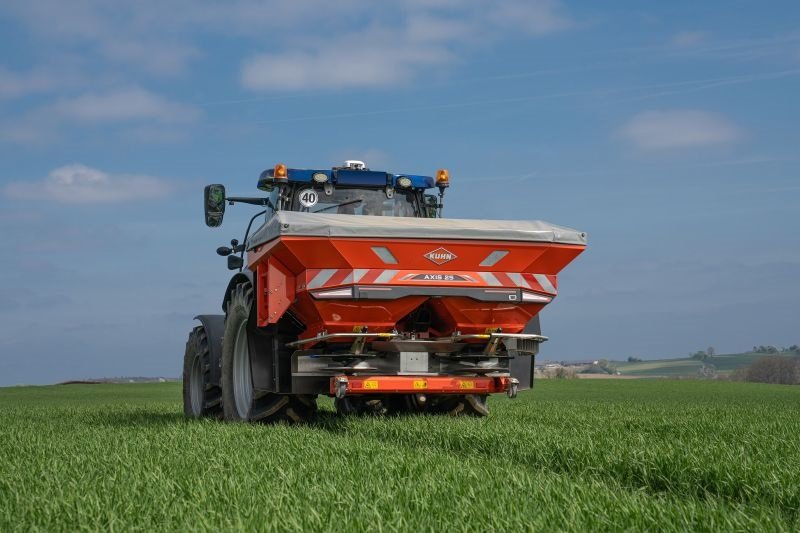

Fertiliser is one of the most important variable costs in many commercial farming operations, making the accuracy and efficiency of application increasingly important.
The challenge is not simply getting fertiliser onto a field. Farmers need to apply the intended rate, distribute it evenly, minimise overlap and complete the operation within the right agronomic window.
This is where the KUHN AXIS 25 becomes interesting.
Rather than looking at it simply as another mounted fertiliser spreader, its combination of capacity, spreading width and electronic control raises a broader question for African agriculture: can greater precision translate into lower operating costs and better use of expensive inputs?
KUHN’s AXIS 25 is specified with a maximum payload of 2,500 kg, while hopper capacity can range from 1,500 to 2,500 litres depending on configuration.
The machine offers working widths from 12 to 42 metres and can be equipped with VariSpread V18 section control, Electronic Mass Control (EMC), CDA spreading technology and ISOBUS electronics. TELIMAT X is also available for boundary spreading.
For Africa, however, the important question is not whether these technologies are advanced.
It is whether they can create enough economic value on a commercial farm to justify the investment.
Capacity matters when downtime has a cost
The AXIS 25’s maximum 2,500 kg payload can potentially reduce the number of times a farmer has to stop spreading to refill.
On a large commercial farm, this can become important because fertiliser application is not simply a matter of machine capacity. Every interruption involves the tractor, operator, loading equipment and time spent travelling between the field and fertiliser supply point.
The economic value of additional capacity can therefore be considered through a simple farm-specific calculation: refills avoided × time saved per refill × cost of the field operation. The result will vary substantially between farms.
Where fertiliser is stored close to the field and loading is rapid, the benefit may be modest. Where fields are extensive and loading points are distant, reducing interruptions could be considerably more valuable.
This makes the AXIS 25’s capacity particularly relevant to larger African commercial operations where fertiliser must be distributed over substantial areas within limited application windows.
The machine’s capacity should nevertheless be assessed together with tractor lifting capability, loading infrastructure and transport logistics rather than considered as an isolated specification.
Wide spreading can improve field productivity
The AXIS 25’s 12–42 metre working width is another potentially important productivity feature. In simple terms, increasing working width allows more hectares to be covered during each pass.
The theoretical field capacity can be estimated using working width, travel speed and field efficiency, although actual performance will always be affected by turning, refilling, field shape, obstacles and other interruptions.
For a large commercial farm, the economic benefit of greater width can come from reduced tractor hours, lower operator time and the ability to complete fertiliser applications within a narrow agronomic window.
That last point can be particularly important where rainfall and crop development determine when fertiliser should be applied.
However, maximum working width should not automatically be interpreted as maximum economic value.
African commercial farms vary greatly in field size, shape, terrain and production systems.
A 42-metre spreading width may be highly productive on large, relatively uniform fields but less useful where fields are irregular or constrained.
The relevant question for a farmer is therefore not whether the machine can spread 42 metres, but how many hectares the farm can realistically cover at an economically useful width.
Section control could reduce a measurable input cost
The AXIS 25’s VariSpread V18 system provides 18-section control. This becomes particularly relevant around headlands, field boundaries and irregular areas where conventional spreading can create overlap.
When a spreader continues applying fertiliser to ground that has already been treated, the farmer is effectively paying for additional input without necessarily receiving a corresponding increase in productive area.
The economic value of reducing this overlap can be calculated without inventing an assumed saving.
A farmer can measure the area affected by overlap and multiply it by the quantity of fertiliser applied and its delivered cost. The larger the cropped area, the higher the fertiliser expenditure and the more frequently fertiliser is applied, the greater the potential financial significance.
This is one reason precision spreading could become more attractive to African commercial farms as input costs rise.
Section control is not valuable simply because it is a sophisticated electronic feature. Its value comes from preventing an identifiable source of input inefficiency.
EMC focuses on consistency
The AXIS 25’s Electronic Mass Control (EMC) takes precision further by monitoring the torque required to drive the spreading discs and using that information to adjust fertiliser flow independently on the left and right sides.
KUHN says the system measures disc drive torque continuously and adjusts fertiliser flow when conditions change.
The economic argument for EMC should be made carefully. It would be inappropriate to claim that the system automatically increases crop yields.
A more defensible proposition is that more consistent application can help reduce avoidable under- and over-application, potentially improving fertiliser-use efficiency.
The actual value will depend on the crop, soil, weather, fertiliser product and existing application accuracy.
A commercial farmer could therefore evaluate EMC by comparing measured fertiliser application performance before and after adoption rather than relying on a generic percentage improvement.
This distinction is important in Africa, where fertiliser economics differ substantially between countries and farming systems.
Where fertiliser represents a significant production cost, even relatively small improvements in application efficiency can become financially relevant.
Where fertiliser use is already low or the farm has limited capacity to exploit precision technology, the return may be harder to justify.
ISOBUS could make the spreader part of a larger system
The AXIS 25 can also be specified with ISOBUS electronics, creating a pathway for the spreader to operate as part of a connected tractor and precision-agriculture system.
This is potentially more significant than simply having another electronic feature on the implement.
For a commercial farm already using guidance, digital field boundaries, GPS-based application or prescription maps, ISOBUS can help integrate the fertiliser spreader into existing workflows.
In such a situation, the additional value of the AXIS 25 may come from how it interacts with technology the farm has already invested in.
The situation is different for a farm starting from conventional spreading. ISOBUS capability may require additional investment in compatible tractor terminals, GPS equipment, software, training and technical support.
The economic calculation must therefore consider the complete technology system rather than the spreader alone.
This is likely to be an important adoption consideration for Africa. Precision machinery does not create precision agriculture by itself. The surrounding farm infrastructure has to be capable of using the information and automation that the implement provides.
Boundary spreading has both economic and environmental implications
The AXIS 25 can also be equipped with TELIMAT X, a remotely controlled boundary-spreading system intended to control fertiliser application at field edges.
The economic logic is straightforward: fertiliser that lands outside the intended productive area provides little or no direct return to the farmer. Controlling the spreading pattern around field boundaries can therefore help keep more of the purchased fertiliser within the target area.
There can also be an environmental consideration where fields are located close to waterways, roads, neighbouring properties or sensitive areas.
However, the value of boundary control will again depend on individual farm layouts. A farm with simple, regular fields may have fewer opportunities to benefit than an operation with complex boundaries and numerous headlands.
When could the investment make sense?
The business case for an AXIS 25 should ultimately be built around measurable farm economics rather than specifications.
A commercial farmer would need to establish how many tonnes of fertiliser are applied each season, how many hectares are covered, how much time is spent refilling, how much overlap actually occurs and what the farm’s current tractor and labour costs are.
The machine’s potential annual benefit could then be compared with its actual delivered purchase price, financing, depreciation, maintenance, dealer support and any additional technology or training requirements.
No single purchase price or saving should be assumed for Africa because these variables differ between countries, suppliers and individual farms.
The strongest case is likely to occur where several factors come together: a large cropped area, substantial fertiliser expenditure, costly downtime, measurable overlap and existing precision-agriculture infrastructure.
In such circumstances, the AXIS 25 does not need to generate one dramatic saving. Its economic value could come from several smaller improvements — fewer refills, greater field capacity, reduced overlap, more consistent application and better integration with existing digital systems.
A potential fit for Africa’s larger commercial farms
The AXIS 25 should therefore not be presented as a universal fertiliser solution for African agriculture.
The continent’s farming systems are too diverse, and the economics of machinery vary enormously between smallholders, emerging commercial farmers and highly mechanised agricultural businesses.
Its potential fit is more specific. Large commercial farms with extensive fields, significant fertiliser expenditure and growing investment in precision agriculture are more likely to have the scale necessary to exploit its capabilities.
For these operations, the question is whether improved fertiliser management can generate enough measurable value to justify the additional technology.
That makes the AXIS 25 an interesting machine to watch from an African perspective.
Its 2,500 kg capacity addresses productivity; its 12–42 metre working width addresses field capacity; VariSpread V18 targets overlap and section management; EMC focuses on application consistency; and ISOBUS provides a route into a more connected farming system.
None of these features guarantees profitability. But together they create a framework for a commercial farmer to measure whether precision fertiliser application can pay.
For African agriculture, that may ultimately be the most important question surrounding the AXIS 25: not whether the technology is available, but whether the value of saving fertiliser, time and field capacity is high enough to make precision spreading economically worthwhile.
Also Read
- The essential guide to manure spreaders
- Fertilizer spreaders: Essential tools for precision agriculture
- Inside Kakuzi’s Digital Farm Strategy: Precision Agriculture, data and AI

Martin is a writer at Agrimachinery Africa specializing in agricultural machinery, mechanization trends, and farm technology across Africa. His work focuses on tractors, harvesting equipment, irrigation systems, and emerging innovations helping farmers improve productivity and efficiency. Through in-depth industry coverage, he highlights technologies shaping the future of modern agriculture.