


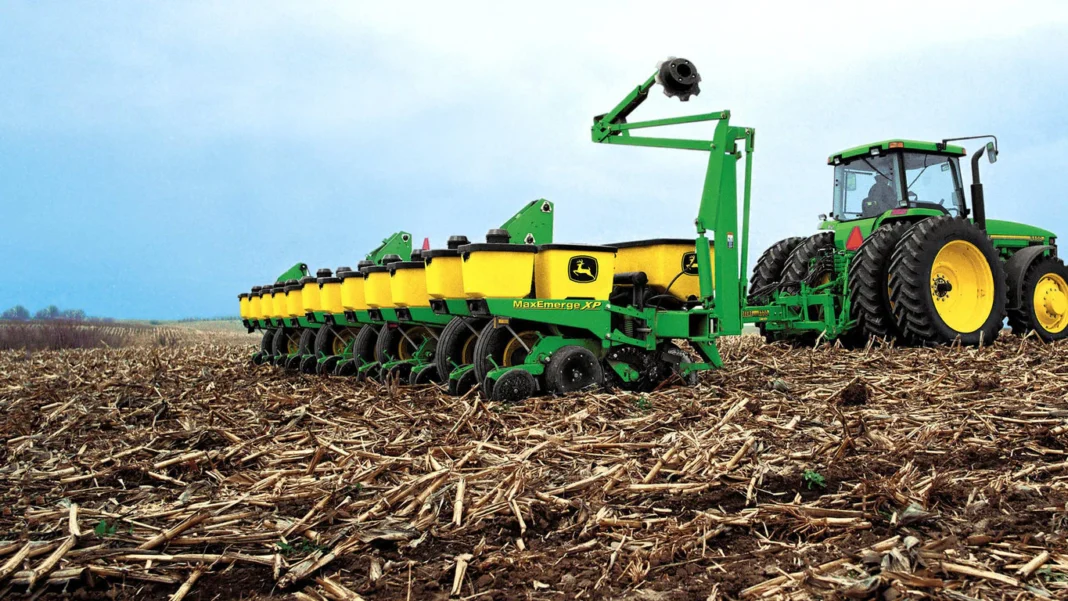

Precision planting is becoming an increasingly important part of modern farm mechanisation.
For crops such as maize, sunflower, cotton and some vegetables, placing seed at a consistent depth and spacing can help farmers establish a more uniform crop stand and make better use of seed, land and other inputs.
Africa’s precision planter market includes global agricultural machinery manufacturers, specialist planting-equipment companies and African manufacturers. However, these companies do not all operate in the same way.
Some manufacture equipment in Africa, while others supply African farmers through regional dealers and distributors.
For farmers, therefore, the most useful question is not simply which manufacturer is the biggest. It is whether a planter matches the crop, farm size, tractor, soil conditions and available technical support.
Here are some of the leading precision planter manufacturers and brands serving African agricultural markets.
What Is a Precision Planter?
A precision planter is designed to meter and place individual seeds at controlled intervals within a row.
Unlike a conventional broadcast seeder, which distributes seed over an area, a precision planter uses row units and seed-metering systems to control where individual seeds are placed.
Important components can include:
- Seed meters
- Seed discs
- Seed hoppers
- Furrow openers
- Depth-control wheels
- Closing wheels
- Fertilizer systems
- Seed sensors
- Vacuum systems
- Electronic monitoring systems
The objective is to achieve the required plant population while maintaining consistent seed spacing and depth.
Precision planters are particularly relevant to row crops where plant-to-plant spacing is an important part of the production system.
How We Selected the Manufacturers
This is not a ranking of which company makes the “best” planter.
Instead, the list considers manufacturers and brands with documented precision planting equipment and an established or identifiable presence in African agricultural markets.
The distinction matters. A global manufacturer supplying equipment to Africa should not automatically be described as an African manufacturer.
For example, John Deere has a dedicated Africa/Middle East planting-equipment range, but that does not mean every John Deere planter sold in Africa is manufactured on the continent.
Ndume, by contrast, is an East African agricultural machinery manufacturer offering planters for local farmers.
1. John Deere
John Deere is one of the major global agricultural machinery manufacturers serving African farmers with a broad range of planting equipment.
Its Africa-focused product portfolio includes both integral and drawn planters. The range includes smaller machines such as the 1010 as well as larger equipment designed for medium and large-scale operations.
John Deere lists planters for crops including corn, cotton, peanuts and vegetables.
The John Deere 1010, for example, is available in up to four rows and offers row spacing options from 66 to 100 cm.
It uses mechanical seed plates and can be equipped with dry granular fertilizer and optional insecticide systems. Depending on configuration, John Deere lists tractor requirements of about 53 to 105 hp.
At the other end of the range, the 2100 series is aimed at medium and large-scale growers and is available in configurations ranging from eight to 34 row units. John Deere specifically positions these machines for no-till systems.
This range makes John Deere particularly relevant to African farmers operating at very different scales.
2. Massey Ferguson
Massey Ferguson is another major international machinery brand with a precision planting range specifically marketed through its African product portfolio.
The MF 500 Series is a trailed vacuum precision meter planter available in nine configurations. Depending on the model, the machines range from four to 15 rows, with working widths from 3.6 to 7.2 metres.
The manufacturer lists minimum power requirements ranging from 60 hp to 225 hp across the configurations.
The MF 500 uses precision seed metering and gauge wheels to control planting depth. Its configurations also allow farmers to select different row spacings, including 45, 75 and 90 cm options.
For African farmers, the significance of the range is its spread of machine sizes. A farmer does not necessarily need to move directly to a very large commercial planter; the range includes smaller configurations that can be matched with lower-horsepower tractors.
3. Monosem
Monosem is particularly relevant because precision planting is central to its equipment portfolio.
The company is known for precision planters and seed-metering technology, with equipment designed for crops requiring controlled individual seed placement.
Its African presence is especially visible in South Africa, where Monosem equipment is marketed through an established local operation.
The African-focused Monosem site lists equipment including Wing-Max, Quad-Max, rigid pull-type, lift-type and vegetable planters.
Monosem’s South African operation also highlights its vegetable and fine-seed planters. It reports more than 400 of its MS vegetable planters operating in South Africa.
This makes Monosem an interesting option for farmers looking beyond general-purpose agricultural machinery manufacturers and specifically seeking precision planting equipment.
Its equipment is relevant to crops such as maize, sunflower and vegetables, where accurate seed placement can be important.
4. Ndume
Ndume provides an important African perspective in the precision planter market.
Based in Kenya, Ndume manufactures agricultural machinery for farmers in the region and offers a two-row maize planter designed around a relatively simple mechanical approach.
The Ndume precision planter uses a vertical spoon pick-up seed disc. Seed spacing can be changed through the planter’s gearbox, while planting depth is controlled using adjustable press wheels. The planter also has a fertilizer metering system and separate seed discs for larger and smaller seeds.
One of the notable characteristics of the Ndume approach is simplicity.
Rather than relying on a large number of electronic components, the machine uses mechanical systems that farmers can adjust and maintain.
That can be significant in markets where access to sophisticated diagnostic equipment or specialised technicians is more limited.
Ndume therefore represents a different proposition from the high-capacity precision planting systems offered by major global manufacturers.
5. KUHN
KUHN has a broad portfolio of precision seed drills and planters covering different farm sizes and planting systems.
Its range includes mechanical and pneumatic precision seed drills, with models designed for smaller farms as well as larger operations. KUHN’s precision range includes the PPK, PG, FLEX M, GRAN PG, PRIME and PLANTER 3.
The PG mechanical precision seed drill, for example, is available in seven- to 17-row configurations. KUHN says the machine is designed to provide consistent seed depth and can be configured for different soil conditions.
Its PLANTER 3 pneumatic range offers multiple frame configurations and row spacings from 25 to 80 cm. The range includes three- to 12-row configurations, with additional options for larger farms.
KUHN also incorporates electronic monitoring and ISOBUS options into some precision planting systems, allowing farmers to monitor planting performance and use GPS-based row shut-off functions.
Availability varies by country, so farmers need to confirm which models and configurations are supported by their local dealer.
What Should African Farmers Look for in a Precision Planter?
The most expensive planter is not automatically the best choice.
Farmers should start with the production system and then select the machine.
Crop compatibility
A planter designed for maize may not be the appropriate machine for wheat or other small grains.
Check the manufacturer’s recommended crops, seed-metering options and available seed discs.
Row spacing
Row spacing should match the crop and agronomic requirements.
A planter offering several row-spacing options can be more useful for farmers growing multiple crops.
Tractor requirements
The planter must be compatible with the tractor’s horsepower, hydraulic capacity, hitch system and lifting capability.
This is particularly important when comparing large trailed planters.
Seed-metering system
The metering system is one of the most important parts of a precision planter.
Farmers should examine how the machine handles different seed sizes and shapes and how easily the meter can be calibrated.
Planting depth
Depth-control systems help maintain consistent seed placement as field conditions change.
Gauge wheels, downforce systems and row-unit design all influence how well the planter maintains depth.
Fertilizer application
Some planters allow fertilizer to be placed during planting.
This can reduce the number of field operations, but farmers should consider fertilizer capacity, metering accuracy and the additional tractor requirements.
Parts and technical support
For African buyers, dealer support can be as important as planter specifications.
Before purchasing, farmers should ask:
- Are replacement seed discs available locally?
- How quickly can common wear parts be supplied?
- Is there a trained technician nearby?
- Is operator training provided?
- What does the warranty cover?
- Can the planter be serviced by the farm’s existing mechanics?
A technically advanced planter that remains idle because a small replacement part is unavailable can be more expensive than a simpler machine that can be repaired quickly.
Precision Planters and African Farm Sizes
Africa does not have one typical farm size, so manufacturers have developed machines covering very different operating scales.
A small or medium-sized farmer may need a two-, four- or six-row planter that can operate with a relatively modest tractor.
A large commercial operation may require a planter with 12, 16, 24 or more rows to cover large areas during a narrow planting window.
John Deere’s African range illustrates this difference particularly well, extending from the four-row 1010 to 2100-series machines with configurations reaching 34 rows.
The same principle applies to other manufacturers: the correct machine is determined by the farm’s acreage, crop, available tractor and required field capacity.
Is More Technology Always Better?
Not necessarily.
Modern planters can include GPS, variable-rate seeding, electronic seed monitoring, hydraulic or electric drives, automatic section control and other technologies.
These systems can provide valuable information and control, but they also add cost and complexity.
For a large commercial farm already using precision agriculture software, advanced electronic controls may provide significant benefits.
For a smaller operation, a mechanically driven planter with accurate seed metering, simple calibration and readily available parts may be the more practical investment.
The important question is whether the technology solves a real problem on the farm.
The Future of Precision Planting in Africa
Precision planting is likely to become increasingly relevant as African farmers face pressure to improve productivity while managing the cost of seed, fertilizer, fuel and labour.
The next stage will involve greater integration between planters, tractors and digital farm-management systems.
Variable-rate seeding can allow plant populations to be adjusted according to field conditions, while GPS guidance can help reduce overlap.
Electronic monitoring can also alert operators when rows experience skips or other planting problems.
However, adoption will depend not only on machine technology but also on affordability, dealer networks, farmer training and access to reliable after-sales service.
For many African farmers, the most useful precision planter may therefore be the one that provides the necessary level of seed-placement accuracy without creating an unsustainable maintenance or financing burden.
The precision planter market serving Africa includes global manufacturers such as John Deere, Massey Ferguson and KUHN, specialist planting-equipment companies such as Monosem, and African manufacturers such as Ndume.
These companies offer very different approaches to precision planting.
John Deere provides a broad range extending from smaller integral planters to high-capacity machines for large-scale no-till operations.
Massey Ferguson’s MF 500 range covers several row configurations and tractor sizes.
Monosem brings specialist precision-planting expertise, particularly evident in its South African market presence.
KUHN offers a wide range of mechanical and pneumatic precision seed drills, while Ndume demonstrates how simpler locally manufactured equipment can address the needs of East African farmers.
For buyers, the decision should ultimately come down to crop, acreage, row spacing, tractor compatibility, soil conditions, seed-metering requirements, parts availability and after-sales support.
Precision planting is not simply about buying the most technologically advanced machine.
It is about selecting equipment that can consistently place the right amount of seed in the right position — and continue doing so reliably throughout the planting season.
Also Read
- Precision Planting and Precision Seeding: How Modern Seed Drills and Planters Improve Crop Establishment
- Avant 02 – seed drill combination with mounted front tank FTender

Martin is a writer at Agrimachinery Africa specializing in agricultural machinery, mechanization trends, and farm technology across Africa. His work focuses on tractors, harvesting equipment, irrigation systems, and emerging innovations helping farmers improve productivity and efficiency. Through in-depth industry coverage, he highlights technologies shaping the future of modern agriculture.