


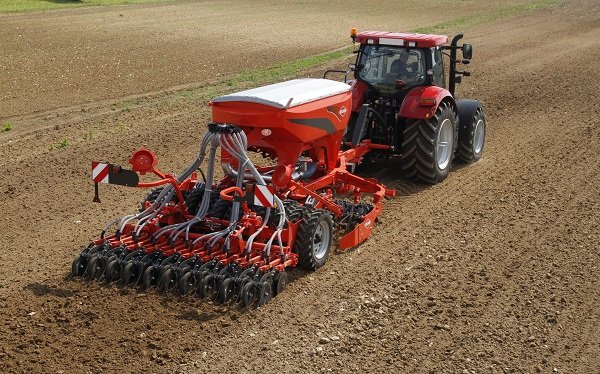

In modern agriculture, getting seeds into the soil is only the beginning. Where each seed is placed, how deep it is planted, and how evenly plants emerge can have a major influence on crop establishment and the efficient use of land, water, nutrients and other farm inputs.
This is where precision planting and precision seeding have become increasingly important.
Modern planting and seeding equipment allows farmers to control seed placement, row spacing, planting depth and seed rate with far greater accuracy than traditional broadcasting methods.
Depending on the crop and machine, technologies such as precision seed meters, GPS guidance, electronic controls, sensors and variable-rate systems can further improve the consistency of planting operations.
Seed drills and precision planters both play important roles, but they are designed for somewhat different planting applications.
Understanding the difference between these machines — and how modern technology is changing them — is important for farmers looking to improve crop establishment and make better use of expensive seed and other farm inputs.
What Is Precision Planting and Precision Seeding?
Precision planting refers to the controlled placement of seeds in the soil according to a planned spacing, depth and plant population.
Precision seeding is closely related and generally refers to the accurate metering and placement of seed to achieve a desired seed rate, spacing and depth.
The two terms are sometimes used interchangeably, although precision planting is often used more specifically when discussing individual seed placement and precision planters.
The objective is to create conditions in which seeds have a more consistent opportunity to germinate and establish.
Traditional broadcasting involves distributing seed over a relatively large area. While effective for some crops and farming systems, broadcasting provides less control over the exact location and depth of individual seeds.
Modern planting equipment, by contrast, uses mechanical or electronic seed-metering systems, openers and depth-control mechanisms to place seed according to predetermined settings.
In more advanced systems, GPS guidance, sensors and digital controls can help operators maintain accurate rows and adjust planting rates according to field conditions.
How Does Precision Seeding Work?
Precision seeding starts with seed metering.
The metering system controls how much seed leaves the machine and, in precision planters, can separate individual seeds so they are delivered at a controlled interval.
The seed is then transported from the meter to the soil through a delivery system before being placed into a furrow created by the machine’s opener.
Several factors determine the quality of the final seed placement:
- Seed spacing
- Planting depth
- Row spacing
- Seed population
- Seed rate
- Forward speed
- Soil conditions
- Seed size and shape
After placement, closing wheels or other mechanisms cover the seed with soil.
The objective is not simply to put seed into the ground. It is to establish a consistent crop stand suited to the requirements of the particular crop and field.
The Role of Seed Drills in Modern Seeding
Seed drills remain among the most important machines used for establishing crops, particularly cereals and other crops that are planted at relatively high seed populations.
A seed drill meters seed and places it into rows at a controlled depth and rate.
Depending on the design, a drill may use mechanisms such as:
- Seed boxes or hoppers
- Metering systems
- Coulters or disc openers
- Depth-control mechanisms
- Seed tubes
- Press wheels
- Covering or closing systems
Unlike broadcasting, where seed is distributed across the soil surface, a drill places seed into prepared furrows or slots.
This provides greater control over row placement, seed depth and seed rate.
Modern drills can also incorporate electronic controls, GPS guidance, variable-rate systems and monitoring technology.
However, it is important not to assume that every seed drill provides the same level of individual seed placement as a precision planter.
Seed Drill vs Precision Planter: What’s the Difference?
Seed drills and precision planters are both used to establish crops, but they have different strengths and applications.
| Feature | Seed drill | Precision planter |
|---|---|---|
| Typical crops | Wheat, barley, oats and other cereals | Maize, sunflower, cotton and other row crops |
| Seed placement | Controlled placement in rows | Highly controlled individual seed placement |
| Seed spacing | Controlled according to seed rate and machine settings | Designed for precise plant-to-plant spacing |
| Metering | Controls seed flow/rate | Often uses precision singulation or individual seed metering |
| Main objective | Establish a uniform crop stand efficiently | Establish a specific plant population and spacing |
| Typical row configuration | Relatively close rows | Wider, crop-specific rows |
The distinction is particularly important when discussing precision seeding.
A modern seed drill can provide accurate seed rates and consistent placement, but a precision planter is specifically designed to control the placement of individual seeds at predetermined intervals.
For example, a farmer planting wheat may use a seed drill to establish a relatively dense crop across many closely spaced rows.
A maize farmer, meanwhile, may use a precision planter to establish individual plants at a specific distance within each row.
Neither machine is universally better. The appropriate system depends on the crop, soil, farming system, desired plant population and operating conditions.
Key Features of Modern Seed Drills and Precision Planters
1. Accurate Seed Placement
One of the most important functions of modern planting equipment is controlling where the seed enters the soil.
Planting depth matters because seeds need suitable conditions for germination and early development.
If seeds are placed too shallow, they may be more exposed to drying conditions, birds or other environmental stresses. If they are placed excessively deep, seedlings may struggle to emerge.
Depth-control systems help maintain a more consistent planting depth as the machine moves across the field.
2. Controlled Seed Spacing
Plant spacing influences how plants compete for water, nutrients, sunlight and growing space.
Precision planters are designed to place individual seeds at predetermined intervals.
This can help farmers establish a more consistent plant population and reduce problems associated with excessive gaps or doubles.
Seed drills generally focus more on achieving a desired seed rate and row distribution rather than the individual seed spacing associated with precision planters.
3. Precision Seed Metering
Seed metering is at the heart of modern planting equipment.
A metering system controls how seed moves from the hopper into the delivery system.
On precision planters, advanced meters can be designed to separate individual seeds before delivering them to the seed tube or other delivery mechanism.
The quality of seed metering can influence spacing accuracy and the number of skips or doubles in the planted row.
4. Variable-Rate Seeding
Some modern machines can vary the seed rate according to a prescription map or changing field conditions.
This is known as variable-rate seeding.
Using information about soil characteristics, historical yields, field zones or other agronomic data, farmers can establish different target plant populations in different parts of a field.
For example, a field with areas of different productive potential may not require exactly the same seeding rate everywhere.
Variable-rate technology can therefore help farmers move away from applying one uniform rate across the entire field.
5. GPS Guidance
GPS and satellite-based guidance systems can help tractors and planting equipment maintain accurate passes across the field.
This can reduce unnecessary overlap and help maintain consistent row spacing.
More advanced systems can also integrate positioning data with planting controls, prescription maps and automatic section control.
6. Sensors and Electronic Monitoring
Modern planting equipment increasingly uses sensors to monitor the planting operation.
Depending on the machine, sensors may detect issues such as:
- Missed seeds
- Double seeds
- Seed flow problems
- Changes in seed population
- Machine performance
- Row-unit performance
The information can be displayed to the operator in the tractor cab, allowing problems to be identified while planting is still underway.
7. Reduced Seed Waste
Accurate metering and placement can help farmers use seed more efficiently.
This is particularly relevant where seed is expensive or where the crop requires a carefully controlled plant population.
Precision planting does not automatically eliminate seed waste, but improved control can reduce problems such as excessive seeding, skips and unnecessary overlap.
8. Adaptability to Different Crops
Planting equipment is available for a wide range of crops.
Seed drills are commonly associated with crops such as:
- Wheat
- Barley
- Oats
- Rye
- Rice
- Other small grains
Precision planters are widely associated with row crops such as:
- Maize
- Sunflower
- Cotton
- Sugar beet
- Some vegetable crops
- Other crops requiring controlled individual seed spacing
Machine configuration, seed-metering systems and row-unit design vary according to the crop.
Benefits of Precision Planting and Seeding
1. More Consistent Crop Establishment
One of the primary benefits of controlled seed placement is greater consistency in crop establishment.
When seeds are placed at suitable depths and rates, farmers can create a more uniform starting point for the crop.
However, final emergence still depends on factors including seed quality, soil moisture, temperature, soil structure and weather.
Precision equipment cannot compensate for unsuitable field conditions.
2. Better Control of Plant Population
Farmers often have a target plant population for a particular crop and production system.
Precision planters can help achieve that target by controlling individual seed spacing.
This can be particularly important for crops where plant population and spacing have a strong influence on crop management and yield potential.
3. More Efficient Use of Seed
Accurate seed metering allows farmers to control how much seed is being planted.
Instead of applying a uniform amount without accounting for field conditions, variable-rate systems can allow seeding rates to be adjusted where appropriate.
This can help improve input management.
4. Faster Planting
Modern planting equipment allows farmers to cover large areas during relatively short planting windows.
This is particularly important where weather conditions create a limited period in which soil conditions are suitable for planting.
Getting the crop established within the appropriate planting window can be an important part of farm management.
5. Reduced Overlap
GPS guidance and automatic section control can help reduce unnecessary overlap when planting irregularly shaped fields or returning to previously planted areas.
Reducing overlap can prevent unnecessary application of seed and other inputs.
6. Improved Data Collection
Modern planting equipment can generate useful operational data.
Depending on the system, farmers may be able to monitor:
- Planted area
- Seed population
- Planting speed
- Seed spacing
- Machine performance
- Field location
- Variable-rate prescriptions
This information can become part of a wider precision agriculture system in which planting data is combined with soil maps, yield data and other field information.
Does Precision Planting Increase Crop Yield?
Precision planting can support better yield potential, but it is important not to assume that a precision planter automatically increases yields.
Yield depends on many factors, including:
- Genetics
- Soil fertility
- Rainfall and irrigation
- Pest and disease management
- Planting date
- Soil conditions
- Weather
- Plant population
- Crop management
The role of precision planting is to give farmers greater control over some of the variables involved in crop establishment.
More uniform spacing and depth can help create a consistent crop stand, while accurate plant populations can help farmers match planting rates to their production system.
The actual yield benefit will vary from farm to farm.
Precision Planting and Soil Management
Modern seeding equipment can also form part of reduced-tillage and conservation agriculture systems.
Some drills are designed to place seed while disturbing relatively little soil outside the planting zone.
This can help farmers maintain more soil cover and reduce unnecessary soil disturbance, depending on the machine and farming system.
However, the relationship between precision planting and soil health depends on the entire production system rather than the planter alone.
Crop rotation, residue management, cover crops, tillage practices, organic matter and water management all influence soil condition.
The Role of Variable-Rate Technology in Precision Seeding
Variable-rate technology is becoming increasingly important in precision agriculture.
Rather than treating an entire field as if it has identical characteristics, farmers can divide fields into management zones based on available information.
These zones may be created using:
- Soil sampling
- Yield maps
- Satellite imagery
- Drone data
- Soil conductivity measurements
- Historical field records
- Agronomic recommendations
A planting prescription can then specify different target seed populations for different parts of the field.
The planter or drill can use GPS positioning to determine where it is operating and adjust the rate accordingly.
The usefulness of this technology depends heavily on the quality of the data and the agronomic decisions behind the prescription.
How AI and Automation Could Change Precision Seeding
The next generation of planting equipment is becoming increasingly connected and automated.
Manufacturers are integrating more sensors, cameras, electronic controls and data-processing capabilities into planting systems.
These technologies could allow machines to identify changes in field conditions and make adjustments during operation.
Artificial intelligence and machine learning could also play a greater role in analysing field and machine data.
Automation is another area of development.
Advanced tractor and implement systems can already automate certain steering, section-control and planting functions. Further development could allow more planting operations to be managed with less direct operator intervention.
However, fully autonomous planting remains dependent on machine capability, field conditions, safety systems, connectivity and the regulatory environment.
Choosing Between a Seed Drill and a Precision Planter
The right machine depends on the crop and the farmer’s production system.
A seed drill may be the more appropriate choice where the objective is to establish crops such as wheat or barley across many closely spaced rows.
A precision planter may be more appropriate where individual seed spacing and plant population are critical, such as maize or sunflower production.
Farmers should consider:
- Crop type
- Required row spacing
- Target plant population
- Seed characteristics
- Farm size
- Soil conditions
- Tillage system
- Available tractor power
- Seed and input costs
- Availability of local service and spare parts
Technology should serve the farming system rather than being adopted simply because a machine has more electronic features.
The Future of Precision Seeding
Precision seeding is moving beyond simply placing seed at a controlled depth and rate.
Modern planting equipment is becoming part of a wider digital farming ecosystem connecting tractors, implements, GPS systems, sensors, farm-management software and agronomic data.
The direction of development is toward machines that can measure, decide and adjust more of the planting operation automatically.
For farmers, the objective remains relatively simple: establish the right crop population, at the right depth and spacing, under suitable soil conditions.
The machinery used to achieve that objective, however, is becoming increasingly sophisticated.
Also Read

Martin is a writer at Agrimachinery Africa specializing in agricultural machinery, mechanization trends, and farm technology across Africa. His work focuses on tractors, harvesting equipment, irrigation systems, and emerging innovations helping farmers improve productivity and efficiency. Through in-depth industry coverage, he highlights technologies shaping the future of modern agriculture.