


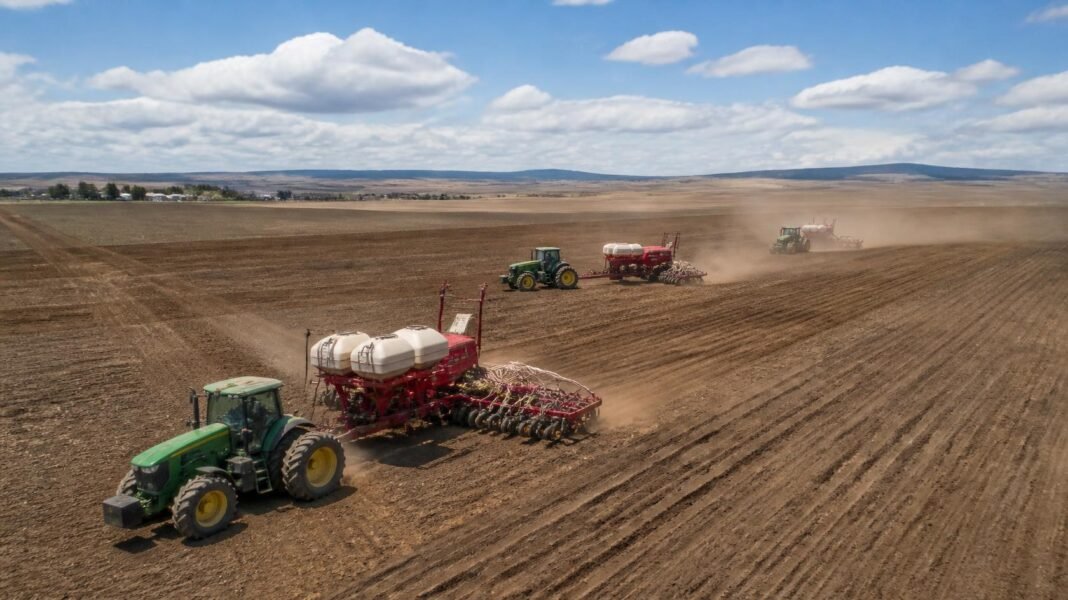

South Africa’s next agricultural machinery cycle may be shaped less by the expansion of farmland and more by the need to produce more from the land already under cultivation, according to the latest BFAP Baseline 2026 outlook.
That shift could favour machinery and technologies that improve productivity per hectare, from high-capacity tractors and combines to precision planting, automated irrigation and connected farm equipment.
BFAP does not forecast South African machinery sales. But its outlook for the agricultural sector points to a market where productivity is becoming increasingly important as farmers face constraints on land, water, labour and operating costs.
The underlying change is already visible.South Africa has about 15.8 million hectares planted to field crops, limiting the scope for agricultural growth to come simply from putting substantially more land into production.
At the same time, productivity has been rising. Maize yields have increased by an average 3.5% a year over the past decade, compared with 2.6% over the preceding five decades.
Machinery investment has been part of that productivity story. BFAP says machinery investment doubled between 2019 and 2023, while larger machinery units have helped farmers capture scale efficiencies within increasingly narrow planting and harvesting windows.
The result is an agricultural economy that is gradually asking more of every hectare — and, by extension, more of every machine working on it.
South Africa’s current three-year average maize yield stands at 6.28 tonnes per hectare, 36% above its level a decade ago.
BFAP also estimates that maize yield per millimetre of rainfall has increased by 312% since 1983.
Those numbers matter for machinery manufacturers because they show where the market is heading.
The opportunity is no longer simply to sell a farmer a machine capable of covering more hectares. Increasingly, the machine needs to help the farmer get more output, greater precision and better resource efficiency from each hectare already being farmed.
That changes the equipment equation.
A high-capacity combine can shorten the harvesting window. A precision planter can improve seed placement.
Guidance and automated steering can reduce overlap. Variable-rate technology can target inputs more precisely. Telematics can help farmers monitor machine utilisation and operating costs.The common denominator is productivity.
Related Articles
Inside Kakuzi’s Digital Farm Strategy: Precision Agriculture, AI, Drones and Data
China’s Agricultural Machinery Revolution: From Low-Cost Tractors to AI and Autonomous Machines
Brazil’s Precision Agriculture Market Has a Technology Problem — But Not the One You Might Expect
Top Tractor Dealers in Mozambique: Where to Buy New, Used and Small Tractors in 2026
Horticulture could accelerate the shift
The case for intensification becomes even clearer in horticulture, where the economics of producing more from existing land are particularly strong.
BFAP expects horticultural planted area to remain relatively constrained after years of expansion, with future growth increasingly dependent on higher yields, improved cultivars, better production practices and technologies such as precision irrigation.
Citrus illustrates the point.
BFAP projects citrus planted area to grow by only about 0.5% annually, while gross production value is expected to increase by roughly 5% a year.
That gap between acreage growth and value growth is significant.
It suggests that a larger share of agricultural value will have to come from improving the productivity and profitability of existing orchards rather than continually expanding the planted area.
For equipment suppliers, that points towards a different type of opportunity.
The next investment may not always be a larger tractor. It could be a precision irrigation system, an orchard sprayer, harvesting equipment, automated handling technology or a digital system that allows growers to monitor crops and respond to problems earlier.
In other words, the value of machinery increasingly follows the value of the crop it helps protect or produce.
Water could become just as important as land
The same logic applies to water.
BFAP identifies water availability as a fundamental constraint on South African agriculture, while climate change is expected to increase pressure through higher temperatures and changing rainfall patterns.
Agriculture accounts for roughly 60% of national water consumption, making irrigation efficiency an increasingly important economic issue for farmers.
The machinery opportunity therefore extends beyond pumps and irrigation equipment.
It includes soil-moisture monitoring, automated irrigation, weather-linked systems, fertigation, remote controls and digital platforms that help farmers determine when and where water is needed.
The objective is not simply to move more water.
It is to produce more with every unit of water available.
That is increasingly the same productivity equation driving machinery investment across the farm.
Bigger machines will still have a role
The shift towards intensification should not be interpreted as a move away from large machinery.
BFAP’s analysis suggests that larger machinery has helped South African farmers capture scale efficiencies as operating windows become tighter.
That remains particularly important for grain producers.
When weather leaves only a limited number of suitable days for planting or harvesting, field capacity has a direct economic value. A machine that can cover more hectares in the available window can reduce delays and protect yield.
But horsepower alone is unlikely to define the next equipment cycle.
The more valuable proposition may be capacity combined with intelligence.
A high-horsepower tractor equipped with automated steering, telematics and precision implements can deliver capabilities that a similarly powered conventional machine cannot.
That also creates an opportunity for manufacturers to compete through technology rather than simply machine size.
Replacement demand could become more sophisticated
A land-constrained agricultural sector also changes the replacement market.
If farmers are not significantly increasing their cultivated area, manufacturers cannot rely entirely on additional hectares to generate equipment demand.
Replacement and upgrading become more important.
But the next replacement does not have to be a like-for-like purchase.
A farmer replacing an older tractor can move into a connected, precision-ready machine. An existing planter can be upgraded with more accurate application technology. Irrigation can be automated. A fleet can be connected through telematics.
That creates a market for productivity upgrades as well as new machines.
It also increases the importance of dealers and after-sales support. As equipment becomes more connected and software-dependent, diagnostics, training, technical support and parts availability become part of the value proposition.
The machinery market is moving beyond the field
The implications of intensification also extend into South Africa’s export-oriented horticulture sector.
BFAP expects exports to remain an important source of agricultural value, with citrus, table grapes and berries among the key products.
But producing more fruit is only part of the challenge.
Export crops have to be harvested, sorted, graded, packed, cooled and transported within tight quality windows.
BFAP highlights logistics, infrastructure, energy and market-access pressures as risks to horticultural profitability.
That broadens the equipment opportunity into the post-harvest chain.
Sorting and grading systems, pack-house automation, material-handling equipment, refrigeration, cold-chain systems and traceability technologies all become part of the productivity equation.
The machinery market is therefore becoming less about a tractor working alone in a field and more about a connected equipment ecosystem extending from production to export.
What this means for machinery manufacturers
BFAP does not provide a direct forecast for South African tractor or farm machinery sales.
But the direction of the agricultural economy provides several signals.
Farmers are likely to place greater value on equipment that can:
- increase field capacity during narrow operating windows;
- improve productivity per hectare;
- reduce water and input waste;
- improve labour productivity;
- provide real-time operating data;
- support climate-risk management; and
- protect crop quality beyond the field.
That favours precision-ready equipment, automation, telematics, efficient irrigation and specialised horticultural machinery alongside conventional tractors and implements.
It also suggests that the replacement market could become increasingly technology-led.
Productivity becomes the market
The central machinery story in the BFAP Baseline 2026 is therefore not simply how many tractors South Africa will need.
It is what farmers will expect those machines to deliver.
With limited scope for major increases in cultivated land, rising production costs and growing pressure on water resources, the economics increasingly favour equipment that can help farmers extract more value from every hectare, every machine hour and every unit of water.
South Africa does not necessarily need dramatically more farmland to increase agricultural output and value.
It needs to make the farmland it already has more productive, more efficient and more resilient.
For machinery manufacturers and dealers, that could make intensification — rather than land expansion — one of the defining forces shaping South Africa’s next agricultural equipment cycle.
Also Read
- Inside Kakuzi’s Digital Farm Strategy: Precision Agriculture, AI, Drones and Data
- Valtra Tractor Dealers in Africa: 12 Countries, Contacts and Buyer Guide (2026)
- Why Farm Machinery Makers Are Turning Sustainability into a Profit Strategy

Martin is a writer at Agrimachinery Africa specializing in agricultural machinery, mechanization trends, and farm technology across Africa. His work focuses on tractors, harvesting equipment, irrigation systems, and emerging innovations helping farmers improve productivity and efficiency. Through in-depth industry coverage, he highlights technologies shaping the future of modern agriculture.