


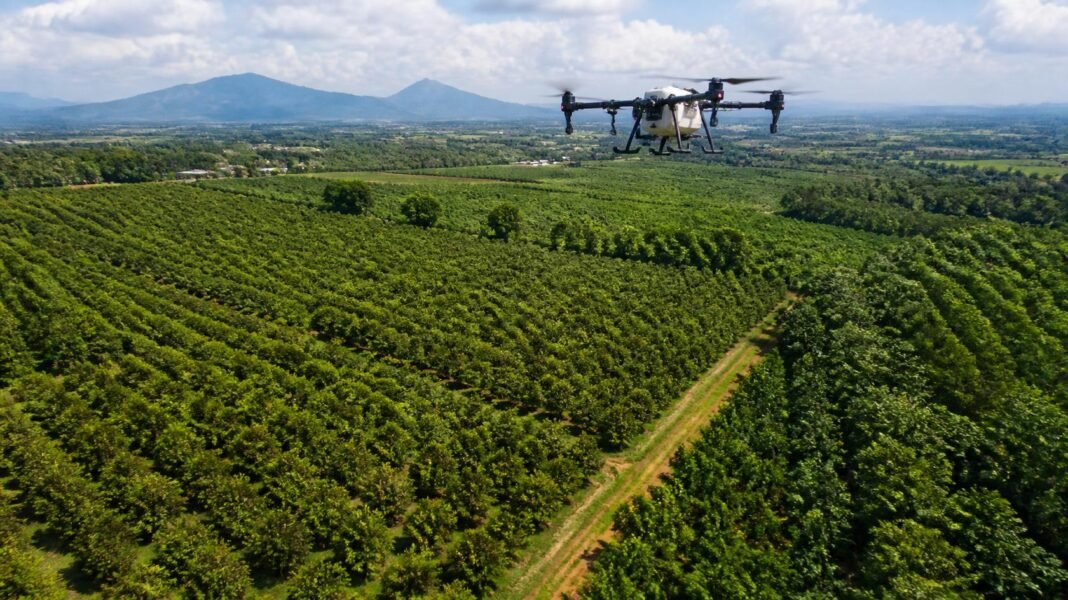

Kakuzi PLC is moving to make digital technology a more deeply embedded part of its farming operations, creating a dedicated Digital Agricultural Transformation Department as the Kenyan agribusiness responds to increasingly unpredictable climatic conditions.
The company says it is already implementing artificial intelligence (AI), machine learning and data analytics, while deploying agricultural technology in its fields and expanding drone-based surveillance.
But the clearest indication of the scale of the transformation comes from a Digital Agricultural Transformation Manager position advertised by Kakuzi on 7 August 2026.
The role goes well beyond introducing individual technology projects.
Kakuzi wants the manager to implement precision-agriculture platforms across operations, integrate multiple data sources, validate digital information against actual field conditions and turn agricultural data into daily and weekly management insights.
That points to a broader transition: from using agricultural technology as a collection of individual tools to building a connected digital management system for the farm.
Kakuzi is creating a dedicated digital agriculture function
Kakuzi Managing Director Chris Flowers said the company’s Ag-Tech adoption strategy is already underway and is being supported by the establishment of a fully fledged Digital Agricultural Transformation Department.
The department will be headed by a Digital Agricultural Transformation Manager, whose responsibilities include implementing and managing digital agriculture and precision-agriculture platforms across Kakuzi’s operations.
Kakuzi says the department is intended to accelerate the adoption of technology required to support its transition towards climate-smart agriculture.
This is important because it places digital agriculture within the company’s organisational structure rather than treating it simply as an IT project.
What Kakuzi has disclosed: A dedicated department is being established, with a manager responsible for driving digital agricultural transformation.
Agrimachinery Africa analysis: The structure suggests Kakuzi wants digital technology to become part of routine operational decision-making rather than remain confined to isolated pilot projects.
Related Articles
Precision agriculture will be at the centre
The job description specifically requires the new manager to implement and manage digital agriculture platforms and precision agriculture solutions across operations.
Kakuzi is also seeking someone with at least five years of experience implementing digital or precision-agriculture solutions, with experience in horticulture and tree crops preferred.
That requirement is particularly relevant to Kakuzi’s production profile, which includes avocado, macadamia, blueberry and tea operations.
Precision agriculture essentially allows farm decisions to account for differences within fields and crops rather than treating an entire farm as a uniform production area.
For a large commercial operation, this can eventually connect information such as field conditions, crop performance, weather, machinery and other operational data to decisions about where and when resources should be applied.
However, Kakuzi has not publicly disclosed the complete list of precision-agriculture platforms it intends to use.
That is one of the areas where further information from the company could reveal how advanced its digital farming architecture has become.
The data strategy may be even more important than the AI
One of the most revealing responsibilities in Kakuzi’s job advert is the requirement to integrate multiple data sources into a unified management reporting system.
The manager will also be responsible for producing weekly and monthly management reports and actionable insights.
This indicates that Kakuzi’s digital transformation is not simply about acquiring more technology.
The bigger challenge is likely to be making different sources of agricultural information work together.
A farm can have multiple digital systems generating information. But if those systems remain isolated, managers may still have to manually interpret different datasets before making operational decisions.
Kakuzi appears to be seeking a structure in which data from different sources can be brought together and translated into information managers can use.
What Kakuzi has disclosed: Multiple data sources are expected to be integrated into a unified management reporting system.
Agrimachinery Africa analysis: This could become one of the most consequential parts of the transformation. The value of AI and precision agriculture increases when data is connected rather than trapped inside separate technology platforms.
Kakuzi wants digital data checked against the real farm
There is another particularly interesting requirement in the job description: the new manager will have to verify digital data against field conditions to ensure accuracy and reliability.
This requirement recognises a fundamental challenge in agricultural technology.
A dashboard can show a crop-health indicator, moisture reading or operational metric, but the number still needs to correspond to what is happening on the ground.
Kakuzi’s reference to multiple, independent sources of truth and field verification suggests the company is placing considerable emphasis on data quality.
That could become increasingly important as AI and machine-learning systems are introduced.
An AI model is only as useful as the data used to train and operate it. Poor-quality, incomplete or incorrectly interpreted field data can produce misleading recommendations.
For a large commercial farm, therefore, data validation could be as important as data collection.
AI is already operating inside the macadamia processing plant
Kakuzi has already disclosed one concrete AI application.
Its Macadamia Processing Plant incorporates an AI-powered Intelligent Optical Sorting system that automates macadamia nut grading. The company says the system is intended to improve production quality.
Optical sorting is a particularly practical application of machine vision technology in agricultural processing.
Instead of relying entirely on manual inspection, cameras and software can examine products and classify them according to programmed quality characteristics.
Kakuzi has not publicly disclosed detailed performance figures for the system, such as throughput improvements, rejection rates or labour productivity.
Those figures would be useful for determining the commercial impact of the technology.
For now, what is clear is that AI is not merely something Kakuzi is discussing as a future possibility.
It already has a disclosed application inside the company’s macadamia-processing operation.
Drones are part of the wider technology push
Kakuzi has also said it is deploying the latest Ag-Tech technology in its fields alongside enhanced drone security-surveillance systems.
The company has not publicly provided a detailed breakdown of all the agricultural uses of its drones.
That distinction matters.
Some agricultural drones are used for crop imaging, mapping and crop-health assessment, while others can be configured for spraying or other field applications.
Drone systems can also be used primarily for security and estate surveillance.
Therefore, it would be premature to assume that Kakuzi’s drones are already being used for every possible precision-agriculture application.
What is disclosed: Kakuzi is deploying Ag-Tech in its fields and enhanced drone security surveillance.
What remains unanswered: Which drone platforms are being used, whether they carry agricultural sensors, how frequently they fly, and how their data is connected to Kakuzi’s wider digital agriculture system.
These are important questions because the commercial value of drones increasingly comes not simply from collecting aerial imagery, but from connecting that imagery with other farm data.
Climate change is helping drive the transformation
Kakuzi has directly linked its Ag-Tech strategy to climate uncertainty.
Flowers said increasingly uncertain and unpredictable traditional climatic patterns make it essential for agriculture to adapt and adopt new technology.
The company says its Ag-Tech journey is anchored in sustainability initiatives and resilient agronomy practices as it works towards climate-smart agriculture.
This provides an important context for understanding the technology investment.
Digital agriculture is not necessarily being positioned simply as a productivity tool.
For Kakuzi, it is also being presented as part of a strategy for managing uncertainty.
The ability to collect information more frequently, identify changes and provide managers with actionable insights could become increasingly valuable as weather conditions become harder to predict.
The exact applications Kakuzi intends to develop for climate-risk management, however, have not yet been disclosed.
The human side of digital farming is part of the strategy
Another notable aspect of the job description is that the new manager will be expected to drive daily use of digital tools and build digital capability across teams.
That is an important detail.
Buying technology does not automatically create a digital farm.
Farm managers, agronomists, machinery operators and other employees have to understand the information being generated and incorporate it into their workflows.
Kakuzi’s requirement for the manager to train employees suggests that adoption and organisational change are being treated as part of the technology strategy.
The company is therefore looking for a professional who combines agricultural knowledge with data, technology and communication skills.
Its qualifications span agriculture, agricultural engineering, information systems and data science, among other related disciplines.
What could this mean for agricultural machinery?
The most interesting question for the agricultural machinery industry is what happens when Kakuzi’s digital systems become more deeply integrated with its physical farm equipment.
Precision agriculture increasingly connects software and data with machinery.
Depending on Kakuzi’s future technology choices, that could eventually involve equipment telematics, GPS-guided operations, variable-rate applications, automated field records, machine-performance monitoring or other digitally connected machinery.
Kakuzi has not said that it is implementing all of these technologies.
But the company’s decision to recruit a manager specifically tasked with precision agriculture, data integration and technology-vendor management creates the organisational foundation through which such systems could potentially be evaluated and deployed.
This is where Kakuzi’s strategy becomes relevant beyond the company itself.
Large commercial farms can serve as important proving grounds for technologies that could eventually be adopted by other African producers.
Why Kakuzi’s strategy matters
Kakuzi’s move is significant because it illustrates a broader evolution in commercial African agriculture.
The conversation around agricultural technology has often focused on individual technologies: drones, sensors, AI, satellite imagery, automated machinery or farm-management software.
Kakuzi’s approach points toward something broader.
The objective appears to be creating an integrated digital operating environment in which data is collected, validated, combined and turned into decisions for managers and field teams.
That is a more ambitious proposition than simply adding a drone to a farm.
The company is effectively building the organisational capability required to make digital agriculture part of everyday farm management.
For agricultural technology and machinery companies looking to expand in Africa, that development is worth watching.
The opportunity may not simply be to sell another machine or software platform. Increasingly, the opportunity could be to provide technologies that can connect to the wider digital farm.
Kakuzi’s next phase will reveal how far that model can go.
For now, the evidence is clear: the company has established a dedicated digital agricultural transformation function, is already using AI in macadamia processing, is deploying Ag-Tech and drones, and is seeking a specialist to integrate precision agriculture, data analytics and AI into its wider operations.
The unanswered question is no longer whether Kakuzi intends to digitise its farming operations.
It is how deeply that digital layer will eventually reach into the farm—from crop data and management dashboards to machinery, field operations and real-time decision-making.
Also Read
- High-Horsepower Equipment Struggles While Replacement Demand
- U.S. Tractor Sales Fall 10.9% in July as North American Farm Machinery Market Remains Under Pressure
- U.S. Agricultural Machinery Prices Rise 2.6% Over the Year as Equipment Costs Edge Higher
- Brazil’s Precision Agriculture Market Has a Technology Problem — But Not the One You Might Expect

Martin is a writer at Agrimachinery Africa specializing in agricultural machinery, mechanization trends, and farm technology across Africa. His work focuses on tractors, harvesting equipment, irrigation systems, and emerging innovations helping farmers improve productivity and efficiency. Through in-depth industry coverage, he highlights technologies shaping the future of modern agriculture.