


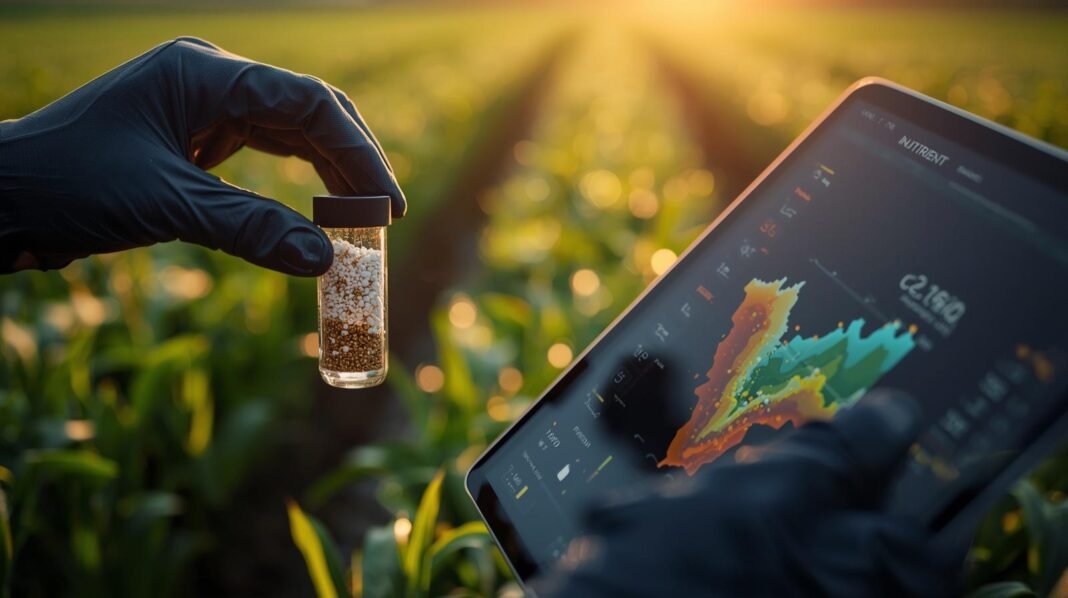

For most of modern farming history, fertilizer has been applied with a blunt instrument.
Bags of a standard nitrogen-phosphorus-potassium formulation are spread uniformly across fields, regardless of whether the soil in one corner is already nitrogen-rich or the crop in another zone is entering a critical growth phase.
The result is a system riddled with waste — economically, environmentally, and agronomically. That blunt instrument is now giving way to something far more surgical: precision fertilizer blending.
Precision fertilizer blending is the practice of formulating and applying customised nutrient mixes tailored to the specific requirements of individual soil zones, crops, and growth stages — and then delivering those mixes with variable-rate technology that adjusts application in real time.
It is a convergence of soil science, data analytics, IoT sensing, and equipment engineering, and it is fast becoming one of the defining pillars of sustainable agriculture in the 2020s.
“Precision nutrient strategies have demonstrated the potential to reduce fertilizer waste by up to 30%, delivering measurable gains in both yield and sustainability.”
The Problem with Conventional Fertilization
The scale of fertilizer waste in conventional agriculture is staggering. Research indicates that as much as 50% of applied nitrogen fertilizer exceeds what crops can actually absorb and use.
That surplus nitrogen does not simply disappear.
Soil microbes convert a portion of it into nitrous oxide (N₂O), a greenhouse gas that is 265 times more potent than carbon dioxide over a 100-year period.
The remaining excess leaches into waterways, contributing to algal blooms, dead zones in aquatic ecosystems, and the contamination of drinking water sources.
The climate cost is measurable: agricultural nitrous oxide emissions rose by 40% between 1980 and 2020, largely driven by the expanding use of synthetic nitrogen fertilisers.
Emerging economies across Africa, Asia, and South America are among the largest contributors to this trend, as smallholder and commercial farmers alike ramp up fertilizer use in pursuit of food security.
Yet the paradox is acute — the same practice meant to feed more people is quietly destabilising the climate systems on which food production depends.
Insight: Agricultural soils are responsible for as much as 75% of total U.S. nitrous oxide emissions — a pattern replicated across many high-intensity farming regions globally.
What Precision Blending Actually Involves
Precision fertilizer blending begins with detailed knowledge of the soil. Grid-based soil sampling and on-field sensor networks generate granular data on nutrient levels, pH, organic matter content, moisture, and temperature across different zones within a single field.
IoT-enabled soil sensors can now provide continuous data streams rather than one-off seasonal snapshots, enabling dynamic, responsive nutrient management throughout the growing season.
This data feeds into farm management software platforms that generate prescription maps — field-specific blueprints specifying what nutrient blend should be applied where, and at what rate.
The prescription is then executed through variable rate technology (VRT), which instructs spreaders, planters, and sprayers to adjust their output on the fly as they traverse different soil management zones.
A sandy, potassium-deficient patch in one quadrant receives a different blend from the clay-heavy, phosphorus-saturated section 200 metres away.
On the blending side, fertilizer producers and co-operatives are investing in on-site blending facilities that can formulate customised NPK ratios and micronutrient packages to order, rather than supplying only off-the-shelf grades.
This shift from commodity to customised product is reshaping the fertilizer supply chain, with some agri-input companies now offering digital platforms where farmers can upload soil test results and receive blended product recommendations within hours.
Technology Enablers: Sensors, Drones, and AI
Several converging technologies are accelerating the precision blending revolution. Drone-based remote sensing and hyperspectral imaging now allow large-scale fertility mapping at a fraction of the time and cost of ground-level sampling.
A drone pass over a 500-hectare field can generate nutrient stress maps, chlorophyll index readings, and moisture distribution data that would take a team of agronomists weeks to compile manually.
On-site, portable X-ray fluorescence (XRF) analysers and handheld near-infrared (NIR) spectrometers are becoming standard tools for rapid soil and plant tissue analysis.
These instruments provide lab-grade nutrient readings within minutes, allowing agronomists to make immediate blending adjustments without waiting for laboratory turnaround times.
Machine learning algorithms are increasingly embedded in decision support systems, processing multi-year yield data, weather forecasts, crop phenology models, and real-time sensor inputs to generate optimised fertilization recommendations.
The agricultural variable rate technology market reflects this growing momentum, estimated at USD 4.29 billion in 2024 and projected to reach USD 4.84 billion in 2025 — a trajectory expected to continue as digital agriculture platforms lower the barriers to adoption for farms of all sizes.
Key Stat: IoT-enabled soil sensors with continuous data streams can reduce nutrient waste by over 25% compared to static, one-time soil sampling approaches.
“In a single field, sandy areas might need more potassium while clay-rich zones need extra phosphorus — precision blending addresses each with surgical accuracy.”
Nanotechnology and Smart Fertilizer Formulations
Beyond variable application, innovation is also happening at the formulation level. Nanotechnology is enabling a new generation of controlled-release fertilizers (CRFs) that use polymer coatings, nano-encapsulation, and smart-release triggers to synchronise nutrient availability with plant uptake windows.
These formulations significantly reduce the risk of nutrient leaching and volatilisation, the two primary pathways through which conventional fertilizers escape the soil-plant system and enter the broader environment.
Simultaneously, the integration of biofertilizers — microbial inoculants that fix atmospheric nitrogen or solubilise soil phosphorus — with precision-blended chemical inputs is gaining traction as a complementary strategy.
Rather than viewing biological and synthetic fertility inputs as alternatives, progressive agronomy is increasingly treating them as complementary layers: precision blending determines the synthetic nutrient profile, while biology enhances nutrient cycling and soil structure to maximise uptake efficiency.
Implications for African Agriculture
For Africa, where agricultural productivity growth is a development imperative, precision fertilizer blending carries particular significance. Soil nutrient depletion is chronic across much of sub-Saharan Africa, with soils exhausted by decades of continuous cropping and insufficient replenishment.
Yet the cost of fertilizer — especially in import-dependent markets — is a persistent barrier for smallholder farmers.
Applying expensive inputs imprecisely amplifies both the economic loss from waste and the agronomic damage from imbalanced nutrition.
The proliferation of affordable smartphones, satellite-derived soil data, and mobile-compatible farm management platforms is beginning to make precision nutrition accessible beyond large commercial operations.
Initiatives combining satellite imagery, AI-driven crop advisory services, and local blending hubs are emerging across East and West Africa, creating pathways for smallholders to access customised nutrient solutions matched to their specific soil types and crops.
Kenya’s growing network of soil testing laboratories and the expansion of digital agronomy platforms represent early but meaningful steps in this direction.
Barriers and the Road Ahead
Adoption challenges remain real. The upfront cost of VRT-compatible equipment, sensor networks, and precision agriculture software is beyond the reach of many operations.
Data literacy and the capacity to interpret prescription maps remain uneven, particularly in regions with limited agricultural extension services. Interoperability between hardware brands and software platforms is inconsistent, creating friction in building integrated systems.
Policy frameworks and incentive structures also lag behind the technology. In many markets, fertilizer subsidies are tied to volume rather than efficiency, inadvertently rewarding application without accountability for outcomes or environmental impact.
Shifting support toward precision-based nutrient management — through rebates on VRT equipment, investment in soil testing infrastructure, and performance-linked subsidy mechanisms — would substantially accelerate the transition.
Despite these hurdles, the trajectory is clear. As climate commitments tighten, regulatory pressure on agricultural emissions grows, and digital tools continue their cost curve decline, precision fertilizer blending is moving from the domain of early adopters to mainstream agricultural practice.
The question for farmers, agribusinesses, and policymakers is not whether this shift will occur — but how quickly, and who will be equipped to benefit.
Conclusion
Precision fertilizer blending is not a silver bullet for agriculture’s sustainability challenges, but it is one of the most powerful tools currently available.
By replacing blanket application with data-driven, zone-specific nutrient management, it addresses the environmental cost of over-fertilisation, improves yield quality and consistency, and reduces input costs for farmers willing to invest in the enabling technology.
For a sector under increasing pressure to produce more with less — and to do so on a warming, resource-constrained planet — that combination of outcomes is not optional. It is essential.
Also Read
U.S. Tractor Sales Fall 12% in February as Farmers Tighten Belts, AEM Data Shows
Fertilizer spreaders: Essential tools for precision agriculture and enhanced crop yields
