



When Brazil’s agricultural machinery industry descends on Bothaville each May, it arrives not merely as an exhibitor but as a strategic mission.
This year is no different. At NAMPO Harvest Day 2026, a delegation of eleven Brazilian manufacturers is on the ground at NAMPO Park — backed by the full weight of Brazil’s government-industry export promotion machinery — with one clear brief: turn Africa’s growing appetite for farm mechanisation into signed contracts.
The timing is deliberate. Brazilian agricultural machinery exports grew 11.9% in 2025, reaching USD 1.65 billion — a figure that reflects the confidence of an industry which has spent decades engineering equipment for the demanding tropical and subtropical conditions that characterise much of the African continent.
South Africa’s NAMPO, the southern hemisphere’s largest agricultural exhibition, is the continent’s most efficient gateway for making those connections happen.
| Brazil at NAMPO 2026 — The Numbers
Delegation size: 11 manufacturers (Brazil Machinery Solutions programme) 2025 export growth: +11.9% year-on-year 2025 total agri-machinery exports: USD 1.65 billion - Advertisement -
NAMPO 2025 business generated: USD 5.9 million (completed + projected, 12-month horizon) Year-on-year improvement at NAMPO: +56% over 2024 edition Programme backing: ABIMAQ + ApexBrasil (Brazil Machinery Solutions) |
Who Is in Bothaville — and What They Are Selling
The eleven companies participating under the Brazil Machinery Solutions programme represent a broad cross-section of Brazilian agricultural technology.
Magno Jet, Irrigabrasil, SaveFarm, INRODA, Marispan, J. Assy, Ebara, Rugeri Mec-Rul, Indutar, Planti Center, and Implemaster are presenting solutions that span the full crop production cycle — from soil preparation through planting, crop protection, and harvest logistics.
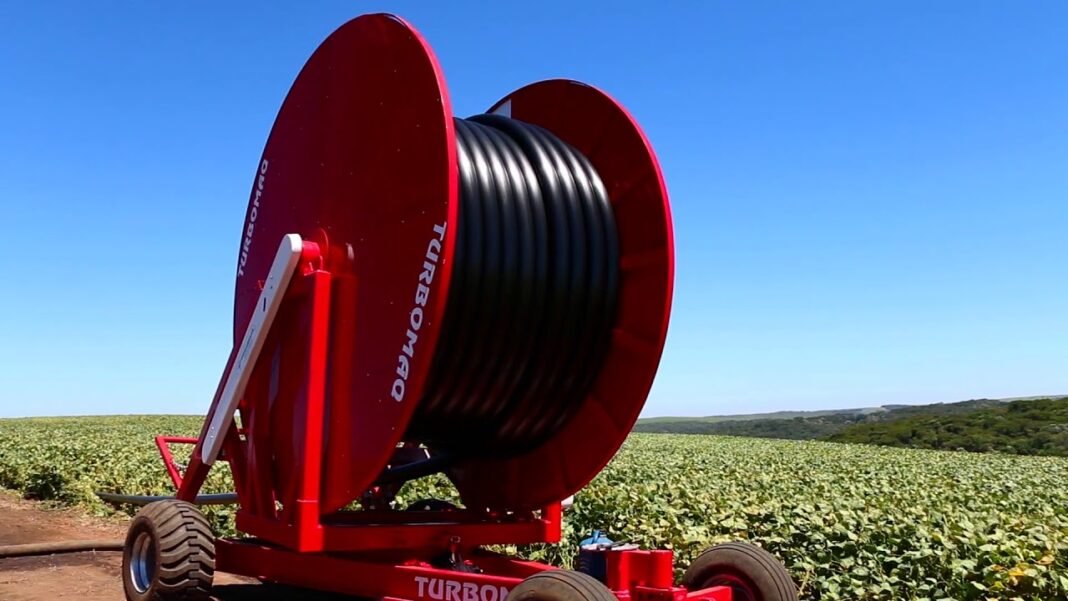
The product portfolio on the stands covers planters and seeders engineered for direct sowing systems, corn headers, grain carts, soil preparation implements, irrigation solutions, spraying technologies, and operator cabin systems.
This range is deliberately comprehensive: the Brazilian delegation is not targeting a single segment but rather positioning itself as a supplier capable of supporting African farming operations at multiple stages of mechanisation maturity — from entry-level first-time mechanisation to more sophisticated precision farming investments.
Direct sowing technology is a particular area of Brazilian expertise that translates well to Southern and East African conditions.
South Africa has seen rapidly growing adoption of no-till and conservation agriculture practices, and Brazilian planters and seeders — engineered for the same high-volume soybean and maize production systems that dominate Brazil’s Cerrado — are well matched to the large-scale grain farming operations of South Africa’s Free State and the emerging mechanisation needs of Zimbabwe, Zambia, and Tanzania.
| Magno Jet | Spray nozzle technology and precision application systems |
| Irrigabrasil | Irrigation solutions for field crops and horticulture |
| SaveFarm | Agri-tech and farm management solutions |
| INRODA | Agricultural implements and soil preparation equipment |
| Marispan | Planters, seeders, and direct sowing equipment |
| J. Assy | Agricultural implements |
| Ebara | Pumps and water management systems |
| Rugeri / Mec-Rul | Agricultural machinery and implements |
| Indutar | Grain carts and bulk handling equipment |
| Planti Center | Planting systems and precision agriculture |
| Implemaster | Agricultural implements and corn headers |
The Business Model Behind the Delegation
Brazil’s presence at NAMPO is not improvised. It is structured through Brazil Machinery Solutions — a coordinated export promotion programme run jointly by ABIMAQ (the Brazilian Machinery Builders’ Association) and ApexBrasil, Brazil’s trade and investment promotion agency.
The programme’s model is specifically designed to convert trade fair attendance into measurable commercial outcomes rather than brand visibility alone.
Central to this approach at NAMPO 2026 is a business matchmaking agenda: structured meetings between the Brazilian manufacturers and pre-identified importers, distributors, and agribusiness buyers from across Southern Africa.
This is not a passive exhibition strategy. The delegation arrives in Bothaville with appointment books, commercial targets, and follow-up frameworks already in place.
| “The international scenario requires more strategic decisions and the search for markets with consistent growth potential. NAMPO facilitates direct contact with regional partners and expands the reach of Brazilian companies across the continent.”
— Rayane Alvarenga, Executive Manager of International Market Commercial Promotion, ABIMAQ |
The track record justifies the investment. At NAMPO 2025, the Brazilian delegation generated USD 5.9 million in completed and projected business over the following twelve months — a result 56% higher than the previous year’s edition.
Going further back, NAMPO 2023 generated USD 8 million in closed and forecast deals from a delegation of thirteen companies, with 96 business meetings held against an initial expectation of 40 — a 140% overrun on contact volume that ABIMAQ described at the time as exceeding all expectations.
The compound effect of repeated participation is a key element of the strategy. Each NAMPO edition builds on the distributor relationships and market intelligence gathered in previous years, creating a cumulative commercial footprint that single-appearance exhibitors cannot replicate.
Why Africa, and Why Now
The strategic logic behind Brazil’s escalating African push is grounded in structural parallels that few other machinery-exporting nations can claim.
Brazil and sub-Saharan Africa share broadly similar agro-climatic conditions: tropical and subtropical temperatures, variable rainfall, red laterite soils, and primary crop portfolios — maize, soybeans, sorghum, sunflower — that overlap significantly.
Brazilian machinery has been engineered and field-tested in these conditions over decades. German or North American equipment, by contrast, was designed primarily for temperate continental climates and often requires adaptation for African operating environments.
Africa’s mechanisation deficit also creates a demand dynamic unlike any other major market. Sub-Saharan Africa remains one of the most under-mechanised farming regions in the world.
Tractor density across much of the continent stands at fewer than five units per 1,000 hectares of arable land — compared to over 200 in Brazil and more than 300 in Western Europe.
Even modest increases in mechanisation penetration represent enormous absolute market volume given the scale of African agriculture.
| African Markets in the Brazilian Crosshairs
South Africa — Primary entry market; established distributor networks; large-scale grain and livestock production Zimbabwe — Growing maize and tobacco mechanisation demand; recovering commercial farming sector Tanzania — Rapidly expanding rice, maize, and sunflower production; government mechanisation drives Angola — Post-conflict agricultural recovery; strong Brazilian-Portuguese commercial ties Mozambique — Emerging large-scale farming corridor; Nacala corridor development creating demand Zambia — Copper belt and commercial farming corridor; growing cooperative sector mechanisation |
NAMPO’s geographic positioning makes it the ideal commercial bridge. Bothaville draws buyers and distributors not just from South Africa but from Zimbabwe, Mozambique, Zambia, Tanzania, and Angola — making it possible for a Brazilian manufacturer to hold commercial meetings with potential partners from six countries in four days, at a cost and logistical complexity that individual market visits could not match.
The Argentine machinery industry is making the same calculation. At NAMPO 2026, Argentine companies including Apache — presenting its 27000+ and 99000 planter ranges — are also targeting South Africa’s direct sowing market, which covers an estimated 4.5 million productive hectares with maize comprising roughly 60% of the cultivated area. The competition for African agri-machinery distribution channels is intensifying, and Brazil is competing with a home-field advantage in climate-adapted technology.
The Kenya and East Africa Angle
For readers and operators in East Africa, the implications of Brazil’s NAMPO push reach beyond South Africa’s grain belt.
Kenya’s large-scale grain production in the North Rift — Trans Nzoia, Uasin Gishu, Elgeyo Marakwet — operates on farm sizes and in climate conditions directly comparable to parts of Brazil’s southern producing states.
The direct sowing planters, grain carts, and precision spraying systems on the Brazilian stands at NAMPO are not theoretical products for this market; they are functionally applicable to it.
The more immediate near-term pathway is through the distribution networks that Brazilian manufacturers are building in South Africa.
Several Brazilian brands that entered the Southern African market through NAMPO in previous years have subsequently extended distribution arrangements northward into East Africa.
As distributor relationships consolidate in Bothaville this week, some of those agreements will include territory clauses that cover Kenya, Tanzania, and Uganda.
East African agricultural policymakers and cooperative farming organisations tracking equipment sourcing options should be watching the Brazil-Africa agricultural machinery corridor closely.
Brazil’s combination of climate-adapted technology, government-backed export financing support, and competitive pricing relative to European equivalents makes it an increasingly serious alternative source for the mechanisation investments that will define African farming productivity over the next decade.
| NAMPO 2026 — Brazil at a Glance
Programme: Brazil Machinery Solutions (ABIMAQ + ApexBrasil) Companies at NAMPO 2026: 11 manufacturers Products: Planters, seeders, corn headers, grain carts, irrigation, sprayers, implements Target markets: South Africa, Zimbabwe, Mozambique, Angola, Tanzania, Zambia Format: Exhibition stands + structured business matchmaking with regional distributors 2025 export total (all agri-machinery): USD 1.65 billion (+11.9% year-on-year) |
Outlook
NAMPO runs through Friday 15 May. The Brazilian delegation’s structured matchmaking programme continues through the final day, with follow-up commercial engagement expected to extend well beyond the showgrounds.
ABIMAQ’s track record suggests the 2026 cohort will close this edition with a business pipeline that significantly exceeds the headline exhibit cost — making NAMPO not merely an awareness exercise but a measurable return-on-investment event for Brazil’s agricultural machinery export sector.
For the African farming industry, the Brazilian presence at NAMPO 2026 is a signal worth reading carefully.
It reflects the assessment of one of the world’s most commercially sophisticated agricultural machinery industries that the African market has crossed a threshold of scale and commercial seriousness that warrants structured, persistent investment.
That is a different kind of endorsement from any press release.
Also Read
NAMPO 2026: New Holland CR10 and Scania Super Steal the Show as Machinery Giants Race to Prove ROI
NAMPO 2026 kicks off Tomorrow but Cloven-Hoofed Animals are Banned
