


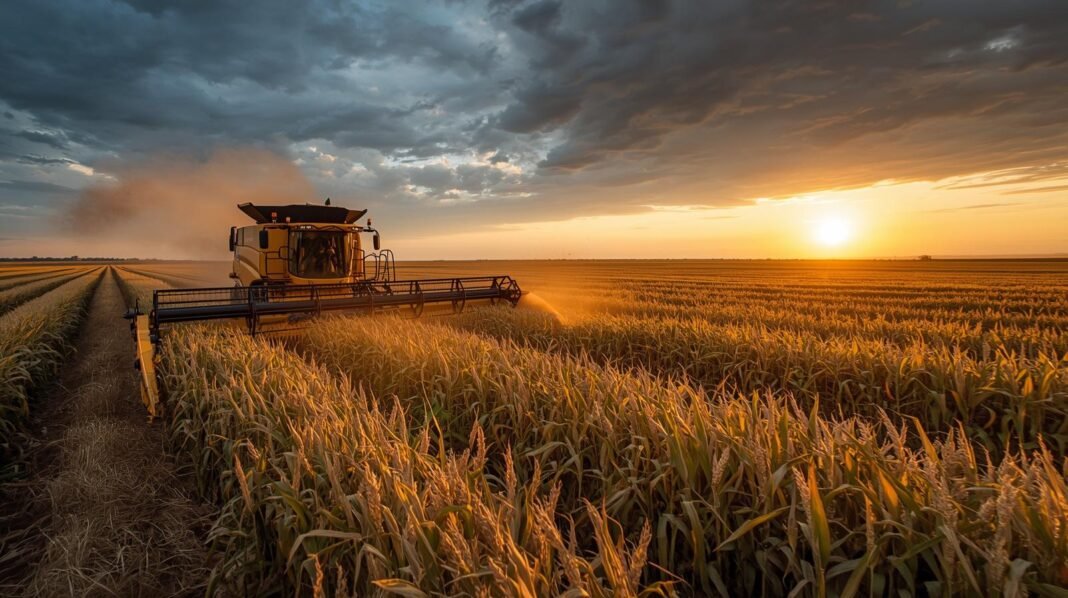

With an estimated 16.44 to 17 million tonnes harvested in 2024/25 — the largest crop in the country’s history — South Africa’s grain farmers leaned heavily on combine harvesters and precision technology to handle a surplus that is now reshaping regional food security and agricultural trade.
June 2026:South Africa’s 2024/25 summer grain season delivered what many in the industry had been waiting for.
After the brutal El Niño-induced drought of 2023/24 slashed maize output to around 12.85 million tonnes, a decisive swing to La Niña conditions brought above-average rainfall to the maize triangle — the Free State, North West, and Mpumalanga provinces that form the backbone of national grain production.
The result was a harvest of approximately 16.44 million tonnes, confirmed by the Crop Estimates Committee (CEC) as the second-largest on record, with some revised forecasts pointing to as high as 17.064 million tonnes.
That volume — more than four million tonnes above South Africa’s annual domestic maize requirement of approximately 12 million tonnes — represents a genuine surplus.
It has already triggered a resumption of large-scale exports to regional and international markets.
But behind the numbers lies a story about machinery: the combine harvesters, grain carts, and precision agriculture systems that made it possible to cut, thresh, and deliver a crop of this scale in the narrow harvest windows available to South African farmers.
KEY HARVEST FIGURES — 2024/25 SEASON
More Tonnes Per Hectare — Not More Hectares
One detail in the harvest data deserves particular attention from anyone involved in agricultural equipment: the planted area for the 2024/25 maize crop was actually slightly lower than the previous season, at 2.59 million hectares.
This means the dramatic jump in total production was driven almost entirely by yield improvement — more tonnes per hectare, not more land under cultivation. That is, fundamentally, a mechanization and agronomy story.
Higher yields per hectare place direct stress on harvesting equipment. A combine harvester operating in a high-yielding field processes significantly more crop mass per hour than the same machine would have managed in a drought year.
Grain tanks fill faster. Threshing concaves and rotors work harder. Straw walkers and sieves handle larger volumes.
For South Africa’s commercial grain farmers — whose large-scale Free State and North West operations are among the most mechanized on the continent — the 2024/25 season was as much a test of their machinery as their agronomy.
The industry data reflects this pressure on equipment demand. South Africa’s agricultural machinery market is estimated at approximately USD 910 million in 2025, dominated by John Deere, AGCO Corporation (Fendt, Massey Ferguson), CNH Industrial (Case IH, New Holland), Mahindra, and Kubota.
Tractor and combine harvester sales tracked well above historical averages through much of the 2024/25 cycle, though Agbiz noted some moderation in early 2026 — a pattern analysts attributed to the natural correction following the elevated procurement of a bumper season rather than a structural downturn.
The Role of Precision Agriculture in Capturing the Surplus
South Africa’s large commercial grain farms have been among the early adopters of precision agriculture technology on the African continent.
In a high-yield season like 2024/25, that technology pays its most visible dividends.
Yield mapping systems on modern combine harvesters generated real-time field performance data, helping farm managers identify which paddocks over-performed and which faced micro-climate stress — intelligence that feeds directly into the next season’s planting and input decisions.
John Deere’s S-Series and X-Series combines — including the S790 flagship with its 473-horsepower engine and 450-bushel grain tank — were widely deployed on large-scale Free State and North West operations.
The integration of AutoTrac guidance, Active Yield mapping, and the Operations Center platform allowed farm teams to coordinate multi-machine harvest operations, minimise overlapping passes, and reduce grain losses during the push to clear fields before weather windows closed.
CLAAS’s LEXION range and CNH Industrial’s Case IH Axial-Flow 250 Series likewise featured prominently, with their variable-rotor systems proving particularly effective in the variable crop densities that La Niña rains can produce across a single large field.
For smaller and emerging commercial operators in Mpumalanga and KwaZulu-Natal, the rise of contract harvesting services provided access to modern combine technology without the capital expenditure of ownership.
This model — where a harvesting contractor brings machinery and expertise to a farm for the season — has been an important democratising force in South African grain mechanization, and the bumper harvest created strong demand for these services across the region.
Export Volumes and the Post-Harvest Equipment Chain
The surplus has translated directly into export activity. From the start of the 2025/26 marketing year in May 2025, South Africa exported 1.07 million tonnes of maize in the first seven months of the season, with Zimbabwe accounting for 30% of that volume, Botswana 13%, and Vietnam 10%.
Further markets included Namibia, Eswatini, South Korea, and Taiwan — reflecting both the white maize demand of southern African neighbours and the yellow maize appetite of Far Eastern feed industries.
Behind every exported tonne lies a post-harvest equipment chain: grain augers and conveyors moving maize from combine hoppers to grain carts; grain carts ferrying loads to waiting trucks at field headlands; those trucks delivering to commercial silos and co-operative storage facilities; and from there, road or rail transport to the export terminals at Richards Bay and Durban.
Each link in that chain represents equipment investment, and a bumper season tests each link simultaneously.
South Africa’s silo network — critical for managing the timing of exports and smoothing domestic price impacts — has undergone significant private investment in recent years, with expanded capacity at major co-operative storage points in the Free State and North West reducing the bottlenecks that plagued earlier surplus seasons.
Grain dryers and moisture management equipment also saw elevated use in 2024/25, as rapid crop growth following intensive rains produced maize at moisture levels that required conditioning before safe storage.
Implications for the Broader African Market
South Africa’s mechanization model carries important lessons for grain-producing nations across the continent.
The 2024/25 result was not primarily achieved through expanding land under cultivation — it was achieved by intensifying productivity on existing land, using higher-yielding varieties, better agronomic practice, and critically, the combine harvester and precision agriculture technology that allows large volumes to be harvested efficiently within narrow seasonal windows.
Africa is currently the fastest-growing regional market for harvesting machinery, with a projected compound annual growth rate of 7.62% through to 2031, according to market research published in 2025.
Government mechanization programs, rising commercial farm sizes, and the expansion of contract harvesting models across East and West Africa are all contributing to this trajectory.
South Africa’s performance in 2024/25 — demonstrating how mechanized, precision-guided harvesting can extract maximum value from a good rainfall season — is the clearest recent evidence of why that investment makes sense.
Key Takeaways for Equipment Stakeholders
- Yield improvement, not area expansion, drove South Africa’s record harvest — placing maximum performance demands on combine harvesters and post-harvest equipment.
- South Africa’s agricultural machinery market reached approximately USD 910 million in 2025, with John Deere, AGCO, CNH Industrial, Mahindra, and Kubota as the dominant players.
- Precision agriculture technology — yield mapping, auto-guidance, variable rate application — delivered measurable returns during the intensive 2024/25 harvest campaign.
- Contract harvesting services expanded access to modern machinery for smaller commercial producers, sustaining mechanization uptake beyond the large-farm segment.
- The post-harvest chain (grain carts, silos, dryers, transport) is as critical as the combine itself in converting a bumper harvest into exportable surplus.
- Africa’s harvesting machinery market is projected to grow at 7.62% CAGR through 2031 — South Africa’s 2024/25 performance strengthens the investment case.
Also Read
Fields of Partnership: How Belarus Became Zimbabwe’s Farming Lifeline
U.S. Tractor Sales Fall 12% in February as Farmers Tighten Belts, AEM Data Shows

Martin is a writer at Agrimachinery Africa specializing in agricultural machinery, mechanization trends, and farm technology across Africa. His work focuses on tractors, harvesting equipment, irrigation systems, and emerging innovations helping farmers improve productivity and efficiency. Through in-depth industry coverage, he highlights technologies shaping the future of modern agriculture.