


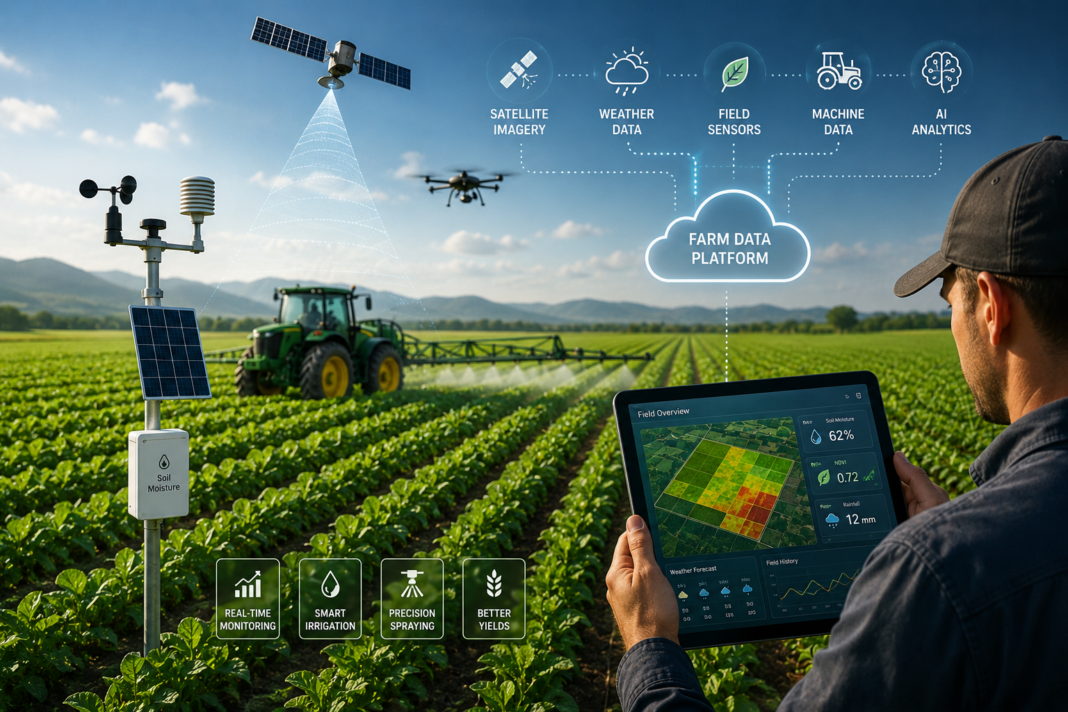

Agriculture monitoring systems are becoming an important part of modern farm management.
Using IoT sensors, satellite imagery, connected machinery, weather stations, cameras and farm-management software, farmers can monitor what is happening across their fields without being physically present everywhere.
An agriculture monitoring system can track soil moisture, crop health, weather, irrigation, machinery and other farm conditions.
More advanced systems combine these data sources with artificial intelligence to help farmers identify problems and decide what action to take.
This shift is becoming increasingly important in 2026.
Tim Hassinger, President and CEO of Intelinair, describes the direction of agricultural intelligence as a move from “what happened” to “what should we do next, and when?” The value, he argues, comes from clean, timely and unified data.
This guide looks at seven leading agriculture monitoring systems and the technologies behind them.
Agriculture Monitoring Systems at a Glance
| System | Best for | Main strength |
|---|---|---|
| John Deere Operations Center | Connected machinery | Equipment and field monitoring |
| Climate FieldView | Crop monitoring | Field imagery and analytics |
| Trimble Agriculture | Precision agriculture | Guidance and field operations |
| Raven Slingshot | Fleet monitoring | Equipment connectivity |
| Ag Leader SMS | Farm data management | Mapping and analysis |
| Granular | Farm management | Operational and financial data |
| CropX | Soil and irrigation | Sensors and agronomic monitoring |
What Is an Agriculture Monitoring System?
An agriculture monitoring system is a technology solution that collects, transmits and analyses information about a farm.
Depending on the system, it can monitor:
- Soil moisture and temperature
- Weather and rainfall
- Crop health
- Irrigation
- Machinery location and performance
- Field operations
- Yield
- Water use
- Pest and disease risks
A typical system may combine sensors + connectivity + cloud software + analytics + mobile alerts.
For example, a soil sensor can measure moisture levels and send the information to a cloud platform. The farmer can then view the data on a phone and determine whether irrigation is required.
More advanced systems combine ground-based measurements with satellite imagery, machinery data and weather information.
Related Smart Agriculture Stories
Explore more Agrimachinery Africa coverage on smart farming, precision agriculture, irrigation technology and AI-powered agricultural machinery.
How Does an Agriculture Monitoring System Work?
The basic process is:
Sensors and equipment → connectivity → data platform → analysis → alerts/recommendations → farmer action
The difference between older and newer systems is increasingly what happens after the data is collected.
A traditional system may simply show a farmer that soil moisture has fallen.
A smarter system can combine soil data with weather forecasts and crop information and help determine whether irrigation is needed.
This is why agricultural monitoring is moving toward decision intelligence, rather than simply producing dashboards.
A 2026 smart-farming review also highlights the value of modular and offline-capable monitoring and alerting tools, particularly where connectivity and technical infrastructure are limited.
7 Best Agriculture Monitoring Systems for 2026
1. John Deere Operations Center
John Deere Operations Center is one of the strongest agriculture monitoring platforms for farms using connected John Deere equipment.
The cloud-based platform connects information from machinery, fields and farm operations. Farmers can monitor field progress, machine locations and operational information remotely.
Its capabilities include field mapping, work planning, machine monitoring, data analysis and prescription management.
The major advantage is its close integration with John Deere machinery. Farms operating large equipment fleets can use the platform to bring machine and agronomic information into a single digital environment.
Best for
Medium and large farms with connected machinery.
Key features
- Machinery monitoring
- Field mapping
- Work planning
- Machine location
- Yield and moisture data
- Prescription management
- Farm reporting
2. Climate FieldView
Climate FieldView is designed around digital crop and field management.
The platform allows farmers to collect and analyse field data, monitor field conditions and use imagery to identify areas requiring attention.
Its field-health tools can help farmers understand differences across fields and support crop scouting. The platform also provides yield analysis, field data management and connections to agricultural equipment.
This makes FieldView particularly useful for farmers who want to combine crop monitoring with operational data.
Best for
Crop farmers focused on field health and crop analytics.
Key features
- Crop monitoring
- Field imagery
- Field scouting
- Yield analysis
- Weather information
- Prescription management
- Equipment data
3. Trimble Agriculture
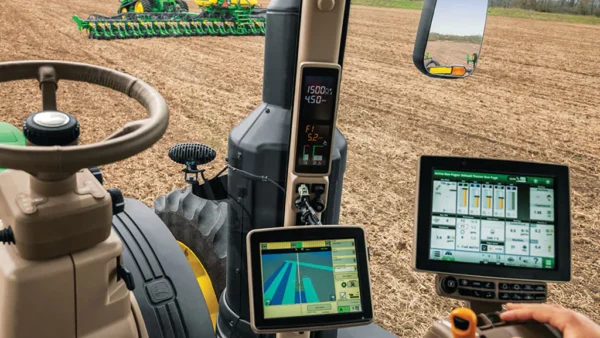
Trimble Agriculture provides a broad precision-agriculture technology ecosystem.
Its solutions cover positioning, guidance, steering, field mapping, application control and farm data.
The company’s precision-agriculture technology is particularly useful for farms that need accurate positioning and control during planting, spraying, harvesting and other field operations.
Trimble is also relevant to mixed-equipment operations because of its focus on interoperability and precision field technology.
Best for
Commercial farms focused on precision agriculture.
Key features
- GPS positioning
- Guidance and steering
- Field mapping
- Variable-rate applications
- ISOBUS compatibility
- Farm data management
- Precision field operations
4. Raven Slingshot
Raven’s Slingshot technology has focused strongly on agricultural connectivity and equipment monitoring.
Its fleet-tracking capabilities can provide information about equipment location and operating status, making it useful for farms with multiple machines working across large areas.
For a farm manager, equipment monitoring can help answer practical questions such as where machines are working, how they are being utilised and which assets require attention.
Best for
Large equipment fleets and commercial agricultural operations.
Key features
- Fleet tracking
- Equipment connectivity
- Machine location
- Asset monitoring
- Operational data
- Equipment history
5. Ag Leader SMS
Ag Leader’s SMS software provides tools for organising, mapping and analysing agricultural data.
The platform supports field mapping, prescription management and precision-agriculture workflows. It can bring information from different field operations into a structured data environment.
This makes it particularly useful for farmers and agronomists who want to understand historical field performance and use that information to improve future operations.
Best for
Farmers and agronomists who need detailed field-data management.
Key features
- Field mapping
- Data management
- Prescription creation
- Field analysis
- Water-management tools
- Reporting
6. Granular
Granular takes a broader farm-management approach.
The platform combines operational information with financial and field-level analysis, helping commercial farms understand both production activities and their economic performance.
This can be particularly valuable for businesses managing multiple fields, crops and farm operations.
Rather than focusing on one type of sensor, Granular is designed to provide a broader view of farm management.
Best for
Commercial farms that want operational and financial visibility.
Key features
- Farm planning
- Field-level analysis
- Crop management
- Operational management
- Financial analysis
- Team coordination
7. CropX
CropX is particularly focused on soil, irrigation and agronomic monitoring.
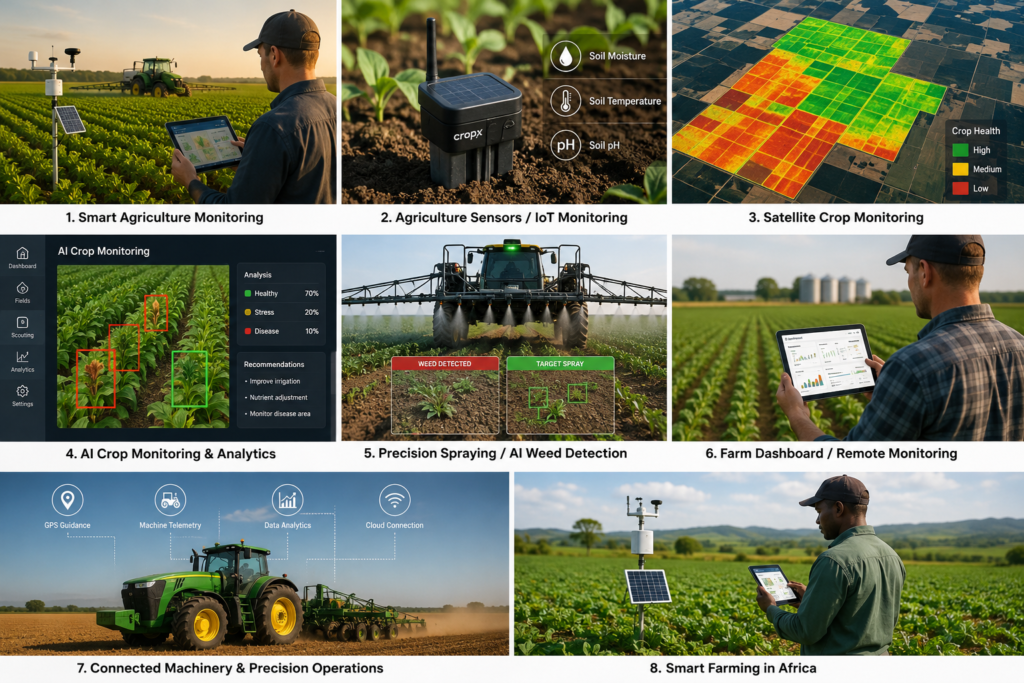
Its system combines soil sensors and software to provide information about soil conditions and crop requirements. Sensors can monitor factors including soil moisture, temperature and electrical conductivity.
The platform can also integrate weather, rainfall, satellite and other farm data.
This makes CropX different from machinery-focused platforms. Its primary value is helping farmers understand field conditions and use that information to improve irrigation and crop management.
CropX has also been expanding its use of AI and imagery for crop monitoring.
Best for
Irrigation, soil monitoring and data-driven agronomy.
Key features
- Soil-moisture monitoring
- Soil temperature
- Electrical conductivity
- Weather monitoring
- Irrigation management
- Crop monitoring
- Satellite data
- AI-driven insights
Types of Agriculture Monitoring Systems
The term agriculture monitoring system covers several different technologies.
IoT Agriculture Monitoring
IoT systems use connected sensors to collect information from fields.
A typical system works like this:
Soil sensor → wireless connection → cloud platform → smartphone
These systems are particularly useful for soil moisture, irrigation, weather and greenhouse monitoring.
They can also be deployed gradually, allowing farmers to begin with a small number of sensors before expanding.
Satellite Agriculture Monitoring
Satellite imagery allows farmers to monitor large areas without installing physical sensors throughout every field.
Satellite data can help identify variations in vegetation health, crop development and field conditions.
It can also complement ground-based monitoring. Satellite imagery might identify an area of concern, after which the farmer can investigate that specific location using sensors, cameras or physical scouting.
AI Crop Monitoring
Artificial intelligence is increasingly being used to analyse satellite imagery, sensor data and crop images.
AI can help identify patterns associated with:
- Crop stress
- Water shortages
- Disease
- Abnormal growth
- Irrigation problems
But farmers do not necessarily need to interact directly with the AI.
As Reinder Prins of Agworld told CropLife, “Most AI on the farm today is still under the hood.” AI is already being used behind the scenes for applications including yield prediction, disease modelling, irrigation scheduling and imagery analysis.
Crop Monitoring Cameras
Cameras can provide another layer of field monitoring.
Fixed cameras can repeatedly capture images from a particular area, while drones can survey larger fields.
Computer vision can then analyse images to identify differences in crop growth or plant condition.
Smart Agriculture Monitoring Systems
A smart agriculture monitoring system combines multiple technologies rather than relying on a single sensor.
A typical smart system could combine:
IoT sensors + satellite imagery + weather + machinery data + AI + farm-management software
The goal is to convert these different data streams into useful information.
For example, soil sensors may indicate falling moisture levels while weather data shows little rainfall is expected. A smart platform can combine the information and generate an irrigation alert.
This is where the industry is moving from monitoring toward prediction and recommendation.
The Human Still Matters
Increasing automation does not mean removing farmers from the decision-making process.
Tim Hassinger of Intelinair describes human-in-the-loop automation as an important model for agriculture, where machines handle repetitive tasks while people remain in control of important decisions.
That distinction matters.
A monitoring system can identify that a crop is under stress, but a farmer or agronomist may still need to determine whether the cause is drought, disease, pests, nutrition or another factor.
The best systems therefore augment agricultural expertise rather than simply attempting to replace it.
Agriculture Monitoring Systems for African Farms
Agriculture monitoring technology has significant potential in Africa, particularly for commercial farms, irrigation operations and farms managing large areas with limited labour.
However, connectivity is an important consideration.
Farmers should check whether sensors can reliably communicate from the field and whether the system can continue collecting data when internet access is interrupted.
Solar-powered sensors, low-power devices and offline-capable systems can be particularly useful in areas with limited infrastructure.
For irrigation-dependent farms, soil-moisture monitoring may provide one of the most practical applications.
Instead of irrigating entirely according to a fixed schedule, farmers can monitor actual soil conditions and make more informed decisions.
For large commercial farms, satellite monitoring, machinery telematics and farm-management platforms can provide a broader operational view.
How to Choose an Agriculture Monitoring System
Before purchasing a system, identify the main problem you want to solve.
For irrigation: prioritise soil sensors, weather monitoring and irrigation controls.
For crop monitoring: look for satellite imagery, field-health maps, scouting tools and AI analysis.
For machinery: prioritise GPS, telematics, equipment connectivity and fleet management.
For precision agriculture: look for guidance, variable-rate applications, field mapping and prescription management.
For farm profitability: consider systems that combine operational data with financial and field-level analysis.
Also consider:
- Connectivity
- Hardware costs
- Software subscriptions
- Ease of use
- Technical support
- Compatibility
- Scalability
- Data security
- Total cost of ownership
The most expensive system is not necessarily the best system.
The Future of Agriculture Monitoring
The next generation of agriculture monitoring systems will increasingly combine sensors, satellite imagery, AI, machinery and weather data.
The major change will be the move from reporting to recommendation.
Instead of simply telling farmers that soil moisture is low, systems will increasingly help answer:
Which field needs attention?
Why is it underperforming?
What should the farmer do next?
When should the action happen?
This is the direction described by Hassinger’s shift from “what happened” to “what should we do next, and when?”
At the same time, automation will continue to expand. Autonomous machinery, automated irrigation and robotic systems could eventually act on information generated by monitoring platforms.
However, human oversight will remain important.
The most useful systems will likely be those that combine automation with farmer expertise, rather than attempting to remove people entirely from agricultural decision-making.
Frequently Asked Questions
What is an agriculture monitoring system?
An agriculture monitoring system uses sensors, software, imagery and connected technologies to collect and analyse information about farms, including soil, crops, weather, irrigation and machinery.
What is the best agriculture monitoring system?
There is no single best system. John Deere Operations Center is strong for connected machinery, Climate FieldView for crop and field analytics, Trimble for precision agriculture and CropX for soil and irrigation monitoring.
What is a smart agriculture monitoring system?
It is a monitoring system that combines technologies such as IoT sensors, satellite imagery, AI, weather data and connected machinery to provide farmers with actionable insights.
Can satellites monitor crops?
Yes. Satellite imagery can help monitor vegetation health, crop development and field variability across large agricultural areas.
Can AI monitor crops?
Yes. AI can analyse satellite imagery, camera images and sensor data to identify patterns associated with crop stress, disease, water shortages and other conditions.
Can agriculture monitoring systems work without internet?
Some systems can continue collecting data locally when connectivity is interrupted. Farmers in areas with unreliable connectivity should specifically look for offline-capable systems or alternative communication technologies.
Agriculture monitoring systems are moving beyond simple sensors and dashboards.
Modern platforms can combine IoT sensors, satellite imagery, cameras, weather information, connected machinery and artificial intelligence to give farmers a more complete picture of their operations.
The seven systems covered here approach monitoring differently.
John Deere Operations Center is particularly suited to connected machinery, Climate FieldView to crop and field analytics, Trimble to precision agriculture, Raven to equipment connectivity, Ag Leader SMS to field data management, Granular to broader farm management and CropX to soil and irrigation monitoring.
For farmers, the key is to start with the problem rather than the technology.
The best agriculture monitoring system is the one that produces reliable information, fits the farm’s infrastructure and helps turn that information into better decisions.
In 2026, that means moving beyond “what happened?” toward the more valuable question:
“What should we do next, and when?”
Also Read
- Smart Tractors in Africa: Are Smallholder Farms Ready?
- Top Smart Irrigation Systems for African Farms
- John Deere Pushes the Boundaries with Smart Retrofit Solutions for Aging Farm Equipment

Martin is a writer at Agrimachinery Africa specializing in agricultural machinery, mechanization trends, and farm technology across Africa. His work focuses on tractors, harvesting equipment, irrigation systems, and emerging innovations helping farmers improve productivity and efficiency. Through in-depth industry coverage, he highlights technologies shaping the future of modern agriculture.