


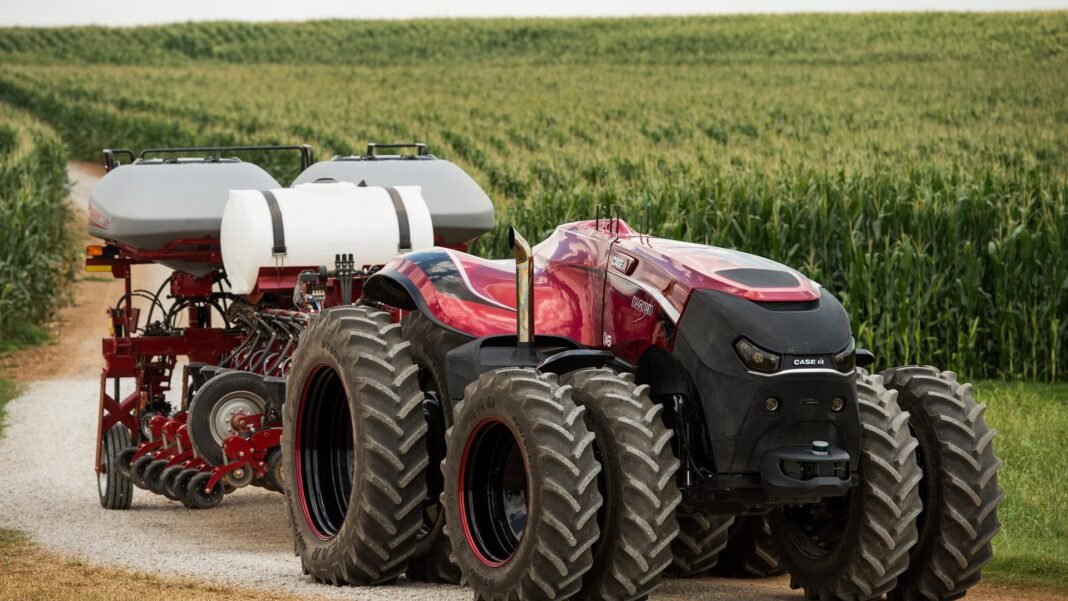

For generations, the agricultural machine had a simple relationship with the farmer: the farmer gave the instructions and the machine did the work.That relationship is changing.
Modern tractors can steer themselves. Sprayers can use cameras to identify weeds. Combines can adjust their settings according to crop conditions.
Drones can survey fields from above. Agricultural robots can perform specialised tasks without a conventional operator.
And artificial intelligence is increasingly being used to turn the information collected by these machines into decisions.
But the most interesting development may not be the autonomous tractor itself.
It could be what happens when multiple autonomous machines begin working together.
That is the direction in which the agricultural machinery industry is moving, and it raises a more interesting question than whether farmers will eventually disappear from tractor cabs.
What happens when the farm machinery fleet itself starts coordinating the work?
The autonomous tractor is solving a labour problem
The popular image of an autonomous tractor is a machine driving across a field without anyone inside it.
That makes for an impressive demonstration, but it misses much of the economic argument behind autonomy.
CLAAS’s Julian Siggemann, from its Advanced Development department, argues that autonomous machines are not being developed to replace agricultural workers.
The objective, he says, is to allow skilled workers to concentrate on higher-value activities during periods when farms are under the greatest pressure.
That problem can become acute when weather compresses the agricultural calendar.
Siggemann points to the 2023 grain harvest in Central and Northern Europe. Weather delays meant that harvesting, stubble tillage, soil cultivation and the sowing of catch and succession crops had to be carried out at the same time.
There simply were not enough skilled workers to operate every machine simultaneously.
That is a much more compelling case for autonomy than the idea of replacing farmers.
An autonomous tractor could perform a repetitive operation while the available operator concentrates on harvesting, crop assessment or another task where human judgement is more important.
The machine is not replacing the farmer.It is extending the farmer’s capacity.
Related Stories
- China’s Agricultural Machinery Revolution: From Low-Cost Tractors to AI and Autonomous Machines
- New Holland Unveils Autonomous R4 Robot Series, Signaling a New Era for Specialty Crop Farming
- Robots Replacing Tractors: The Future of Autonomous Farming
- New Holland boosts autonomous baling with new technology
From self-steering to machines that can act
Agricultural automation has been developing for decades.
GPS guidance was an early step. Automatic steering followed. More recently, machines have gained the ability to automate implement control, headland turns, application rates and other parts of field operations.
CLAAS is now taking that progression further.
Its current systems allow pre-planned work orders to be executed automatically, including steering, headland management, obstacle avoidance and site-specific application.
With its AXION and XERION systems, the operator can monitor the work while the machine and implement execute the programmed operation.
This is important because autonomy is unlikely to arrive as one dramatic technological event.It is being assembled piece by piece.
- First the machine learns to steer.
- Then it learns to manage the implement.
- Then it learns to recognise obstacles.
- Then it can execute a complete work order.
Eventually, the operator may no longer need to be sitting in the machine at all.
AI gives the machine eyes
Autonomy depends on a machine being able to understand its surroundings.
That is where cameras, radar, positioning systems and artificial intelligence become critical.
A tractor cannot simply follow a GPS route and be considered autonomous. Agricultural fields contain people, animals, trees, rocks, ditches, irrigation infrastructure and changing ground conditions.
The machine has to determine what is around it and decide whether it can safely continue. AI and machine vision are increasingly being used for that purpose.
The same technologies are finding their way into crop production.
A camera mounted on a sprayer can identify plants and weeds. Software can interpret the images and determine where treatment is required. A machine can then activate individual nozzles rather than applying the same treatment uniformly across an entire field.
That takes precision agriculture beyond the traditional question of where the machine is.
The machine is beginning to understand what is in front of it.
The smart sprayer could be more important than the driverless tractor
There is enormous attention around autonomous tractors, but some of the most commercially significant applications of agricultural AI may be less spectacular.
Precision spraying is one example.
A field is rarely uniform. Weed pressure, crop growth, soil conditions and disease incidence can vary considerably within the same block.
A conventional sprayer is designed to deliver an application according to a predetermined strategy.
A machine equipped with machine vision can potentially make decisions at a much finer scale.
The implications extend beyond chemical savings. More targeted applications can reduce unnecessary inputs while creating detailed digital records of what happened in the field.
The machine therefore becomes both an operator and a data collector.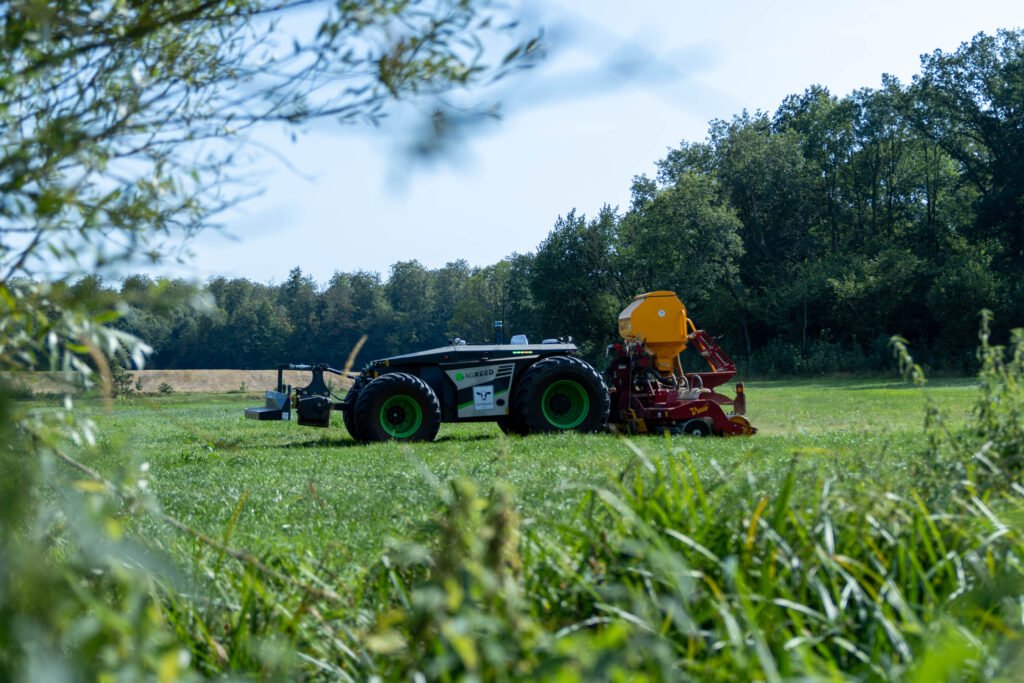
Robots are changing the idea of mechanisation
Agricultural robots represent another route into automation.
They do not necessarily attempt to replicate a tractor. Many are designed around a specific problem.
A robot may weed vegetable crops, monitor plants, operate between orchard rows or perform another repetitive operation that is difficult or expensive to mechanise conventionally.
This could become particularly important in labour-intensive agriculture.
Instead of making every agricultural machine larger, manufacturers and technology companies can build smaller machines that perform one job extremely well.
That could eventually produce a different type of farm fleet: fewer machines doing everything, and more specialised machines working together.
Drones are becoming another part of the machinery fleet
Agricultural drones have also moved beyond simple aerial photography.
They can collect high-resolution imagery, monitor crop development, identify areas requiring attention and, in some applications, perform spraying.
Their greatest value, however, may not be the drone itself.
It is the information it provides to other parts of the farm.
A drone identifies an area of crop stress. The data enters a farm-management system. The information is analysed and an intervention is planned. A ground machine then performs the required operation.
The drone has effectively become another sensor in the machinery system.
That distinction matters because the future smart farm will not be built from isolated gadgets.
It will be built from machines that share information.
Kakuzi shows that Africa is entering the conversation
That transition is beginning to have an African dimension.
Kenyan agricultural company Kakuzi has been investing in technology as part of a broader effort to improve productivity and operational efficiency.
Chris Flowers, Kakuzi’s Managing Director, previously described artificial intelligence as having a role in the company’s operations and said the business planned to invest in AI-linked AgTech solutions.
Kakuzi’s more recent reporting shows that the strategy has continued to develop. Its 2024 ESG reporting describes plans to increase automation and AI use, alongside sensor-based agriculture and automated irrigation processes that adjust schedules using real-time data.
The significance is not that Kakuzi has suddenly become an autonomous tractor operation.
It has not publicly disclosed such a claim.
The significance is that a major African agricultural producer is increasingly treating data, automation, AI and connected technology as part of the operating model of the farm.
That is an important distinction.
The next generation of agricultural machinery will require more than sophisticated equipment. It will require farms to have the digital systems, people and processes capable of using the information those machines produce.
Kakuzi’s direction suggests that this infrastructure is beginning to take shape in African commercial agriculture.
The real breakthrough could be the autonomous fleet
This is where CLAAS’s vision for 2035 becomes particularly interesting.
Siggemann does not envisage a future in which one driverless tractor simply works alone in a field.
He expects entire fleets of autonomous machines capable of cooperating.
He describes a future autonomous harvest in which a LEXION combine harvests the crop, an autonomous AXION works with the chaser bin and an autonomous XERION begins tillage operations at the same time, with farm data available through CLAAS Autonomy connect.
That is a much harder engineering problem than making one tractor autonomous.
One machine has to understand where it is.
A fleet has to understand what every other machine is doing.
The combine has to coordinate with the grain cart. The grain cart has to position itself correctly. The tillage tractor needs to know when harvested land becomes available. The farm management system has to keep track of the entire operation.
In other words, the autonomous farm becomes a system rather than a collection of machines.
CLAAS itself acknowledges the difficulty. Siggemann says programming a single tractor is relatively straightforward; coordinating a whole fleet of different machines that can independently act and respond is much more complicated.
That may be the defining challenge of the next decade.
The machine will increasingly make decisions
The transition can therefore be understood as a progression.The first generation of precision machinery helped farmers control machines more accurately.
The next generation helped machines automate individual functions.The emerging generation is allowing machines to interpret their environment and execute tasks.
The next step is to allow multiple machines to coordinate those tasks.That is where AI, connectivity, machine vision, positioning technology, farm-management software and autonomous control converge.
And it changes the meaning of agricultural mechanisation.A tractor is no longer simply an engine attached to an implement.
It is becoming a connected computing platform capable of sensing its environment, receiving a work order, adjusting its operation and reporting what it has done.
Interoperability becomes critical
There is an obvious problem.A farm rarely buys every machine from the same manufacturer.
Its tractor may come from one company. The planter from another. The sprayer from another. Drones may come from a specialist technology company, while farm-management software comes from somewhere else.
If these systems cannot communicate, the vision of a connected autonomous farm becomes much harder to achieve.
This is why interoperability and standardised interfaces are becoming increasingly important.
CLAAS says findings from its autonomous machinery development are being fed into the Agricultural Industry Electronics Foundation, or AEF, with the aim of advancing standardisation for autonomous applications.
The autonomous farm of the future will therefore depend as much on software and communication standards as it does on engines, transmissions and hydraulics.
What does this mean for Africa?
Africa will not necessarily follow the same path as Europe or North America.
The economics of machinery are different. So are farm sizes, labour markets, connectivity and access to technical support.
For a large commercial farm, an autonomous tractor could make economic sense if it helps overcome a shortage of skilled operators during critical periods.
For a smaller farmer, GPS guidance or access to drone-based crop monitoring may deliver a much faster return.
There is also another possibility.
Autonomous machinery could eventually make contract mechanisation more sophisticated. A single operator or service provider might remotely supervise several machines working across different fields, increasing the utilisation of expensive equipment.
But that future depends on connectivity, reliable machines, technical skills, financing and appropriate business models.Technology alone will not solve those problems.
2035 could be the decade of machine cooperation
The agricultural machinery industry is therefore heading toward something more ambitious than the driverless tractor.
CLAAS’s vision of 2035 is a useful way of understanding the destination: the autonomous combine harvesting, the autonomous tractor moving grain, another machine beginning tillage and the entire operation coordinated through a common digital environment.
That future is not yet agriculture’s everyday reality.But the pieces are being assembled.Autonomous tractors are already executing increasingly complex work orders.
AI is giving machines the ability to interpret images and operating conditions. Drones are becoming field-level data collectors.
Robots are taking on specialised tasks. Farm-management platforms are bringing information together.
And in Africa, companies such as Kakuzi are demonstrating that digital transformation is moving from the technology showcase into the management of real agricultural businesses.
The important question is no longer whether agricultural machinery will become autonomous.
It is how autonomous, how connected and how coordinated it will become.
By 2035, the most advanced farm may not be the one with the biggest tractor.
It could be the one where the tractor, combine, drone, robot and farm-management system know what the others are doing — and where the farmer remains at the centre, making the decisions that machines are not yet capable of making.
The future of agricultural machinery may therefore be less about removing people from the farm than about giving them a fleet that can do far more when they are needed most.
Also Read

Martin is a writer at Agrimachinery Africa specializing in agricultural machinery, mechanization trends, and farm technology across Africa. His work focuses on tractors, harvesting equipment, irrigation systems, and emerging innovations helping farmers improve productivity and efficiency. Through in-depth industry coverage, he highlights technologies shaping the future of modern agriculture.