


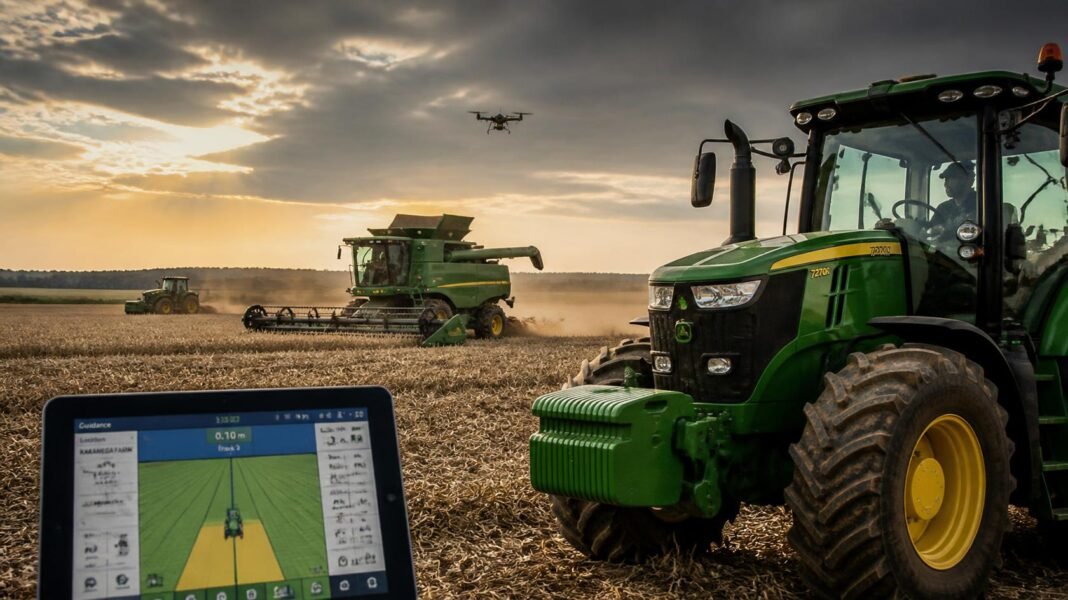

Agricultural mechanisation is changing the way farming is carried out across Africa.
From large commercial grain farms in South Africa to tractor-hire services supporting smallholders in Tanzania and Kenya, machinery is increasingly becoming an important part of the continent’s agricultural transformation.
But which African countries are the most mechanised?
There is no single statistic that can answer the question. Counting tractors alone can produce a misleading picture because countries differ greatly in farm size, agricultural land area, cropping systems, machinery ownership and access to machinery services.
For this ranking, Agrimachinery Africa looks at agricultural mechanisation more broadly, considering tractor availability, the extent to which machinery is actually used in farming operations, mechanised land preparation and harvesting, machinery access through contractors and hire services, irrigation and post-harvest mechanisation, as well as the development of national mechanisation programmes.
The result is a ranking that looks not only at how many machines a country has, but also at how deeply mechanisation is integrated into agriculture.
1. South Africa
South Africa is arguably the most advanced agricultural mechanisation market in Africa, but its position should not be based simply on the number of tractors operating in the country.
A major challenge when comparing African countries is that South Africa does not consistently publish a single, up-to-date national figure for its operational agricultural tractor fleet.
Instead, the strength of South African mechanisation is visible through the scale of its commercial farming sector, machinery market, equipment sales and the extensive use of machinery across crop-production operations.
A large commercial farming sector drives mechanisation
South Africa’s commercial agricultural sector is highly capital intensive.
Large farms producing maize, wheat, soybeans, sunflower, sugarcane and other crops use tractors and specialised machinery across multiple stages of production.
Mechanisation is particularly advanced in:
- land preparation
- planting
- fertiliser application
- crop protection
- harvesting
- baling
- grain handling
- transport
- irrigation
Large farm sizes also make it economically possible for producers to invest in high-horsepower tractors, combine harvesters, precision planters and specialised implements.
High-powered machinery is an important part of the market
South Africa’s machinery market includes a substantial share of high-horsepower equipment.
BFAP’s agricultural baseline data show that tractors above 130 kW represented approximately 32% of mechanisation-product imports in the period covered by its analysis. Machinery parts accounted for a further 20%.
The importance of high-powered tractors is significant because it reflects the nature of South Africa’s commercial farming system.
Large-scale grain producers can justify machinery capable of covering hundreds or thousands of hectares efficiently.
Mechanisation extends beyond tractors
South Africa’s advantage is not simply its tractor market.
Farmers increasingly use:
- precision-guidance systems
- GPS
- automated steering
- variable-rate application
- telematics
- digital farm-management systems
- high-capacity combine harvesters
- specialised planting equipment
- modern irrigation systems
This makes South Africa one of the few African agricultural markets where advanced machinery and digital agriculture are increasingly integrated into mainstream commercial farming.
Grain farming is heavily mechanised
The country’s large commercial grain sector is one of the strongest drivers of mechanisation.
Maize, wheat, soybean and sunflower producers rely extensively on mechanised land preparation, planting and harvesting.
Large-scale harvesting operations are particularly dependent on combine harvesters, grain carts, trucks and other equipment that allows farmers to harvest large areas within relatively short seasonal windows.
Machinery dealers and contractors strengthen access
South Africa also has a mature agricultural machinery distribution network.
International manufacturers operate alongside local dealers, implement manufacturers, machinery contractors and specialist agricultural service companies.
This means farmers can access not only machinery but also:
- spare parts
- maintenance
- technical support
- operator training
- precision-agriculture services
- machinery finance
The result is an agricultural machinery ecosystem that is significantly more developed than in most African markets.
The major qualification
South Africa should not be presented as having uniformly mechanised agriculture.
The country’s commercial farming sector is highly mechanised, but smaller-scale and emerging farmers can face significant barriers to accessing modern machinery.
The cost of tractors, combines and precision equipment can be prohibitive for smaller producers.
Consequently, South Africa’s mechanisation advantage is concentrated particularly in its commercial agricultural sector.
Why South Africa ranks first
South Africa’s position at the top of our ranking is therefore based on the depth and sophistication of agricultural mechanisation, rather than a single tractor-count statistic.
The country combines large-scale commercial farming with high-powered machinery, sophisticated harvesting systems, precision agriculture, established machinery dealers and a mature equipment-service ecosystem.
In other words, South Africa does not simply have agricultural machinery.
Machinery is deeply integrated into the country’s commercial agricultural production system.
Related Articles
- Record Harvest, Record Workload: How Mechanization Powered South Africa’s Maize Comeback
- Africa Doesn’t Lack Farmers Who Want Modern Equipment — It Lacks a Way to Finance Them
- Mwea’s Mechanisation Gap: Why Rice Transplanting Remains the Final Frontier
- Top Tractor Dealers in Mozambique: Where to Buy New, Used and Small Tractors in 2026
2. Egypt
Egypt is another major agricultural mechanisation centre, supported by intensive irrigated agriculture and a large agricultural machinery market.
Agricultural machinery is used extensively for land preparation, planting, crop management and harvesting. The country’s irrigated farming systems also create strong demand for pumps, irrigation equipment and other mechanised systems.
Egypt’s distinctive advantage is the combination of mechanisation and intensive agriculture.
Unlike countries with enormous expanses of rain-fed farmland, Egypt’s agricultural production is concentrated around the Nile Valley, Delta and increasingly reclaimed desert areas. Machinery therefore plays an important role in making intensive production possible.
Large agricultural projects in the country’s desert regions have also increased demand for tractors, irrigation systems, harvesting machinery and other equipment.
Egypt also has a significant domestic agricultural machinery industry and a large network of machinery importers, distributors and service providers.
The challenge is that mechanisation is not uniform across all farms. Smallholder agriculture remains important, and access to modern machinery can be constrained by farm size and investment costs.
Mechanisation assessment: Very high
3. Algeria
Algeria has one of North Africa’s strongest agricultural machinery bases, particularly because of its large cereal-producing sector and extensive government support for agricultural development.
Tractors, combine harvesters and implements are widely used in cereal production, where mechanised land preparation, seeding and harvesting are essential.
Wheat and barley production in particular depend heavily on machinery.
Algeria is also developing agriculture in its southern regions, where mechanisation and irrigation are becoming increasingly important. Large-scale agricultural development in the Sahara requires machinery capable of operating over extensive areas while irrigation systems provide the water required for production.
Government-backed agricultural programmes have played an important role in expanding machinery access.
Algeria’s mechanisation system therefore combines commercial agriculture, cereal production, state support and large-scale agricultural development.
However, as with other North African countries, mechanisation is not equally distributed among all farm types.
Mechanisation assessment: Very high
4. Tunisia
Tunisia presents one of the most interesting examples of agricultural mechanisation in Africa because machinery utilisation is much higher than tractor ownership among individual farmers.
Recent research reported by CGIAR indicates that more than 90% of Tunisia’s agricultural land is cultivated using tractors, while only about 6% of farmers own tractors.
That apparent contradiction reveals the importance of machinery contractors and service providers.
Farmers do not necessarily have to own a tractor to benefit from mechanised agriculture. Instead, machinery can be hired for land preparation, planting, harvesting and other operations.
Tunisia has a long-established mechanisation system, particularly in cereal and dryland agriculture. Mechanised soil preparation and harvesting are important components of production.
The country is also working to improve small-scale mechanisation by developing machinery and service models better suited to smaller farms.
One challenge is machinery renewal. Tunisia has historically had an ageing agricultural machinery fleet, making replacement and modernisation an important issue.
Nevertheless, the extent to which tractors are actually used across agricultural land makes Tunisia one of Africa’s strongest examples of machinery access through service provision rather than ownership.
Mechanisation assessment: Very high
5. Morocco
Morocco has developed one of North Africa’s most important agricultural machinery markets.
Tractors are widely used for land preparation, planting and other field operations, particularly in cereal-producing regions and commercial agriculture.
The country’s agricultural mechanisation has also benefited from government programmes designed to encourage farmers to invest in machinery and improve productivity.
Cereal farming is an important driver of mechanisation, while commercial horticulture and irrigated agriculture have created demand for more specialised equipment.
Morocco’s agricultural machinery ecosystem includes international manufacturers, dealers, contractors and local agricultural equipment businesses.
However, the country’s large population of small and medium-sized farms means that machinery access remains uneven.
Machinery contracting and shared access therefore play an important role in allowing farmers who cannot justify buying expensive equipment to benefit from mechanisation.
Morocco’s combination of established machinery use, government support and commercial agriculture puts it firmly among Africa’s more mechanised countries.
Mechanisation assessment: High
6. Zimbabwe
Zimbabwe’s agricultural mechanisation story is one of the fastest-moving on the continent.
Government figures show the country’s tractor fleet rising dramatically over the past decade, while the number of combine harvesters has also increased.
The government reported that the tractor fleet increased from 4,466 tractors in 2015 to 17,220 in 2026, while combine harvesters increased from 158 to 403 over the same period.
This represents a major expansion of the country’s machinery base.
Zimbabwe has also introduced programmes involving international machinery manufacturers and suppliers, including tractor and combine-harvester procurement schemes.
Mechanisation is particularly important in commercial grain production, where tractors and combines are used extensively.
However, Zimbabwe still has a significant mechanisation gap between large commercial farms and smallholder agriculture. Research has found that animal traction remains dominant in much of smallholder land preparation.
This means Zimbabwe’s machinery fleet is expanding faster than the country’s overall agricultural mechanisation level.
The country nevertheless deserves a high position because of the scale and speed of its recent mechanisation expansion.
Mechanisation assessment: Moderate–high, rapidly rising
7. Kenya
Kenya has a relatively developed agricultural machinery market, although mechanisation varies considerably between regions and farming systems.
Tractors are widely used for land preparation in major agricultural areas, while combine harvesters and specialised machinery are increasingly used in crops such as wheat, maize, rice, potatoes and sugarcane.
Kenya’s commercial agricultural sector is considerably more mechanised than much of its smallholder sector.
One of the country’s biggest advantages is the development of machinery-hire and contracting services.
A farmer does not necessarily need to own a tractor or combine harvester. Machinery can be hired for specific operations such as ploughing, planting or harvesting.
This model is particularly important because Kenya’s agricultural sector contains millions of relatively small farms where individual machinery ownership is often economically difficult.
Rice production in Mwea provides an interesting example. Land preparation and harvesting are highly mechanised, while transplanting remains a more difficult operation to mechanise because of local soil and production conditions.
Kenya is also seeing growing adoption of precision agriculture, drones, GPS-based systems, automated irrigation and digital farm-management technologies, particularly among commercial farms.
The country’s biggest challenge remains the fragmented nature of smallholder agriculture.
Operational Tractor Fleet
📍 Where Kenya’s tractors are concentrated
Uasin Gishu
Trans Nzoia
Kakamega
Bungoma
Rift Valley: Maize and wheat production
Western Kenya: Sugarcane production
Mechanisation assessment: Moderate–high
8. Tanzania
Tanzania has emerged as one of Africa’s fastest-growing agricultural mechanisation markets.
Official agricultural data show that the area cultivated using tractors increased to approximately 4.35 million hectares in 2023/24, more than doubling from the level recorded in 2019/20.
The country’s operational tractor fleet also expanded significantly. In 2023/24, Tanzania reported approximately 15,633 small operational tractors and 25,632 large operational tractors, giving a combined total of about 41,265 operational tractors.
This represents substantial progress.
However, Tanzania is not yet fully mechanised. In the same period, approximately 4.69 million hectares were cultivated using animal traction.
The country therefore has a mixed agricultural system in which tractors and animal power remain important alongside each other.
Tanzania’s government is now attempting to accelerate the transition through a new long-term agricultural mechanisation strategy covering the period to 2036.
The strategy includes machinery service centres, tractor procurement and expanded access to mechanisation services.
Rice, maize and other major crops provide significant opportunities for further mechanisation.
Tanzania’s greatest strength is therefore not its current level alone, but the speed at which tractorised agriculture is expanding.
Mechanisation assessment: Moderate–high, rapidly rising
9. Ethiopia
Ethiopia has a huge agricultural sector and is increasingly investing in mechanisation, particularly in cereal production.
Tractors are becoming more common in land preparation, while combine harvesting has expanded in major grain-producing areas.
Wheat has become one of the most visible examples of Ethiopia’s mechanisation drive. Increased wheat production has been accompanied by greater use of tractors, planters, combine harvesters and other machinery.
The government has also promoted agricultural machinery service centres, allowing farmers to access equipment without purchasing machinery individually.
This is particularly important because most Ethiopian farmers are smallholders.
The country’s mechanisation challenge is therefore similar to that of Kenya, Tanzania and Zambia: the machinery needs to reach millions of farmers operating relatively small holdings.
Animal traction remains important, particularly in traditional smallholder farming areas.
Ethiopia consequently has a large gap between highly mechanised commercial and cereal-producing areas and traditional smallholder agriculture.
Nevertheless, its expanding machinery fleet, growing mechanised harvesting sector and strong government push make Ethiopia one of Africa’s most important emerging mechanisation markets.
Mechanisation assessment: Moderate, rapidly rising
10. Zambia
Zambia completes our Top 10, although its inclusion requires an important qualification.
The country currently has a relatively low overall level of agricultural mechanisation compared with the leading countries on this list.
Zambia’s National Agricultural Mechanisation Strategy estimates motorised mechanisation at only around 2% nationally, illustrating the enormous gap that remains.
The majority of Zambia’s farmers are smallholders, many of whom continue to depend on manual labour and animal traction.
Tractor ownership among smallholders is particularly limited.
However, large-scale commercial farms are considerably more mechanised and use tractors, planters, harvesters and other machinery across much of the production cycle.
Zambia’s biggest strength is its aggressive mechanisation expansion programme.
The government has established mechanisation service centres designed to allow farmers to hire machinery instead of purchasing it.
The country is targeting hundreds of mechanisation centres and additional tractor deployment as part of its national strategy.
This machinery-as-a-service model could become particularly important in Zambia because individual ownership is beyond the financial reach of many smallholders.
Zambia therefore makes our Top 10 not because it already has one of Africa’s highest mechanisation rates, but because it combines a substantial commercial farming sector with one of the continent’s more ambitious programmes for expanding machinery access.
Mechanisation assessment: Moderate–low currently, but rapidly rising
What the ranking tells us
The biggest lesson from comparing these countries is that agricultural mechanisation cannot be measured simply by counting tractors.
Tunisia provides perhaps the clearest example. More than 90% of its agricultural land is cultivated using tractors, yet only a small proportion of farmers own tractors.
Machinery contractors and service providers allow farmers to access equipment without purchasing it.
A similar model is emerging in Kenya, Tanzania, Zambia and Nigeria.
This is likely to become increasingly important across Africa because millions of smallholder farmers cannot economically justify owning expensive tractors, combines and specialised implements.
The future of African mechanisation may be machinery-as-a-service
Instead of:
Farmer → buys tractor → uses tractor on own farm
the model is increasingly becoming:
Machinery provider → owns equipment → serves many farmers → farmers pay for the service
This can dramatically increase the number of hectares benefiting from mechanisation without requiring every farmer to become a machinery owner.
The countries to watch
Several countries just outside our Top 10 deserve attention.
Nigeria
Nigeria has one of Africa’s largest agricultural sectors but currently has a severe machinery deficit.
Its government is now implementing a national mechanisation policy, deploying tractors through service providers and developing a machinery-as-a-service model.
Nigeria may therefore become one of the continent’s biggest mechanisation markets over the next decade.
Ghana
Ghana has a growing agricultural machinery market and has invested in mechanisation centres and tractor services, particularly to support smallholder agriculture.
Senegal
Senegal is an important West African mechanisation market, particularly in irrigated agriculture and rice production.
Sudan
Sudan has historically had substantial mechanised agriculture, particularly in large-scale farming systems. However, conflict and disruption make current national comparisons extremely difficult.
Côte d’Ivoire
Côte d’Ivoire’s commercial agriculture, particularly cocoa and other major crops, provides significant opportunities for further mechanisation and agricultural equipment adoption.
Africa’s agricultural mechanisation leaders — at a glance
| Rank | Country | Current mechanisation picture |
|---|---|---|
| 1 | 🇿🇦 South Africa | Very high |
| 2 | 🇪🇬 Egypt | Very high |
| 3 | 🇩🇿 Algeria | Very high |
| 4 | 🇹🇳 Tunisia | Very high |
| 5 | 🇲🇦 Morocco | High |
| 6 | 🇿🇼 Zimbabwe | Moderate–high, rapidly rising |
| 7 | 🇰🇪 Kenya | Moderate–high |
| 8 | 🇹🇿 Tanzania | Moderate–high, rapidly rising |
| 9 | 🇪🇹 Ethiopia | Moderate, rapidly rising |
| 10 | 🇿🇲 Zambia | Moderate–low, rapidly rising |
A ranking that will change
Africa’s agricultural mechanisation landscape is changing quickly.
South Africa, Egypt, Algeria and Tunisia already have relatively mature mechanised agricultural systems. But countries such as Zimbabwe, Tanzania, Kenya, Ethiopia and Zambia are expanding machinery access rapidly.
Meanwhile, Nigeria has enormous potential because of its vast agricultural sector and very large unmet demand for machinery.
The next phase of African mechanisation may therefore be less about simply selling more tractors and more about building the infrastructure around them — machinery hire, financing, operators, repair centres, spare parts, local assembly, precision technology and specialised equipment.
For agricultural machinery manufacturers and dealers, that represents a potentially enormous market.
For African farmers, the ultimate measure will be simpler:
How much easier, faster and more productive is it to farm?
Also Read
- Economist Says Nigeria Needs One Million Tractors to Modernise Agriculture
- How Agricultural Machinery Is Powering Europe’s Biomass Energy Revolution—and What Africa Can Learn
- U.S. Tractor Sales Fall 10.9% in July as North American Farm Machinery Market Remains Under Pressure
- Tractor Prices in Kenya (2026): New & Used Tractor Price Guide

Martin is a writer at Agrimachinery Africa specializing in agricultural machinery, mechanization trends, and farm technology across Africa. His work focuses on tractors, harvesting equipment, irrigation systems, and emerging innovations helping farmers improve productivity and efficiency. Through in-depth industry coverage, he highlights technologies shaping the future of modern agriculture.