



A commercial seed-processing plant has a job that goes far beyond simply cleaning harvested grain.
It must remove unwanted material, separate inferior seed, protect the quality of the remaining lot and, where required, apply seed treatment consistently before the finished product reaches the packaging line.
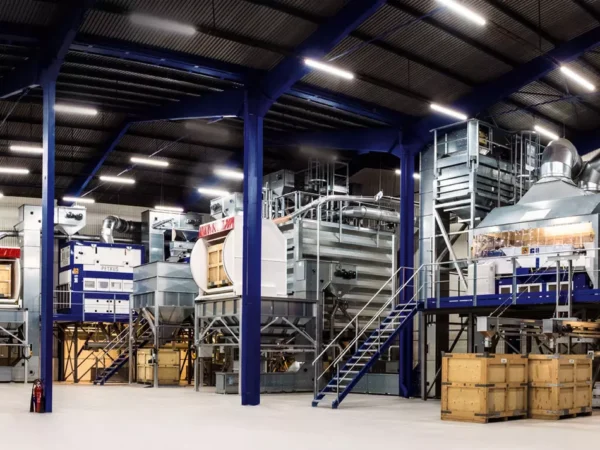
A seed-processing installation commissioned by PETKUS in South Africa in late 2022 provides a useful example of how several of these processes can be integrated into a multi-crop line.
The German seed-processing equipment manufacturer designed the installation for processing different crops and incorporated three key technologies: the S12 Airmax seed cleaner, G40 gravity separator and CM300 batch treater. PETKUS says the installation was developed for one of its key accounts in South Africa.
Rather than looking at the plant simply as a collection of machines, it is more useful to examine how the technologies work together and why each stage matters.
Why seed processing requires more than cleaning
Harvested seed is rarely a uniform product.
A crop arriving at a seed-processing facility can contain plant residues, dust, weed seeds, broken kernels and other foreign material.
Even after these impurities have been removed, the remaining seed may still vary in size, weight, density and quality.
That is why commercial seed-processing plants combine different separation technologies.
Screening can separate material according to size. Air aspiration can remove lightweight material. Gravity separation can distinguish seed according to density.
Further grading or optical sorting can be added where the required quality specification demands it.
The final stage may involve seed treatment, coating or other enhancement processes.
PETKUS describes its seed-conditioning business as covering a wide range of crops, including maize, sunflower, soya, pulses, grass and grain seeds. The company says its plant designs are customised according to crop and processing requirements.
This flexibility is particularly relevant to a multi-crop installation such as the South African project.
The South African multi-crop seed-processing line
PETKUS completed commissioning of the South African plant in late 2022.
The company says the line was designed to process multiple crops and incorporates technologies for cleaning, density separation and seed treatment.
One of the issues highlighted by PETKUS in connection with the project was Fusarium affecting wheat.
The company said effective separation, sorting and seed treatment were important for identifying and removing affected kernels and maintaining the quality of the seed lot.
That point illustrates why seed processing cannot be treated as a single operation.
A seed lot may require several different separation principles before it reaches the desired specification. In the South African installation, the process moves from air-screen cleaning to gravity separation and then treatment.
S12 Airmax: the first major cleaning stage
The S12 Airmax is the cleaning stage of the PETKUS installation.
Air-screen cleaners combine mechanical screening with aspiration. The screens separate particles according to their physical dimensions, while controlled airflow can remove lighter material from the product stream.
PETKUS says its Airmax system uses a three-channel aspiration concept.
The company’s current S Airmax documentation describes staged aspiration designed to remove light impurities, broken or half kernels and lower-density material from the product stream.
This approach is important because unwanted material can have different physical properties.
For example, a piece of plant residue may be considerably lighter than the desired seed, while another unwanted particle may be similar in size but different in density. Combining screening and air separation therefore gives the processor more control than relying on a single separation method.
The S12 Airmax is also designed around operator control and changeover. PETKUS lists recipe management, sensor-based process control and features intended to simplify screen changes among the characteristics of its S Airmax range.
For a multi-crop plant, this matters because the equipment may have to be adjusted when changing from one crop or seed lot to another.
PETKUS says the S12 Airmax used in the South African project incorporates an integrated control cabinet, which the company says improves usability while maintaining cleaning performance.
G40 gravity separator: separating seed by density
Cleaning alone does not necessarily remove every undesirable seed.
Some unwanted kernels can be similar in size to good kernels but differ in density. This is where a gravity separator becomes important.
The G40 gravity separator in the South African line separates seed according to specific weight.
PETKUS specifically identifies the G40’s midex deck as the stage used to remove lighter wheat grains affected by Fusarium.
The principle is different from conventional screening.
Instead of asking whether a particle is larger or smaller than another particle, gravity separation uses differences in density and weight.
A properly adjusted gravity table can therefore separate fractions that may be difficult to distinguish through screening alone.
This makes gravity separation particularly valuable when the processor is trying to improve the physical quality of a seed lot without simply discarding large quantities of otherwise usable material.
PETKUS says its G-series gravity separators are designed for grains and seeds and use controlled airflow and digitalised sorting processes.
The company’s published product information lists the G40 with a capacity of up to 12 tonnes per hour, although actual performance depends on the crop, product condition and processing configuration.
CM300: treating the seed after separation
Once the seed has been cleaned and separated, the process can move to treatment.
The South African installation uses a PETKUS CM300 batch treater before the seed reaches the packaging stage.
Seed treatment is intended to distribute a treatment product consistently across the seed. Uniform application is important because variations in coating or treatment can affect the amount of active material carried by individual seeds.
PETKUS says its batch treater technology combines coating and drying in one process. The company also says this approach can reduce dust and seed abrasion.
The current PETKUS MultiCoater CM range describes integrated drying as a central part of the system.
PETKUS says the equipment can provide up to 100% surface coverage and can handle different treatment techniques, including seed treatment, film coating, encrustation and pelleting. The CM300 is listed with a capacity of up to 25 tonnes per hour.
The technology is therefore not simply about applying liquid to seed.
The treatment and drying stages have to work together so that the seed leaves the process in a condition suitable for subsequent handling and packaging.
Why multi-crop capability matters
A seed plant processing only one crop can be configured around a relatively narrow range of physical characteristics.
A multi-crop plant faces a different challenge.
Maize, wheat, pulses, grass seed and other crops differ in dimensions, density, flow characteristics and processing requirements. Even within one crop, different varieties and seed lots can require different settings.
The processing equipment therefore needs sufficient flexibility to accommodate these changes.
This is one reason controls and recipe management are becoming increasingly important in modern seed plants.
Rather than treating every batch as an entirely new process, operators can use defined processing parameters and adjust them according to the crop and quality requirements.
PETKUS says its seed-processing solutions are designed around different crop types and that its technology portfolio covers conditioning and seed enhancement processes.
For a commercial seed producer, this flexibility can potentially make better use of an existing processing facility and reduce the need for separate equipment for every crop.
Safety and process control
Seed processing also presents engineering challenges that extend beyond separation performance.
The plant contains moving machinery, conveying systems, electrical equipment and dust-producing processes. Guards, control circuits, emergency systems and access arrangements therefore form part of the overall plant design.
For the South African installation, PETKUS says the complete system underwent a safety evaluation involving an independent audit company and an additional safety professional.
According to PETKUS, the assessment covered machine guards, control circuits and process safety. The company says the assessors considered the safety level of the machines, particularly the electrical panels, to be high.
The significance of this is that safety cannot be added as an afterthought to a large seed-processing line. It needs to be considered across the entire installation.
From raw seed to packaged product
The South African PETKUS installation can therefore be viewed as a sequence of complementary processes:
Incoming seed → air-screen cleaning → density separation → seed treatment and drying → packaging
Each stage addresses a different problem.
The S12 Airmax handles the initial cleaning and aspiration process.
The G40 gravity separator adds density-based separation, which PETKUS identifies as particularly important for removing lighter wheat kernels affected by Fusarium.
The CM300 batch treater then provides uniform treatment and integrated drying before the seed moves toward packaging.
The value of the system is consequently not dependent on one machine alone. It comes from integrating different technologies so that the output from one process becomes the input for the next.
What the South African installation demonstrates
The PETKUS project provides a useful example of how commercial seed processing is moving toward integrated, multi-stage systems.
For seed producers, the objective is not merely to increase throughput. A successful processing line must balance capacity with cleaning efficiency, separation accuracy, gentle handling, treatment consistency, operator control and safety.
The South African plant also shows why multi-crop capability can be important. A facility serving several crops needs equipment that can adapt to different seed characteristics while maintaining consistent processing standards.
Ultimately, seed processing is about controlling what remains in the final seed lot as much as removing what does not belong there.
The combination of cleaning, gravity separation and treatment in the PETKUS installation demonstrates that principle clearly: each technology addresses a different quality challenge, while the integrated line turns harvested seed into a more controlled product ready for the next stage of the seed-production chain.
Editor’s note: The South African installation described in this article was commissioned in late 2022. Equipment specifications and capabilities cited above are based on information published by PETKUS and should not be interpreted as performance guarantees for every crop or seed lot.
Also Read
Case IH Updates precision Air 5 Series Air Carts, Flex Hoe 900 Air Drills
This Potato Harvester from Agrimerin is phenomenon

Martin is a writer at Agrimachinery Africa specializing in agricultural machinery, mechanization trends, and farm technology across Africa. His work focuses on tractors, harvesting equipment, irrigation systems, and emerging innovations helping farmers improve productivity and efficiency. Through in-depth industry coverage, he highlights technologies shaping the future of modern agriculture.