

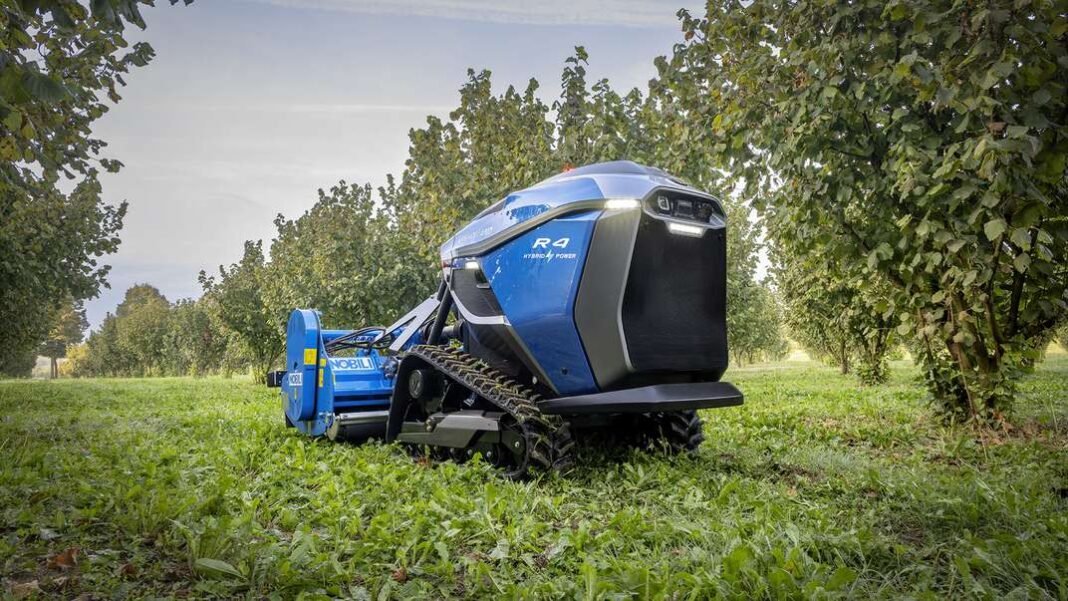

New Holland has introduced its Autonomous R4 Robot Series, a next-generation agricultural robotics platform designed to tackle labour shortages, reduce emissions, and transform farming operations in vineyards, orchards, and specialty crop sectors.
The unveiling of the R4 concept highlights the accelerating shift toward driverless farm machinery, a trend that could redefine how high-value crops are produced globally.
Two Autonomous Robots for Modern Farming
The R4 platform consists of two models tailored for different farming environments:
-
R4 Electric Power – a compact, fully electric robot designed for narrow vineyards
- Advertisement - -
R4 Hybrid Power – a hybrid diesel-electric machine built for orchards and larger specialty crop farms
Both machines are designed to perform repetitive tasks such as mowing, tillage, and spraying without a human operator, allowing skilled workers to focus on higher-value activities like crop management and data analysis.
Advanced Autonomous Technology
The R4 robots are controlled via a mobile application and rely on a combination of GPS, LiDAR, and vision cameras for navigation and precision task execution.
This sensor fusion enables the machines to operate autonomously in complex environments such as vineyards with narrow rows and orchards with dense canopy structures.
New Holland says the robots can integrate with existing implements and use an intelligent electric drivetrain to power tools without hydraulic oil, reducing maintenance needs and environmental impact.
Key Technical Features
R4 Electric Power
-
Powered by a 40 kWh battery pack
-
Compact design for 1.0–1.5 m row spacing
-
Weighs about 1 tonne
- Advertisement - -
Zero-emission operation for sustainable agriculture
R4 Hybrid Power
-
Combines a 59 hp diesel engine with electric generator technology
-
Can run on vegetable-oil-based fuels to cut carbon emissions
-
Offers extended autonomy and double-pass coverage for large orchards
-
Capable of fully electric operation for quiet, zero-emission tasks
Both models feature rubber-track drive systems to reduce soil compaction and improve traction, a critical factor for specialty crops.
Addressing Labour and Sustainability Challenges
The R4 Robot Series was developed to help farmers overcome key industry challenges such as skilled labour shortages and the demand for more sustainable food production.
New Holland says high-value crops require intensive, repetitive labour, especially during peak seasons, making them ideal candidates for automation.
By automating routine operations, growers can reduce operational costs while improving consistency and productivity.
A Step Toward Fully Autonomous Farms
Although initially targeted at vineyards and orchards, the technology behind the R4 robots could eventually expand to row-crop farming, including cereals and oilseeds.
Industry experts believe autonomous platforms like R4 could complement or even replace traditional tractors in specific tasks, especially in precision agriculture environments.
New Holland has showcased the R4 robots at major agricultural technology events, where they have attracted strong interest from growers and agri-tech stakeholders worldwide.
What This Means for African Agriculture
For Africa, where labour shortages, rising fuel costs, and sustainability pressures are increasing, autonomous robots could offer a transformative solution—particularly for high-value export crops such as grapes, avocados, and citrus.
However, high upfront costs, infrastructure needs, and technical skills requirements may limit immediate adoption, suggesting a gradual rollout starting with commercial farms and agribusiness estates.
Also Read
Robots Replacing Tractors: The Future of Autonomous Farming
Top Smart Irrigation Systems for African Farms

Martin is a writer at Agrimachinery Africa specializing in agricultural machinery, mechanization trends, and farm technology across Africa. His work focuses on tractors, harvesting equipment, irrigation systems, and emerging innovations helping farmers improve productivity and efficiency. Through in-depth industry coverage, he highlights technologies shaping the future of modern agriculture.