


For more than a century, the tractor has been the defining symbol of modern agriculture.
It replaced the ox and the draft horse, multiplied the productive capacity of a single farm worker, and enabled the industrialization of food production at a global scale.
Yet despite its enduring dominance, the tractor — and the human operator sitting in its cab — is no longer the apex of agricultural innovation.
A new generation of autonomous farming robots is emerging from research labs, Silicon Valley startups, and the R&D divisions of the world’s largest agritech companies. These machines do not merely automate tractor functions.
They fundamentally reimagine how fields are monitored, managed, and harvested — operating continuously, gathering granular data, and executing precision interventions that no human-driven machine can match.
According to a 2023 report by the Food and Agriculture Organization of the United Nations (FAO), global food demand is projected to increase by roughly 50 percent by 2050, while arable land and freshwater resources remain constrained.
Meanwhile, agricultural labor shortages are accelerating across North America, Europe, and parts of Asia. These converging pressures are creating an urgent and commercially viable market for autonomous farming technology.
This article examines how agricultural robotics is evolving, what technologies are powering the transition, which players are leading the industry, and what the shift from tractors to robots means for farmers, rural economies, and global food security.
From Tractors to Robots: The Evolution of Farm Machinery
The Tractor’s Reign
The internal combustion tractor, commercialized in the early twentieth century, was itself a disruptive technology.
It displaced millions of farm workers and draft animals, enabling a small number of operators to cultivate vast acreages. By the mid-twentieth century, mechanization had transformed agriculture in the developed world, dramatically raising yields and reducing the cost of food production.
Subsequent decades brought incremental improvements: diesel engines, hydraulic systems, GPS auto-steer, and telematics.
John Deere’s introduction of precision agriculture tools in the 1990s marked a turning point, embedding data and connectivity into farm equipment for the first time. Yet these advances all shared a common assumption — that a skilled human operator would remain in the cab, making real-time decisions.
The Shift to Autonomy
The limitations of that assumption have become increasingly apparent. Human operators fatigue, require rest periods, and command rising wages.
They are also prone to suboptimal decision-making under the cognitive load of managing complex, variable field conditions across long working days.
And for routine, repetitive tasks — applying herbicides, scouting for disease, thinning fruit — human labor is simultaneously expensive, slow, and insufficiently precise.
Three technological breakthroughs have converged to make autonomous farm machinery viable at commercial scale: the maturation of artificial intelligence and computer vision capable of interpreting field conditions in real time; the availability of centimeter-accurate GPS positioning through Real-Time Kinematic (RTK) systems; and the dramatic cost reduction of sensors, processors, and actuators that followed the consumer electronics and automotive industries’ investment in autonomous vehicle technology.
The result is a rapidly maturing ecosystem of autonomous farming robots that spans everything from fully driverless tractors to centimeter-scale weeding robots operating as coordinated swarms.
Types of Autonomous Farming Robots
Autonomous Tractors and Retrofit Kits
The most straightforward category of agricultural robotics involves removing the human operator from the tractor cab while preserving the machine’s established utility.
John Deere’s 8R Autonomous Tractor, commercially released in 2022, uses six pairs of stereo cameras combined with machine learning to navigate fields, avoid obstacles, and execute tillage and planting tasks without a driver.
Operators monitor and manage the machine remotely via a smartphone application.
CNH Industrial, the parent company of Case IH and New Holland, has pursued a parallel strategy through its Project Monarch concept — a compact, electric autonomous tractor designed to execute specialized tasks in orchards and vineyards.
Startup Monarch Tractor (no relation to CNH’s project) has commercialized a 40-horsepower electric autonomous tractor aimed at specialty crop producers, pairing autonomy with an emissions-free drivetrain.
For farmers unable or unwilling to invest in new autonomous hardware, retrofit autonomy kits offer an alternative.
Companies including Sabanto, Raven Industries (acquired by CNH), and Naio Technologies offer hardware-software packages that can be installed on existing tractors, adding GPS-guided autonomous operation without replacing the underlying machine.
Small Field Robots: Weeding, Spraying, and Harvesting
Some of the most technically sophisticated autonomous farming robots are not large machines at all. Small field robots — typically weighing between 50 and 500 kilograms — operate between crop rows, performing tasks that benefit from precision at the individual plant level.
Carbon Robotics’ LaserWeeder uses AI-guided lasers to destroy weed plants at a rate of up to 100,000 per hour without herbicides.
The machine can distinguish target crops from weeds with accuracy exceeding 99 percent, according to the company’s published field trial data. Fendt’s Xaver system deploys swarms of small, seed-planting robots that distribute field operations across dozens of lightweight units simultaneously.
In harvesting, companies including Abundant Robotics (apple picking), Agrobot (strawberries), and FFRobotics have developed robotic arms capable of identifying and picking ripe fruit without damaging the crop.
While harvesting robotics remains technically challenging — fruit identification and gentle manipulation are computationally and mechanically demanding — commercial deployments are increasing, particularly in labor-scarce markets.
Swarm Robotics
Swarm robotics, in which large numbers of small autonomous agents coordinate to complete field-scale tasks, represents one of the more transformative concepts in agricultural robotics. Rather than using one large machine, swarm systems distribute work across many small units operating in parallel.
This approach offers several advantages: smaller robots compact soil less than heavy tractors, individual unit failures do not halt operations, and the system can adapt dynamically to changing field conditions.
The Small Robot Company, based in the United Kingdom, has pioneered a swarm-based approach it calls ‘per plant farming.’
Its Tom, Dick, and Harry robots handle scouting, non-chemical weeding, and micro-dosing respectively — a division of labor across specialized machines that mirrors modern industrial production logic applied to crop management.
Vineyard and Orchard Robots
Specialty crop environments — vineyards, orchards, and berry fields — present unique challenges for autonomous machinery due to irregular terrain, fragile crops, and complex canopy structures.
New Holland’s NHDrive autonomous concept and dedicated vineyard robots from companies including Naïo Technologies, Vitirover (autonomous mowing), and Pek Automotive have been developed specifically for these environments.
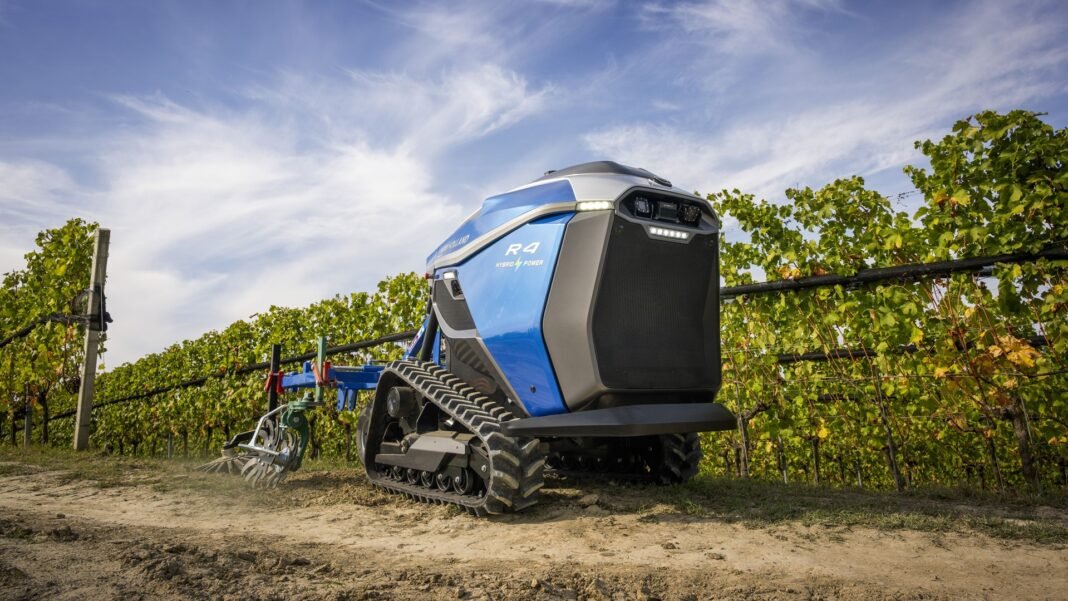
New Holland’s R4 concept tractor, designed for vineyard operations, pairs autonomous navigation with modular tool attachment systems capable of executing multiple tasks — canopy management, spraying, soil cultivation — in sequence without manual intervention.
Pilot deployments in European wine regions have reported labor cost reductions of 30 to 40 percent for routine vineyard operations.
Key Technologies Powering Autonomous Farming
Artificial Intelligence and Machine Vision
At the core of autonomous farming robots is the ability to perceive and interpret the agricultural environment.
Modern field robots use convolutional neural networks and transformer-based vision models trained on millions of labeled agricultural images to distinguish crop species, identify disease symptoms, assess fruit ripeness, and detect obstacles in real time.
The training data for these models has improved dramatically as commercial deployments have expanded.
Carbon Robotics’ LaserWeeder, for example, draws on a proprietary dataset of more than a billion plant images accumulated across commercial field deployments — a competitive moat that makes its models significantly more accurate than those of newer entrants.
GPS and RTK Navigation
Reliable autonomous navigation in agricultural fields requires positioning accuracy to within a few centimeters — far beyond what standard GPS can provide.
RTK (Real-Time Kinematic) GPS systems achieve this by comparing signals from a moving receiver against those from a fixed base station, correcting for atmospheric and satellite errors in real time.
Combined with inertial measurement units and wheel odometry, RTK positioning enables autonomous tractors to maintain sub-inch accuracy across field transects — a precision that is, in practice, superior to human-guided operation.
LiDAR and Sensor Fusion
LiDAR (Light Detection and Ranging) sensors generate high-resolution three-dimensional maps of the environment around an autonomous machine, enabling obstacle detection, terrain modeling, and crop canopy analysis.
When combined with RGB cameras, multispectral sensors, and thermal imaging in a sensor fusion architecture, LiDAR data gives autonomous robots a comprehensive situational awareness that exceeds human perceptual capabilities, particularly in low-light or dusty conditions.
Electric Drivetrains and Robotics Platforms
The shift from diesel to electric powertrains is enabling a new generation of autonomous farming robots characterized by lower operational costs, reduced noise and vibration (which can disrupt sensor readings and animal welfare), and compatibility with precision actuators that require stable electrical power.
Battery technology improvements and the emergence of on-farm solar charging infrastructure are gradually extending the operational range of electric field robots to commercially viable levels.
Cloud-Based Farm Management and Data Analytics
Autonomous farming robots generate enormous volumes of field data — crop health indices, soil moisture readings, weed pressure maps, yield estimates.
The commercial value of this data depends on the ability to aggregate, analyze, and translate it into actionable management recommendations.
Cloud-based farm management platforms, including those offered by Climate Corporation (now part of Bayer), Trimble Agriculture, and CNH’s AFS Connect, are evolving to serve as the operational intelligence layer above autonomous hardware — synthesizing field data with weather forecasts, commodity price signals, and agronomic models to optimize planting, irrigation, and harvest decisions.
Benefits of Robots Over Traditional Tractors
Labor Savings and Productivity Gains
Agricultural labor costs have risen sharply across major farming economies over the past decade.
In the United States, the average hourly wage for farm workers has increased by more than 50 percent since 2010, according to USDA data.
Autonomous robots address this pressure directly: a single operator can supervise multiple autonomous units simultaneously, multiplying effective output per labor dollar.
A McKinsey Global Institute analysis of automation potential in agriculture estimates that 40 to 60 percent of existing farm labor tasks are technically automatable using technologies that are either currently available or in late-stage development.
Autonomous robots do not take breaks, do not require overtime pay, and can operate through the night — advantages that translate directly into higher throughput during time-critical planting and harvest windows.
Precision Agriculture and Reduced Chemical Use
Perhaps the most economically and environmentally significant advantage of autonomous farming robots is their ability to apply inputs — seed, fertilizer, pesticide, water — with a precision that large, human-operated machinery cannot match.
While a conventional tractor-mounted sprayer blanket-applies herbicide across entire fields, autonomous weeding robots treat individual weed plants.
Carbon Robotics estimates that its LaserWeeder reduces herbicide application by up to 95 percent compared with conventional broadcast spraying on fields where it is deployed.
This precision has cascading benefits: lower input costs, reduced chemical runoff into waterways, smaller environmental regulatory exposure, and — increasingly — premium market access for produce grown with documented reduced-chemical protocols.
24/7 Operations and Efficiency
Planting and harvest windows are often narrow, determined by weather patterns and crop physiology. The inability to operate continuously through these windows can materially reduce yields and revenue.
Autonomous robots, which do not require rest periods, can execute field operations around the clock during critical periods — a capability that is particularly valuable in regions with unpredictable growing seasons.
Sustainability and Lower Emissions
Electric autonomous robots emit no direct greenhouse gases during operation.
Their lighter weight relative to conventional tractors reduces soil compaction, which degrades soil structure and reduces water infiltration over time — a long-term yield penalty that conventional farming systems rarely quantify but that agronomists have documented extensively.
The combination of lower emissions and reduced soil compaction positions autonomous robotic farming as a structural contributor to agricultural sustainability strategies.
Challenges and Barriers to Adoption
High Upfront Costs
The primary barrier to autonomous farming robot adoption is cost. John Deere’s 8R autonomous tractor system carries a list price exceeding $500,000 — an investment that is uneconomical for all but the largest row crop operations.
Small field robots, though less expensive individually, require multiple units to achieve field-scale coverage, and the cumulative cost of a swarm deployment can be similarly prohibitive.
Cost reduction is occurring — battery costs, sensor costs, and processing costs have all declined materially over the past five years — but the pace of decline in agricultural robotics lags that of consumer electronics.
Deloitte’s 2024 AgTech Investment Outlook report projects that autonomous farming hardware costs will fall by 30 to 40 percent by 2030 as manufacturing volumes increase, but parity with conventional tractor economics remains a medium-term rather than near-term prospect for most farm types.
Infrastructure and Connectivity Requirements
Autonomous farming robots depend on reliable high-speed connectivity for remote monitoring, software updates, and cloud-based analytics.
In many agricultural regions, particularly in emerging markets and remote rural areas of developed economies, cellular and broadband connectivity remains inadequate.
Low-Earth orbit satellite networks, including Starlink and Amazon’s Kuiper, are beginning to address this gap, but widespread agricultural connectivity is still years away in many markets.
Regulatory and Safety Concerns
Autonomous agricultural machinery operates in environments shared with farm workers, livestock, and members of the public.
Regulatory frameworks governing the safe operation of autonomous field robots are nascent and inconsistent across jurisdictions.
In the United States, the EPA and USDA have begun developing guidance frameworks, but comprehensive autonomous agricultural machinery regulations comparable to those governing autonomous highway vehicles do not yet exist.
This regulatory uncertainty creates liability exposure for early adopters and slows commercial deployment.
Farmer Trust and the Skills Gap
Agriculture is culturally conservative. Farmers who have operated tractors for decades are, understandably, cautious about delegating field operations to machines they do not fully understand and cannot easily repair themselves.
Autonomous robots require software expertise, data literacy, and familiarity with digital farm management platforms — skills that are not uniformly distributed across the farming population.
Leading agritech companies are responding with intensive training programs and support networks, but the skills gap remains a material adoption barrier, particularly among older farmers and in regions with limited access to technical education.
Cybersecurity and Data Ownership
Autonomous farming robots generate detailed operational data about fields, crops, and farming practices.
Questions about who owns this data — the farmer, the robot manufacturer, or the platform provider — remain contested and are subject to evolving legal frameworks.
The cybersecurity exposure of networked autonomous farm machinery is also a legitimate concern: a compromised autonomous fleet could be disabled during a critical harvest window, with significant economic consequences.
Impact on Farmers and Rural Economies
Workforce Transformation
The displacement of farm labor by autonomous robots is a societal reality that the agricultural industry and policymakers must address proactively.
Estimates of the scale of displacement vary widely. A 2022 Oxford Economics study projected that up to 1.5 million agricultural jobs in OECD countries could be automated by 2035, while creating significant demand for new roles in robot operation, maintenance, data analytics, and precision agronomy.
The transition is unlikely to be frictionless. Seasonal farm workers — often among the most economically vulnerable members of rural communities — face the most immediate displacement risk.
Workforce reskilling programs, supported by agritech companies, agricultural universities, and government agencies, will be essential to managing the social consequences of this transition.
Smallholder Farmers in Emerging Markets
The narrative of robots replacing tractors is largely framed around large-scale commercial farming in developed economies.
But the implications for the 500 million smallholder farms that account for approximately 70 percent of global food production — primarily in Africa, South Asia, and Latin America — are arguably more consequential.
Smallholder farmers typically lack access to even basic mechanization; the leap to autonomous robotics appears economically implausible.
Yet service-based deployment models — in which farmers lease access to autonomous robot fleets managed by agritech service providers, rather than purchasing equipment outright — are emerging as a potentially viable pathway.
Companies including Hello Tractor in Nigeria (which operates a tractor-sharing marketplace) and Mahindra’s agritech ventures in India are early indicators of service model innovation in emerging markets.
If autonomous robot fleets can be deployed economically as a service in smallholder contexts, the productivity gains could be transformative.
FAO estimates that closing the yield gap between smallholder and commercial farming operations could increase food supply in sub-Saharan Africa by 30 to 50 percent — a contribution that autonomous precision agriculture could meaningfully accelerate.
The Rise of Agritech Service Companies
The robot-as-a-service model is reshaping the competitive landscape of the agricultural equipment industry. Companies that previously competed on hardware — horsepower, reliability, dealer networks — are evolving toward software-defined service businesses.
John Deere’s strategic pivot toward data and autonomy services, articulated publicly by CEO John May, reflects the industry’s recognition that the long-term value in agricultural technology will accrue to companies that own the data layer, not just the hardware.
Future Outlook: Will Robots Fully Replace Tractors?
A Hybrid Future Through 2035
The complete replacement of tractors by autonomous robots is not imminent. For heavy tillage operations, large-scale grain harvesting, and tasks requiring significant drawbar pull, purpose-built large machinery will remain the economically rational choice for the foreseeable future.
The more accurate near-term prediction is a hybrid future: autonomous large tractors executing primary tillage and planting, complemented by fleets of small autonomous robots managing crop monitoring, weeding, spraying, and selective harvesting.
This division of labor plays to the comparative strengths of each platform type. Large autonomous tractors are efficient at covering ground rapidly with high-power implements. Small autonomous robots excel at precision interventions at the plant level.
The combination delivers productivity and precision advantages that neither system achieves independently.
Predictions for 2030–2040
Industry analysts project significant market expansion over the next fifteen years.
Allied Market Research estimates the global agricultural robot market will grow from approximately $12 billion in 2023 to more than $47 billion by 2030, representing a compound annual growth rate of around 21 percent.
By 2040, multiple analyst projections anticipate that autonomous equipment will account for the majority of new agricultural machinery sales in North America, Europe, and Australia.
The technological capabilities enabling this growth are on a clear improvement trajectory. AI model accuracy for crop and weed identification is improving rapidly. Battery energy density is increasing and cost is declining.
Sensor miniaturization is enabling capabilities in smaller, cheaper robots. And the accumulation of operational field data is compounding the accuracy and reliability of autonomous systems with each passing season.
AI-Driven Decision-Making and Fully Autonomous Farms
Looking further ahead, the integration of large language model reasoning with field sensor data and agronomic knowledge bases is beginning to enable a qualitatively new level of farm management autonomy.
Systems capable of synthesizing real-time field conditions, multi-season yield histories, weather forecasts, soil biology data, and commodity market signals to make end-to-end crop management decisions — without human involvement at the operational level — are in early development at several leading agritech research institutions.
Fully autonomous farms — in which AI systems manage the complete agronomic cycle from soil preparation through post-harvest storage — may be technologically feasible within fifteen to twenty years.
Whether they are socially, economically, and regulatorily viable within that timeframe is a more open question.
The barriers are less technical than institutional: data governance frameworks, liability regimes, rural workforce transition support, and public trust in autonomous food production systems will determine the pace of adoption as much as engineering capability.
The Intelligent Field
The tractor will not disappear. But the tractor as a symbol of agricultural modernity — a human-operated machine that imposes mechanical force on the land at scale — is giving way to a new paradigm: autonomous platforms that sense, reason, and act with a precision and continuity that redefines what a farming machine can be.
The transition from tractors to autonomous farming robots is not a single technological event but a multi-decade structural transformation, driven by the convergence of artificial intelligence, precision navigation, advanced sensing, and electric propulsion.
Its pace will be shaped by cost trajectories, regulatory development, connectivity infrastructure, workforce readiness, and the quality of business model innovation — particularly service-based deployment models that make autonomous technology accessible to farms of all sizes.
For agribusiness companies, the strategic implication is clear: the competitive landscape of agricultural equipment is being permanently reorganized around software, data, and autonomy.
Companies that treat robots and AI as extensions of existing hardware businesses will be outpaced by those that recognize the depth of the structural shift underway.
For farmers, the message is equally clear: autonomous farming technology is not a distant prospect but an accelerating commercial reality.
Engaging with it — through pilot deployments, service partnerships, and investments in digital farm management capabilities — is becoming a prerequisite for long-term competitiveness.
And for policymakers, the challenge is to ensure that the transformation delivers its economic and environmental benefits broadly — that smallholder farmers in emerging markets are not left further behind, that rural workforce transitions are managed with adequate support, and that the data and intelligence generated by autonomous farm systems serve the public interest as well as the private interests of the companies that develop them.
The field is changing. The machines that work it are becoming intelligent. And the farmers, companies, and governments that understand this transformation most clearly will be best positioned to shape what comes next.
Also Read
Precision planting: How seed drills supercharge maximum crop yield
The rise of smart farming: Precision tools for African Farms
