

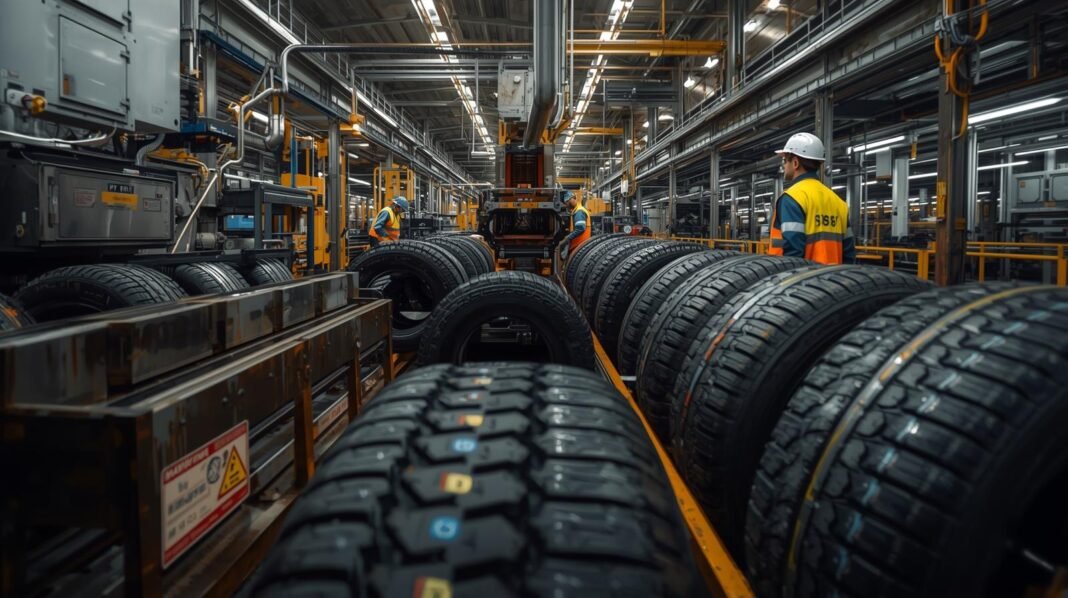

Driouch, Morocco — While most coverage of Morocco’s new €620 million tire manufacturing complex has focused on passenger vehicles, agricultural equipment manufacturers and dealers across Africa should be paying close attention.
The facility, set to produce 18 million tires annually by 2027, could fundamentally alter the economics of agricultural mechanization across the continent.
For decades, African farmers and equipment dealers have faced a persistent challenge: securing reliable, affordable replacement tires for tractors, combines, and other heavy agricultural machinery.
Most agricultural tires are imported from Asia or Europe, leading to extended lead times, high shipping costs, and limited options for specialized applications. Morocco’s massive new production facility in Driouch province may finally offer a regional solution.
The Agricultural Tire Opportunity
When Chinese manufacturer Shandong Yongsheng Rubber announced the 52-hectare facility through its subsidiary Goldensun Tire Morocco, the initial focus was on passenger and light truck tires for the automotive sector.
However, industry insiders suggest agricultural and off-highway tires represent a significant opportunity that could comprise 15-20% of the plant’s eventual output.
“The agricultural tire market in Africa is chronically underserved,” notes agricultural equipment consultant James Omondi, who advises dealers across East and North Africa.
“Right now, if a farmer in Kenya needs replacement tires for a 150-horsepower tractor, they’re looking at a six to eight-week wait for imports from India or Thailand, plus shipping costs that can add 30-40% to the tire price. A manufacturing hub in Morocco changes that equation entirely.”
The timing is particularly relevant as African agricultural mechanization accelerates. Tractor sales across sub-Saharan Africa have grown at double-digit rates over the past five years, driven by government subsidies, growing commercial farming operations, and increasing recognition that manual labor cannot meet the continent’s food security needs.
Strategic Location, Strategic Advantage
Morocco’s position as a tire manufacturing hub offers distinct advantages for agricultural equipment supply chains.
The Driouch facility’s proximity to the Nador West-Med Port provides direct shipping routes to both European and West African markets. Equipment dealers in Senegal, Côte d’Ivoire, or Ghana could receive tire shipments in days rather than weeks.
For North African markets, the advantage is even more pronounced. Morocco shares land borders with Algeria and is a short sea crossing from Spain, providing multiple distribution routes.
The country’s 60-plus free trade agreements, including with the European Union and several African nations, mean competitive duty structures that could make Moroccan-manufactured tires price-competitive with Asian imports even before considering reduced shipping times and costs.
“We’re already seeing agricultural equipment manufacturers establishing assembly operations in Morocco,” explains supply chain analyst Amira Benali.
“Once you have tire production co-located with tractor assembly, you create efficiencies that are difficult to replicate with imports. The next logical step is full-scale agricultural equipment manufacturing.”
Beyond Replacement: Specialized Applications
Perhaps more significant than replacement tire availability is the potential for specialized agricultural tire development tailored to African conditions. Current tire imports are typically designed for North American or European soil types, climate conditions, and farming practices.
African agriculture presents unique challenges: highly variable soil compositions ranging from heavy clay to sandy loam, intense heat in many regions, seasonal extremes between wet and dry periods, and often inadequate road infrastructure requiring tires that perform both in-field and during long transits on rough roads.
A local manufacturing presence could enable customization that’s economically unviable when ordering from overseas suppliers.
Tire compounds could be optimized for local temperature ranges.
Tread patterns could be designed for specific soil types prevalent in key agricultural regions. Sidewall construction could be reinforced for the extended road travel common in African farming operations where fields may be dozens of kilometers from equipment storage facilities.
“The technical knowledge exists,” says Dr. Hassan Idrissi, a materials engineer who has worked with Morocco’s automotive sector.
“What’s been missing is the manufacturing capacity close enough to African markets to make specialized production runs economically viable. An 18-million-tire-per-year facility has the scale to dedicate production lines to niche applications like agricultural tires while maintaining efficiency.”
The Moroccan Manufacturing Ecosystem
The Driouch tire factory doesn’t exist in isolation. Morocco has methodically built an industrial ecosystem that increasingly supports heavy equipment manufacturing.
The country produces over 700,000 vehicles annually and has attracted significant investment in automotive components, wiring harnesses, and metal fabrication.
Several agricultural equipment manufacturers have already taken notice. While specific announcements remain under wraps, industry sources indicate that at least two major tractor manufacturers are evaluating Moroccan assembly operations, attracted by the same factors that drew tire investment: infrastructure, trade access, and growing regional demand.
For equipment dealers, the implications extend beyond tire availability. A robust local manufacturing sector typically brings improved parts availability, faster warranty service, and potentially more competitive pricing as transportation costs decrease and economies of scale develop.
The Challenge of Technical Standards
Not all the news is automatically positive. Agricultural tires must meet demanding technical specifications, particularly for modern high-horsepower equipment.
Radial agricultural tires for large tractors require sophisticated manufacturing capabilities, including precise belt placement, specialized rubber compounds for different tire zones, and rigorous quality control.
Whether the Driouch facility will initially produce the full range of agricultural tire types remains unclear.
Early production may focus on simpler bias-ply tires suitable for smaller tractors and utility applications, with radial production for larger equipment following as the operation matures and technical capabilities expand.
Equipment manufacturers will also need assurance of consistent quality and supply. A single production facility creates concentration risk; any disruption could affect equipment assembly or dealer inventory across multiple markets.
Diversified sourcing will likely remain important even as regional capacity expands.
Water and Environmental Considerations
Morocco’s industrial expansion faces real constraints, particularly regarding water resources.
The Oriental region where Driouch is located has experienced persistent drought conditions, and tire manufacturing requires substantial water for cooling and processing.
For agricultural equipment stakeholders, this matters beyond environmental concerns. Water scarcity could limit production expansion or lead to operational interruptions during severe drought periods.
Facilities that implement closed-loop water systems and invest in water efficiency will be better positioned for long-term reliability.
The environmental footprint of tire production also increasingly matters to equipment manufacturers facing their own sustainability pressures.
European and North American equipment makers are setting ambitious carbon reduction targets.
Having tire suppliers with modern environmental controls and renewable energy integration could become a competitive advantage in serving export markets.
Looking Ahead: Implications for Equipment Dealers and Manufacturers
For agricultural equipment dealers across Africa, the emergence of regional tire manufacturing capacity suggests several strategic considerations:
Inventory management could shift from maintaining large tire stocks to more just-in-time approaches as lead times compress. This frees working capital while reducing the risk of holding obsolete inventory as equipment specifications evolve.
Service capabilities become more important when replacement parts are readily available. Dealers who invest in tire fitting equipment, wheel alignment capabilities, and technical training can capture more of the value chain rather than simply selling equipment.
Local partnerships with the Driouch facility and potential future tire manufacturers could provide preferred pricing, priority allocation during supply crunches, or even co-development of specialized tires for regional conditions.
For equipment manufacturers, the calculation is more complex but potentially transformative.
The question isn’t just whether Morocco can supply tires, but whether the emerging industrial ecosystem can support broader manufacturing operations.
If tire production proves successful, hydraulic components, transmission assemblies, and eventually complete equipment manufacturing could follow.
“We’re watching this very closely,” confirms a product planning executive at a major tractor manufacturer, speaking on condition of anonymity.
“Africa is one of the last major agricultural frontiers. If we’re going to serve that market at scale, we need regional manufacturing. Morocco is showing that it can be done.”
The Continental Context
Morocco’s tire facility also aligns with broader African industrialization efforts. The African Continental Free Trade Area, launched in 2021, aims to create a single market for goods and services across the continent.
For this vision to succeed, Africa needs manufacturing capacity, not just raw material exports.
Agricultural mechanization is central to the continent’s development. The United Nations estimates that Africa must triple agricultural productivity over the next three decades to feed its growing population and achieve food security.
That’s impossible without mechanization, and mechanization requires reliable equipment and parts availability.
A tire factory in Morocco may seem disconnected from subsistence farmers in Uganda or commercial grain operations in Zambia.
But supply chains are interconnected. Reducing the cost and complexity of tire procurement for a dealer in Ghana makes equipment ownership more viable for farmers in that dealer’s territory.
More tractors in operation create larger markets for equipment manufacturers, justifying further investment in regional production and service capabilities.
More Than Just Tires
When the Driouch facility begins production in early 2027, the first tires off the line will likely be standard passenger car radials destined for Morocco’s domestic market.
But for those in the agricultural equipment industry, the facility represents something more significant: proof of concept that sophisticated manufacturing can succeed in Africa, creating supply chain advantages that could reshape equipment economics across the continent.
The agricultural machinery sector has long operated on the assumption that Africa would remain an import market, with equipment and parts shipped from manufacturing hubs in Europe, North America, and Asia.
Morocco’s industrial ambitions suggest that assumption needs revisiting. The question for equipment manufacturers and dealers is whether to watch from the sidelines or engage early with what could become Africa’s emerging agricultural equipment manufacturing corridor.
As one African equipment dealer put it during a recent industry conference: “We’ve spent decades explaining to farmers why parts take so long and cost so much. Maybe we’re finally getting to a point where we can compete on service and value instead of just managing scarcity.”
For an industry built on helping farmers be more productive, that would be a welcome change indeed.
The Driouch tire manufacturing facility is scheduled to commence operations in early 2027, with full production capacity expected within 18 months of startup. Equipment manufacturers and dealers interested in potential supply partnerships should contact Goldensun Tire Morocco through Morocco’s industrial development authorities.
Also Read
Understanding agriculture tyre sizes: A comprehensive guide
Radial vs. bias ply tyres: What’s best for your agricultural machinery?
