


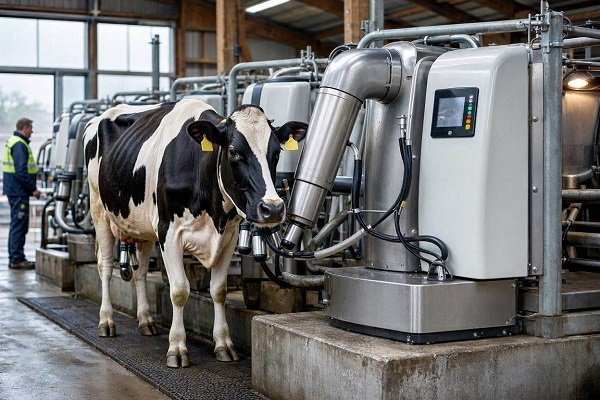
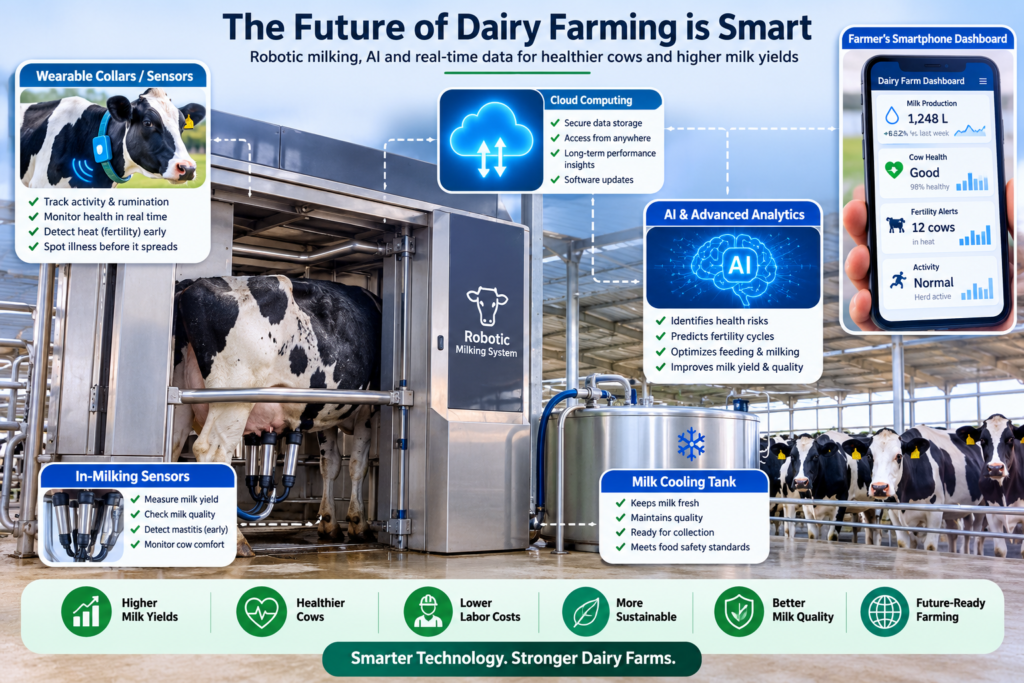
Today’s dairy farms are becoming more connected than ever before. Smart sensors, wearable devices, cloud-based software, and automated milking systems enable farmers to monitor every stage of milk production in real time.
These technologies not only reduce manual labor but also provide valuable insights into herd health, milk quality, feeding behavior, and reproductive performance, allowing farmers to make faster and more informed management decisions.
As the global population continues to grow, so does the demand for dairy products. Meeting this demand sustainably requires greater efficiency without compromising animal welfare or environmental responsibility.
Modern milking technology is helping dairy farmers achieve this balance by increasing milk yields, reducing waste, improving resource utilization, and ensuring cows remain healthier and more productive throughout their lifecycles.
Whether managing a family-owned dairy farm with a few dozen cows or operating a commercial dairy enterprise with thousands of animals, investing in modern milking technology has become an increasingly important strategy for improving profitability and remaining competitive in an evolving agricultural landscape.
What Is Milking Technology?
Milking technology refers to the equipment, machinery, software, and digital systems used to extract, monitor, process, and manage milk production on dairy farms.
While traditional milking relied almost entirely on manual labor, today’s milking technologies combine automation, robotics, sensors, data analytics, and artificial intelligence to create a more efficient and precise dairy production process.
One of the greatest advantages of modern milking technology is its ability to collect and analyze large amounts of data from individual animals.
During every milking session, advanced systems can automatically record milk yield, milk flow rate, conductivity, temperature, milking duration, and cow activity.
This information enables farmers to identify health problems such as mastitis at an early stage, monitor production trends, and optimize herd performance with greater accuracy than ever before.
Automation has also transformed the daily routine of dairy farming. Robotic milking systems allow cows to decide when they want to be milked rather than following fixed schedules.
Guided by sensors and robotic arms, these systems clean the udder, attach milking cups, monitor milk flow, and disinfect the teats after milking—all without human intervention.
The result is a more consistent milking process, reduced stress on animals, improved milk quality, and significant labor savings.
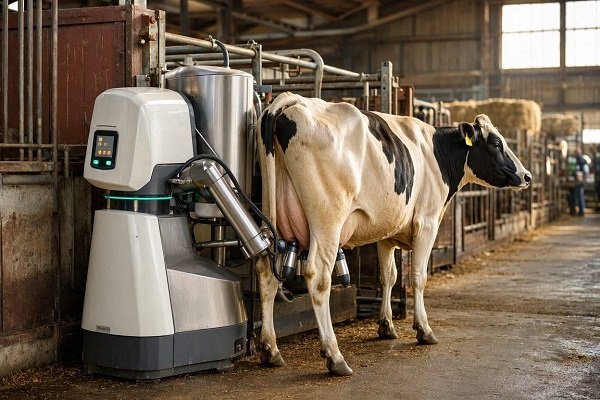
Beyond improving productivity, milking technology plays a vital role in supporting sustainable agriculture.
Smart systems help optimize water and energy consumption, reduce feed waste, monitor environmental performance, and contribute to lower greenhouse gas emissions by improving overall herd efficiency.
As dairy farmers face increasing pressure to produce more with fewer resources, these technologies are becoming essential tools for building resilient and environmentally responsible dairy operations.
Today, milking technology is no longer viewed as a luxury reserved for large commercial farms. As equipment becomes more accessible and digital solutions continue to evolve, farms of all sizes are beginning to adopt technologies that improve operational efficiency, animal welfare, and long-term profitability.
Milking Technology at a Glance
- Automates the milking process using robotics and AI.
- Improves milk quality and consistency.
- Detects diseases such as mastitis early.
- Reduces labor requirements.
- Provides real-time herd management data.
- Supports sustainable dairy farming.
Types of Modern Milking Technology
Modern dairy farms have access to a wide range of milking technologies designed to suit different herd sizes, production systems, and investment budgets.
Selecting the right solution depends on factors such as farm size, labor availability, production goals, and long-term expansion plans.
Conventional Milking Machines
Conventional milking machines remain the backbone of dairy production on thousands of farms worldwide. These systems use vacuum pressure and pulsation technology to extract milk safely and efficiently while minimizing stress on the cow.
Compared to hand milking, conventional machines improve consistency, reduce labor requirements, and enhance milk hygiene. They are particularly suitable for small- and medium-sized dairy farms looking for reliable and cost-effective milking solutions.
Milking Parlours
Milking parlours are specially designed facilities that enable multiple cows to be milked simultaneously in an organized and efficient manner. They have become the standard for commercial dairy operations where maximizing throughput is essential.
The most common parlour designs include:
Herringbone Parlours
Cows stand at an angle, allowing operators easy access to the udder from behind. Herringbone parlours are popular because they provide an excellent balance between efficiency, affordability, and ease of operation.
Parallel Parlours
In parallel parlours, cows stand side by side facing away from the operator. This arrangement allows more animals to be milked within a smaller footprint, making it ideal for high-volume dairy farms.
Rotary Parlours
Rotary milking parlours feature a continuously rotating platform where cows are milked as they move through the system. These highly automated installations can process hundreds of cows per hour and are widely used on large commercial dairy farms around the world.
Automated Milking Systems (AMS)
Automated Milking Systems represent one of the most significant innovations in modern dairy farming. Rather than relying on fixed milking schedules, cows voluntarily visit robotic milking stations whenever they choose.
Each animal is identified using electronic identification technology before robotic arms automatically clean the udder, attach teat cups, monitor milk flow, and record production data.
Automated milking systems offer numerous advantages, including reduced labor requirements, improved animal welfare, higher milking frequency, and comprehensive data collection that supports better herd management decisions.
Robotic Milking Technology
Robotic milking technology combines robotics, artificial intelligence, laser guidance, cameras, and advanced sensors to automate every stage of the milking process.
Modern robotic systems can:
- Identify individual cows automatically.
- Detect teat positions using cameras and laser technology.
- Clean and prepare the udder before milking.
- Attach teat cups with exceptional precision.
- Measure milk yield from each quarter of the udder.
- Detect abnormalities that may indicate mastitis or other health problems.
- Remove milking cups automatically when milk flow decreases.
- Sanitize the udder after milking.
By allowing cows to choose their own milking times, robotic systems reduce stress and often lead to improved milk production, healthier animals, and more flexible farm management.


Martin is a writer at Agrimachinery Africa specializing in agricultural machinery, mechanization trends, and farm technology across Africa. His work focuses on tractors, harvesting equipment, irrigation systems, and emerging innovations helping farmers improve productivity and efficiency. Through in-depth industry coverage, he highlights technologies shaping the future of modern agriculture.