


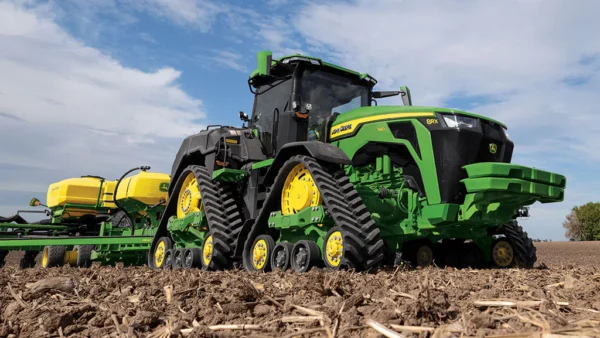

For thirty years, the John Deere 8-Series has been the workhorse of choice for large-scale row-crop farmers across North America, Europe, and beyond — a tractor that balanced raw power with the agility needed to work tight headlands, navigate row-crop fields, and still make legal highway transport speeds.
The John Deere 8RX 540, unveiled on February 26, 2026, at Commodity Classic in Kansas, is one of those machines.
With a rated engine output of 540 horsepower and peak output of 634 hp through an enhanced Intelligent Power Management system, John Deere is laying claim to the title of the world’s most powerful standard-design tractor.
That is not a boast made lightly. So what exactly are we dealing with — and does the claim hold up under scrutiny?
The Horsepower Story: How Did We Get Here?
To appreciate the magnitude of what John Deere has built, consider where the 8-Series stood just months ago.
The previous flagship, the 8RX 410, topped out at 443 horsepower on maximum output — itself a machine considered extremely powerful for its segment.
The jump from 410 to 540 in a single product cycle, within the same chassis family, is not an incremental refinement. It’s a category leap.
The engine at the heart of the new 8RX 540 tells that story vividly. John Deere has fitted these machines with the JD14 — a 13.6-litre, six-cylinder powerplant that was previously reserved exclusively for the larger articulated 9R and 9RX platforms.
This is a significant engineering milestone: this is the first time in 8-Series history that the platform has received a 14-litre-class engine, and it required a complete ground-up redesign of the chassis to accommodate it.
The base rated output is 540 hp. But the real headline belongs to the optional Peak Power Intelligent Power Management (PP IPM) system, which unlocks an additional 40 horsepower — not just at rated engine speed, but all the way down to 1,700 rpm, delivering up to 634 hp for the most demanding applications including heavy hydraulic loads, PTO work, transport, and electric implement offboarding. As Porter himself noted: “It punches way above the model number sticker on the side.”
Full Specifications at a Glance
| Engine | JD14 — 13.6-litre, 6-cylinder |
| Rated Engine Output | 540 hp (403 kW) |
| Peak Output (with PP IPM) | 634 hp (473 kW) |
| Maximum Torque | 2,695 Nm |
| Constant Power Range | 1,450 – 1,900 rpm |
| Peak Power IPM Range | Down to 1,600 rpm (+40 hp) |
| Transmission | Stepless eAutoPowr (EVT) — standard |
| Hydraulic Flow (max) | 418 litres/min (110 gpm) |
| Rear Hitch Lift Capacity | 10.8 tonnes (24,000 lbs) |
| Front Hitch Lift Capacity | 4.8 tonnes |
| Max PTO Power | 548 hp |
| Fuel Tank Capacity (8RX) | 1,123 litres |
| Operating Time at 85% Load | Up to 14 hours |
| Track System | Four-track; Soucy CustomFit P-series belts |
| Track Contact Area (max) | 4.87 m² |
| Ground Pressure (min) | 0.4 kg/cm² |
| Turning Radius | ~7 m (with HD ILS front axle) |
| Max Transport Speed | 37 mph (60 kph) |
| Electric Power Generation | 56V / 15kW integrated (optional) |
| Display / Guidance | G5Plus CommandCenter; StarFire 7500 receiver |
The Four-Track Advantage: Power Without Devastation
Raw horsepower is only half the equation. A 634 hp machine that tears up soil, compacts subsoil layers, and struggles to navigate headlands is of limited value to a row-crop producer. This is where the 8RX architecture justifies its existence — and its premium.
The 8RX’s four-track undercarriage has been extensively redesigned for this generation. New Soucy CustomFit P-series belts with a low-tension design reduce belt stress and extend operating life.
More importantly, the four-track layout distributes the tractor’s considerable weight over a substantially larger contact area — up to 4.87 square metres — achieving ground pressures as low as 0.4 kg/cm². That figure is remarkable for a machine of this power class.
Compare this to traditional two-track configurations, which concentrate mass along the centerline, or to wheeled tractors at equivalent horsepower levels, which can generate ground pressures two to three times higher.
For producers practising controlled traffic farming, operating in wet spring conditions, or working in soils with known compaction risk, this matters enormously — both agronomically and economically.
Why Four Tracks Change Everything
- Ground pressure as low as 0.4 kg/cm² — minimises subsoil compaction
- Weight spread over 4.87 m² contact area for superior flotation
- Soucy CustomFit P-series belts for extended belt life
- Ideal for early-season wet field entry
- Controlled traffic system compatibility
- Stability under heavy draft loads and hillside operations
- Articulated-class power without articulated steering geometry
- Tight ~7 m turning radius preserved despite added mass
The new Heavy-Duty Independent Link Suspension (HD ILS) front axle supports the turning radius of approximately 7 metres — a figure that, combined with the fixed-frame design, gives the 8RX a meaningful maneuverability advantage over articulated tractors operating at similar power levels.
John Deere’s own internal testing shows the 8R 540 achieving a 19 percent tighter turning radius compared to the Fendt 1050 in equivalent dual-wheel configurations.
The Transmission Revolution: eAutoPowr and Electric Drive
Power delivery is where the new 8-Series generation takes its boldest technological step. The stepless eAutoPowr transmission is now standard across all new 8R and 8RX models — including the 540. This is not a conventional hydrostatic CVT.
John Deere describes it as an electro-mechanical split-path layout that replaces internal hydrostatic components with maintenance-free electric motor generators. The result, the company claims, is up to 8% better energy flow efficiency compared to conventional hydrostatic solutions.
In practical terms, this matters during planting — historically one of the most time-critical operations in row-crop agriculture.
The Electric Variable Transmission enables direct electric power offboarding to modern electric-drive planters through a single 56V/15kW connection. Operators no longer need PTO shafts or auxiliary hydraulic generators to supply power to their planter. Connect, engage, and go.
1,200 Acres a Day: The Planting Equation
John Deere’s internal testing with an 8R 490 — one model below the 540 in the lineup — demonstrated planting productivity of up to 1,200 acres per day when running a DB90 planter at 12.5 mph over a 12.3-hour day at 80% efficiency.
Scale that to the 540’s additional power headroom and it becomes clear why large-scale corn and soybean producers are paying close attention.
An independent customer test in Northwest Iowa comparing the 8R 540 against the 8R 410 on manure application showed the 540 covering 39.4 acres per hour versus 26.5 for the 410 — a 49% productivity gain that translates directly to fewer hours in the field during tight application windows.
Head-to-Head: How Does the 8RX 540 Stack Up Against the Competition?
Calling something the world’s most powerful standard-design tractor invites scrutiny. Who are the challengers, and how does the 8RX 540 actually compare?
| Model | John Deere 8RX 540 | Fendt 1052 Vario | Case IH Steiger 540 AFS | John Deere 9RX 590 |
|---|---|---|---|---|
| Category | Fixed-frame, 4-track row-crop NEW | Fixed-frame, 2-wheel row-crop | Articulated, 4-wheel | Articulated, 4-track |
| Rated HP | 540 hp | 520 hp | 540 hp | 590 hp |
| Peak / Boost HP | 634 hp | ~550 hp | N/A (no peak boost) | N/A |
| Frame Type | Fixed / non-articulating | Fixed / non-articulating | Articulated | Articulated |
| Track / Wheel Config | 4-track (Soucy belts) | 2-wheel (tyre options) | 4-wheel | 4-track |
| Row-Crop Maneuverability | High (narrow fixed frame) | High (narrow frame) | Low (articulation radius) | Low (articulation radius) |
| Transmission Type | eAutoPowr (electro-mech CVT) | VarioDrive CVT | Powershift / CVX | Powershift |
| Electric Implement Power | Yes (56V/15kW EVT) | No | No | No |
| Autonomy Ready | Yes (G5Plus, AutoPath) | Partial | No | Partial |
The picture that emerges is nuanced. Articulated tractors from Case IH and the larger 9RX platform from Deere itself do exceed 540 hp in rated output — the 9RX 590 tops out at 590 hp rated, for example.
But those machines are not row-crop tractors in the traditional sense. They are articulated, which means their turning radius, their headland management, and their performance in row-crop conditions are fundamentally different propositions.
Within the fixed-frame, non-articulated tractor category — what John Deere and the industry call “standard-design” — the claim holds.
The Fendt 1052 Vario, Deere’s most credible competitor in this space, reaches 520 hp rated and approximately 550 hp boosted. The 8RX 540’s 634 hp peak output comfortably surpasses that figure — by roughly 15%.
The Technology Stack: A Tractor Built for 2030
Power and tracks alone do not make a modern flagship. The 8RX 540’s technology suite positions it not just as today’s most powerful row-crop machine but as a platform designed to evolve over the coming decade.
Autonomy Readiness
Every new 8R and 8RX model — including the 540 — ships autonomy-ready from the factory. The G5Plus CommandCenter display is standard, along with a StarFire 7500 receiver and JDLink connectivity.
Operators gain access to AutoTrac Turn Automation, AutoTrac Implement Guidance, AutoPath Rows and Boundaries, and Passive Implement Guidance for centimetre-level accuracy.
The non-position-indicating digital controls mean the tractors are inherently prepared for future autonomy hardware retrofits as those technologies mature.
Connectivity and Data
Optional JDLink Boost connectivity ensures reliable machine and field data capture even in areas with weak cell coverage.
Machine Sync enables coordinated operation between the tractor and grain carts or support vehicles — automated machine-to-machine communication that reduces collision risk and improves unloading efficiency during harvest support operations.
CommandView 4 Plus Cab
The 8RX receives the CommandView 4 Plus cab — the same premium enclosure introduced on the 9RX — delivering 15% more operator legroom and a 20% wider panoramic field of view compared to existing 8R standard cabs.
The redesigned CommandArm introduces three control tiers: CommandX, CommandX Plus, and CommandX Pro, allowing operators to tailor control configurations to their preference and operation type.
Push-button start with PIN protection adds a layer of security increasingly important on large modern operations.
Serviceability
Building on lessons from the 9RX platform redesign, the 8RX 540 features engine oil, coolant, and hydraulic sight gauges at eye level for ground-level checks.
Air filters and fuel/DEF fill points are also accessible from the ground. Hydraulic oil service intervals have been extended from 1,500 to 2,000 hours, reducing planned downtime during critical seasons.
An optional Jake Brake engine braking system provides up to 300 kW of retardation power, reducing wear on primary brakes when descending grades under load.
What Farmers Are Gaining: Real-World Impact
Strip away the specifications and the competitive positioning, and the case for the 8RX 540 ultimately rests on one simple question: what does it mean for a farming operation?
For large-scale corn and soybean operations across the US Corn Belt and Canadian prairies, the productivity gains are tangible.
Wider planters — 36-row configurations or larger — can now be deployed with a single tractor rather than requiring a step up to an articulated machine.
Fewer passes mean fewer pinch rows: John Deere calculates that switching from a 24-row planter on an 8R 410 to a 36-row planter on an 8R 540 reduces passes by 34% across an 80-acre field, yielding measurable yield benefits from reduced localized compaction.
For European operations managing thousands of hectares with shrinking labour forces, the calculus is different but equally compelling.
With fuel tanks carrying up to 1,123 litres and the capability to run up to 14 hours at 85% load before refuelling, operators can complete shifts without the interruptions that cost time and productivity.
Hydraulic capacity has jumped from 87 gpm to 110 gpm in the new models — a 26% increase — enabling the power delivery required by large precision drills and high-capacity fertiliser applicators.
For tillage contractors and custom operators, the transport speed of 37 mph (60 kph) supported by the upgraded Independent Link Suspension shortens road moves between fields, compressing overall daily cycle times during tight operational windows.
The Nuance: What the 8RX 540 Is Not
Intellectual honesty demands acknowledging the limits of the claim. The 8RX 540 is the world’s most powerful standard-design (non-articulated) tractor.
That qualifier is doing real work. John Deere’s own 9RX platform exceeds it in rated horsepower. The Fendt 1167 Vario MT — a massive articulated-track machine from AGCO — delivers over 670 hp. These are different categories of machine, serving different operational needs.
The 8RX 540 also carries a premium price commensurate with its specifications. While John Deere has not published a final retail price at time of writing, comparisons within the segment suggest fleet owners will need to evaluate total cost of ownership carefully — fuel consumption at this power level is substantial, and the specialised four-track undercarriage has higher maintenance costs than a wheeled tractor of equivalent horsepower.
Finally, not every row-crop operation needs 634 horsepower. For farms under 5,000 acres running conventional planter widths, the existing 8R 410 or even the new 8R 440 may represent a better return on capital.
The 540 is a tool designed for operations that have genuinely outgrown everything else in its segment.
The Verdict: Yes — With a Caveat
The John Deere 8RX 540 is, by every measurable standard, the most powerful non-articulated row-crop tractor ever built and sold in volume production.
At 634 peak horsepower from the 13.6-litre JD14 engine, it surpasses its closest standard-design rival by a significant margin.
Combine that headline power with Soucy four-track flotation, an electro-mechanical EVT enabling direct electric implement power, a factory-autonomy-ready G5Plus technology stack, and a turning radius that embarrasses machines half its size — and you have something genuinely unprecedented in row-crop agriculture.
The caveat is definitional: articulated platforms from Deere itself and from AGCO deliver more raw horsepower. But articulated is not row-crop.
In the fixed-frame, precision-maneuverable, soil-conscious category that defines the 8-Series’ mission — nothing built before it comes close.
* Planting 1,200 acres each day is based on John Deere internal testing of an 8R 490 with Peak Power IPM pulling a DB90 at 12.5 mph over 12.3 hours with 80% efficiency.
All performance data cited in this article sourced from John Deere press releases, Farmers Weekly, Farmers Guardian, Industrial Vehicle Technology International, Farmtario, and AgriLand (February–March 2026).
Competitive specifications sourced from manufacturer published data current as of March 2026. This article is an independent analysis and is not affiliated with or sponsored by Deere & Company.

Martin is a writer at Agrimachinery Africa specializing in agricultural machinery, mechanization trends, and farm technology across Africa. His work focuses on tractors, harvesting equipment, irrigation systems, and emerging innovations helping farmers improve productivity and efficiency. Through in-depth industry coverage, he highlights technologies shaping the future of modern agriculture.