


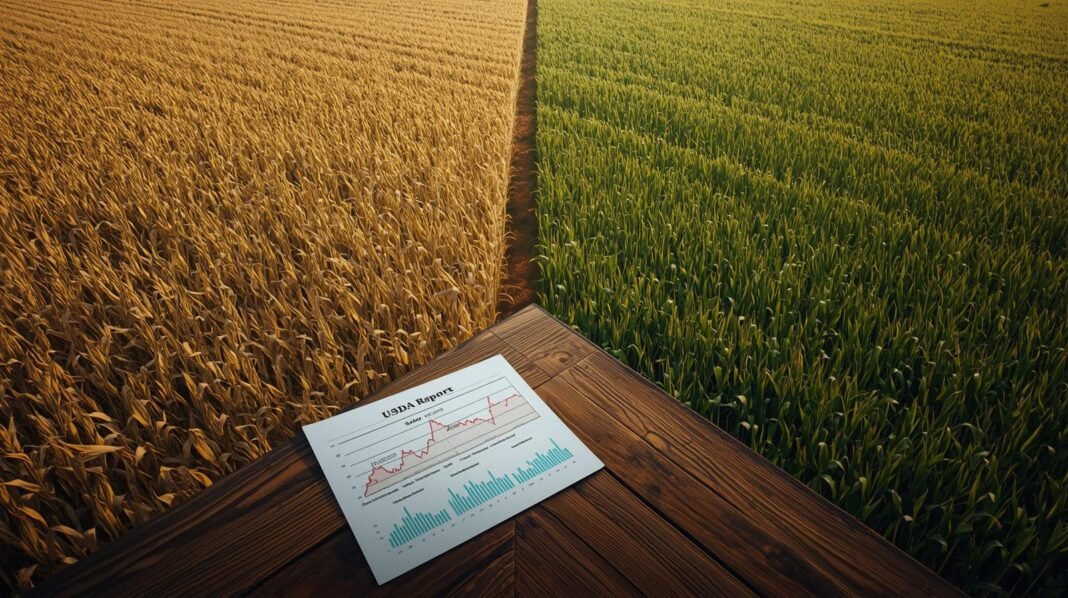

Every March, the USDA’s National Agricultural Statistics Service publishes the Prospective Plantings report — the first survey-based read on what American farmers actually intend to put in the ground for the coming season.
Unlike the computer-modelled outlooks the agency releases at its February Ag Outlook Forum, these numbers come directly from producer surveys conducted across all major growing states. That distinction matters.
The market may already have months of speculative positioning baked in, but the Prospective Plantings report has a track record of delivering surprises: last year, corn acres came in 4.73 million above the 2024 final — the largest upward revision on record — and the data moved futures sharply within minutes.
The March 31 release also bundles the quarterly Grain Stocks report, measuring on-farm and off-farm inventories as of March 1.
Together, the two datasets paint a picture of both the coming supply pipeline and the current demand pace — and right now, both are telling a story that will cut very differently across the agribusiness sector.
🌽 Key Shift in U.S. Planting Strategy (2026)
- Corn acreage: projected to drop by ~4.4 million acres after 2025’s bumper crop
- Soybean acreage: set to increase by a nearly identical margin
- Rotation impact: a near one-for-one switch from corn to soybeans
Bottom line: Farmers are rebalancing crops for profitability and sustainability.
The Numbers on the Table
Based on an average of 16 analyst estimates compiled by Dow Jones and Reuters surveys published ahead of the release, private forecasters expect corn planted area to fall to approximately 94.4 million acres — down from the 98.8 million acres planted in 2025.
That would represent the smallest corn footprint since before the 2019 season and a roughly 4.4 percent decline year over year.
The USDA’s own February Ag Outlook Forum modelled corn acreage at 94.0 million acres, suggesting the market consensus is tracking close to the agency’s internal assumptions.
On the soybean side, the trade is looking for a surge to around 85.5 million acres — up from 83.5 million in 2025 and approaching the record levels last seen in 2018.
USDA’s February baseline put soybean plantings at roughly 87.9 million acres for the season, slightly above the trade guess, though the survey data could push the final figure in either direction.
The driving logic behind the shift is straightforward: the February soybean-to-corn insurance price ratio came in at 2.4, versus 2.24 a year ago.
A higher ratio favors rotation into beans, and Corn Belt producers — particularly in Iowa, Minnesota, and South Dakota — have been signaling through the winter that they intend to make that switch.
Nitrogen fertilizer cost pressures add another layer. Corn is a nitrogen-intensive crop and fertilizer prices have risen sharply following geopolitical disruptions in the Middle East in late February, adding to the economic case for planting more nitrogen-fixing soybeans.
Grain Stocks: The Demand Signal
Beyond acreage, Tuesday’s Grain Stocks report will offer a read on how efficiently the 2025 record crop has been absorbed.
The average trade estimate for corn stocks as of March 1 is approximately 8.87 billion bushels.
Corn demand has been notably strong through the first half of the marketing year — exports have been running ahead of schedule, and feed and residual use has been elevated.
If the March 1 stocks number comes in below the trade guess, it would be modestly bullish for corn futures and potentially supportive of the stocks of grain originators and merchandisers.
For soybeans, the picture is more complicated. Analysts are expecting around 2.077 billion bushels on hand, which would be the highest March 1 reading since 2020.
Domestic ending stocks have already reached a six-year high of approximately 350 million bushels according to the March WASDE, and a soybean-stocks surprise to the upside would reinforce the bearish price backdrop that has weighed on soybean producer economics heading into planting.
Corteva (CTVA): Resilient Despite the Rotation
At first glance, a major shift away from corn looks like bad news for Corteva, the Indianapolis-based seed and crop protection company whose North American seed business is heavily weighted toward high-margin corn genetics.
Corn seed commands a significantly higher per-acre input spend than soybeans — farmers routinely pay more for trait packages, herbicide-tolerance stacks, and yield-optimization genetics in corn than in any other major row crop.
But Corteva management has been notably measured in its concern. In its full-year 2025 results release in early February, the company stated directly that any shift from corn to soybean planted acres in the U.S. in 2026 is expected to be manageable.
The qualifier is significant: Corteva guided for 7 percent growth in Operating EBITDA for 2026, and that guidance was issued after the scale of the expected acreage rotation had become clear to the market.
A resolution with Bayer AG worth approximately 610 million dollars, which accelerated corn trait licensing income, provides a meaningful buffer against volume softness.
There is also the structural argument. Even in a lower-price environment, farmers do not trade down on seed. Corteva’s price-for-value strategy — charging premium prices for demonstrably higher-yielding genetics — has held through multiple commodity cycles.
The company’s soybean portfolio, while smaller, provides some offset.
And with Corteva stock up roughly 13 percent year-to-date in 2026, the market appears to have already concluded that the company’s technology moat insulates it from a one-season acreage mix shift.
The key question for CTVA post-Tuesday is the magnitude of the corn decline. An acreage number that comes in below 94 million would be marginally more negative than the market has already priced; anything in the 94 to 95 million range should be taken in stride.
Bunge (BG): The Global Hedge
Bunge is structurally positioned to benefit from higher soybean acreage in the United States, but the picture is more nuanced than a simple supply-expansion story.
As a global grain merchant and oilseed processor, Bunge’s financial performance is driven less by the raw volume of beans grown and more by the crush spread — the margin between the cost of a raw soybean and the combined value of the soybean oil and soybean meal it produces.
More domestic supply, all else equal, should compress bean prices and support crushers who buy beans as an input.
However, the domestic soybean oil market has been caught in a policy holding pattern throughout the first half of the marketing year, with crush margins under pressure due to uncertainty around the Section 45Z Clean Fuel Production Credit.
Biofuel refiners — uncertain about how the Treasury and EPA will finalize carbon intensity scores for 2026 and 2027 — have been reluctant to sign long-term soybean oil contracts, keeping demand soft.
Bunge has navigated this environment better than most. Its 2024 acquisition of Viterra gave it a meaningfully larger footprint in South America, allowing it to process beans closer to Brazilian origins when North American margins are compressed.
The company announced a 3 billion dollar share repurchase program in March 2026, a signal of balance sheet confidence that the market has responded to positively.
Bunge’s 2026 earnings guidance came in below Wall Street estimates, a reflection of the difficult margin environment, but the geographic diversity of its operations provides a buffer that a purely domestic processor like ADM does not have.
For BG, a soybean acreage number above 86 million on Tuesday would be constructive: it signals more raw material moving through the crush system in 2026 and 2027, which eventually translates into volume leverage as biofuel policy clarity arrives.
ADM: The Policy Pivot Play
Of the three primary stocks in focus ahead of Tuesday, Archer-Daniels-Midland carries the most direct sensitivity to the acreage data — and the most complicated investment thesis.
ADM reported a near-catastrophic 81 percent collapse in crushing profits for the full year 2025, a direct result of weak soybean oil demand tied to unresolved biofuel blending mandates.
The company’s heavy concentration in U.S. domestic processing left it far more exposed to the domestic policy vacuum than Bunge’s more geographically distributed model.
Management has been explicit about the recovery path. CEO Juan Luciano, speaking at the Bank of America conference in late February, confirmed that China had already satisfied its initial 12 million ton soybean purchase commitment — a trade flow normalization that ADM cited as a key demand support.
The company’s 2026 adjusted EPS guidance of 3.60 to 4.25 dollars is underpinned by a 500 to 750 million dollar cost savings program and an estimated 100 million dollar tailwind from the 45Z clean fuel credit — though that tailwind is contingent on Washington finalizing biofuel mandates before mid-year.
Wall Street remains skeptical. Of the 11 analysts actively covering ADM, only one carries a buy rating, with seven holds and three underperforms.
The mean price target of around 60 dollars implies meaningful downside from current trading levels.
The bear thesis is simple: if the Trump administration delays Renewable Volume Obligation finalization beyond mid-2026, ADM’s lower EPS guidance scenario becomes the base case and the biofuel recovery catalyst disappears into 2027.
What Tuesday’s soybean acreage number tells ADM investors is primarily about the volume side of the equation.
A large soybean crop creates the raw material base for an eventual crush recovery, but crush margin improvement requires the policy catalyst, not just the beans. In the near term, ADM is less a play on acreage and more a play on regulatory timing.
ADM Focus: Biofuel Policy Over Acres
- The acreage number matters less for ADM than the biofuel policy calendar.
- Soybeans are coming, but uncertainty remains on whether Washington will deliver the demand signal in time.
Key takeaway: Policy timing could outweigh planting decisions in shaping markets.
The Fertilizer Read: CF Industries and Nutrien
One underappreciated downstream consequence of the corn-to-soybean rotation is its effect on nitrogen fertilizer demand.
Corn requires roughly two to three times the nitrogen application of soybeans per acre, making a 4 million-acre shift away from corn a meaningful headwind for nitrogen producers.
CF Industries Holdings and Nutrien have both faced questions about this dynamic heading into the planting season, and a Tuesday acreage number in line with or below the trade estimate would add confirmation to the fertilizer demand concern.
The Middle East conflict that began in late February has added a fertilizer supply disruption risk on top of the demand softness, creating an unusually complex setup for nitrogen commodity pricing.
Investors in CF and NTR should treat Tuesday’s corn acreage number as an incremental demand signal — directionally important, but operating against a macro backdrop that is pulling the other way through supply constraints.
Accuracy Caveats: The Survey Has a History
The Prospective Plantings report carries real forecasting uncertainty. The last five reports have shown an average absolute error between the March survey intention and final planted acreage of roughly two million acres.
Last year’s corn figure came in 4.73 million acres above the March estimate by the time final plantings were tallied — the largest such upward revision on record.
The USDA conducts the survey in the first two weeks of March, meaning that the nitrogen fertilizer anxiety sparked by the Middle East escalation in late February may have been captured in this year’s data — or may have emerged too late to influence responses.
Traders are also watching whether the market places normal weight on Tuesday’s numbers.
Given last year’s historic miss, some participants have indicated they may require confirmation from subsequent reports — notably the June Acreage report — before fully repricing the acreage outlook.
Investor Takeaways
- CTVA: Corn decline within expected range → limited stock reaction. Management guidance already reflects rotation. Corn < 93.5M is negative catalyst.
- BG: Soybean acreage ≥ 86M is constructive medium-term. Near-term upside depends on 45Z policy resolution. Geographic diversification is structural advantage.
- ADM: Acreage secondary to biofuel policy. Large soybean crop supports margin recovery; timing depends on Washington, not Corn Belt.
- CF / NTR: Corn acreage signals nitrogen demand. < 94M reinforces caution on nitrogen producers.
Grain Stocks surprise may matter as much as acreage. A bullish corn stocks number (lower than expected) would support corn prices and grain originator revenues.
Disclaimer: This article is for informational purposes only and does not constitute financial advice. Investors should conduct their own due diligence before making any investment decisions.
Also Read
USDA’s $11 Billion Just Landed in Farm Accounts — Here’s Which AgriStocks Benefit Most
After Oil, Fertilizer Is Next: What the Iran-US Crisis Means for Your Farm Budget

Martin is a writer at Agrimachinery Africa specializing in agricultural machinery, mechanization trends, and farm technology across Africa. His work focuses on tractors, harvesting equipment, irrigation systems, and emerging innovations helping farmers improve productivity and efficiency. Through in-depth industry coverage, he highlights technologies shaping the future of modern agriculture.