


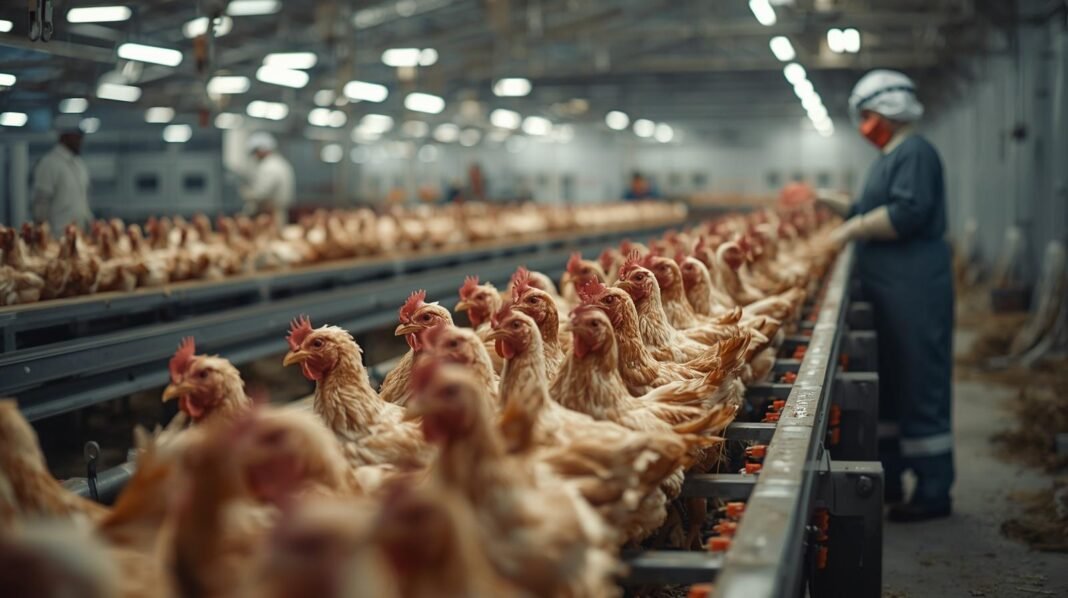

Belgium’s poultry industry closed 2025 on a record-breaking note, with official figures from Statbel, the Belgian statistical office, confirming that 315.6 million poultry animals were slaughtered during the year — a 1.7 percent increase over the already-record 2024 total of 310.5 million head.
At the heart of the milestone sits the broiler chicken, which alone accounted for 314.9 million of those slaughterings, cementing a growth trajectory that has remained unbroken since modern registration systems were introduced in 2008.
The numbers signal more than a production record. They reflect a structural shift in Belgium’s meat economy, one in which chicken is steadily narrowing the gap with pork — a protein category that has held an unchallenged lead in the country for decades.
Pork Still Leads, but Its Grip Is Loosening
Pigs remain the dominant force in Belgian meat production by slaughter weight, supplying 951 million kilograms in 2025 — or 55 percent of total national output. But the rate of growth tells a different story.
Pig slaughterings edged up by only 0.3 percent year-on-year, while the poultry sector posted a 1.7 percent gain.
The bovine sector, by contrast, contracted sharply: cattle slaughterings fell 7.3 percent to 750,000 head, the lowest level recorded since 1980, reversing two consecutive years of moderate growth.
The chicken sector now accounts for 31 percent of Belgium’s total slaughter weight, delivering 543 million kilograms of meat.
That figure has been climbing year-on-year, and industry analysts note that the trajectory aligns with a broader European and global trend toward lower-cost, lower-carbon animal protein. Consumer preferences for white meat, combined with cost pressures on household food budgets, have reinforced demand at retail and foodservice levels across Western Europe.
“The economic impact — both for the poultry holders and for the country as a whole — is enormous.”
— Landsbond Pluimvee, Belgian Poultry Sector Organisation
A Decade of Uninterrupted Expansion
The 2025 record is not an isolated event. Belgian poultry output has expanded with remarkable consistency since the 2008 baseline, making it one of the most sustained growth stories in domestic agriculture.
Monthly slaughter volumes now average 27.31 million animals — a figure that illustrates both the industrial scale of Belgian poultry operations and the sector’s ability to maintain throughput even during periods of biosecurity disruption.
In 2024, the sector registered 25.8 million chickens slaughtered per month.
The 2025 monthly average represents a further step-change, and industry body Landsbond Pluimvee has described the combined economic impact of the sector’s performance as enormous, both at farm level and for the wider national economy.
Earlier Statbel data shows that Belgium operated approximately 1,700 poultry farms in 2024, holding 38.5 million broiler chickens, just under 9 million laying hens, 4.6 million pullets and 2.78 million breeding hens.
Those farm numbers are expected to remain broadly stable in 2025 figures, as the output increase has been driven primarily by productivity improvements rather than a significant expansion in farm count.
Avian Influenza Shadow Looms Over the Sector
The production achievement is all the more notable given that it was accomplished against a backdrop of persistent disease pressure.
Belgium navigated a wave of Highly Pathogenic Avian Influenza (HPAI) outbreaks through the first months of 2025, and the country’s Federal Agency for the Safety of the Food Chain (FASFC) confirmed the sector’s HPAI-free status in May 2025.
That period of disease freedom proved brief. A new outbreak was confirmed at a commercial farm in Houthulst, West Flanders, on 22 October 2025, triggering the reimposition of mandatory nationwide confinement for all commercial and registered poultry holdings.
By January 2026, Belgium had recorded outbreaks at 20 commercial farms in the current wave, with cases confirmed across West Flanders, Limburg, Namur and Liège provinces.
The FASFC has maintained continuous surveillance since the October 2025 reintroduction of the virus, enforcing strict biosecurity protocols including the prohibition of untreated surface water for bird watering and the mandatory use of indoor or netted feeding areas.
The outbreak pattern reflects a wider European crisis. Between September and November 2025 alone, 442 HPAI outbreaks were recorded in domestic birds across 29 European countries, according to the European Food Safety Authority.
Wild migratory birds — particularly waterfowl using flyways through Belgium from northern Europe toward North Africa — are identified as the primary vector introducing the virus into farm environments.
The FASFC has noted that infection pressure from heavily contaminated environments near farm perimeters remains a significant challenge even in fully indoor operations.
Global Tailwinds Support Continued Growth
Beyond Belgium’s domestic market, global conditions favour continued expansion of chicken production.
The United States Department of Agriculture’s most recent world markets and trade analysis projects that global chicken meat shipments will reach a record level in 2026, marking the third consecutive year of rising trade.
Demand for lower-priced animal protein and population growth, particularly across Africa and Southeast Asia, are identified as the primary drivers.
Belgium, as an established processor and exporter within the European Union, is well-placed to benefit from that demand.
EU pork production, by contrast, is forecast to decline by 1 percent in 2026 under pressure from rising regulatory costs and the emergence of African Swine Fever in Spain — headwinds that reinforce the relative competitiveness of chicken as a protein source.
Outlook for 2026
Whether Belgian poultry output can sustain its record-setting run in 2026 will depend heavily on how quickly the current HPAI wave is brought under control.
Prolonged confinement requirements and culling operations impose real costs on producers, and repeated disease cycles affect breeding stock pipelines with a lag that can suppress slaughter volumes several months later.
The sector’s performance through 2024 and 2025 demonstrates considerable resilience, but operators and sector bodies are pressing for accelerated progress on vaccine deployment strategies currently under development at EU level.
The data released by Statbel in March 2026 confirms that, for now, Belgium’s poultry sector is in the strongest position it has occupied since records began — and its structural challenge to pork’s long-standing supremacy in the national meat market is becoming harder to dismiss.
Also Read
The Planting Pivot: What Tuesday’s USDA Reports Mean for Corn, Soybean, and Agribusiness Stocks
Why Tractor Sales Are Rising in Nigeria in 2026
