



MOLINE, ILLINOIS / BOTHAVILLE, SOUTH AFRICA | 22 MAY 2026:Deere & Company’s Q2 2026 results confirm what African grain producers and equipment dealers already know on the ground: large-scale agriculture is deep in a difficult cycle.
But the company’s product launches at Nampo 2026, its Africa mechanisation strategy, and its own guidance point firmly toward recovery — and a wave of next-generation machinery coming to market from August.
The Broader Picture: Where Deere’s Ag Business Stands
Deere & Company reported net income of $1.773 billion for Q2 FY2026, or $6.55 per diluted share — ahead of analyst expectations of around $5.70 to $5.87.
Total worldwide net sales rose 5% year-on-year to $13.37 billion for the quarter. But behind the headline beat lies a sharply divergent story across Deere’s three operating segments, with the agricultural equipment divisions pulling in opposite directions.
CEO John May was direct: fiscal 2026 is the bottom of the current agricultural cycle. Large-scale farm equipment is under sustained pressure from a combination of weak farm income, elevated input costs, high interest rates, and trade-related uncertainty.
Yet Deere is holding double-digit operating margins across all segments — a signal that structural discipline is intact even as volumes compress.
| “We are delivering double-digit margins across all segments and expect to grow our top line by more than 5% this year — even as large ag operates below trough levels.” — John May, CEO, Deere & Company |
Segment Breakdown: Production Ag Down 14%, Small Ag Up 16%
The contrast between Deere’s two agricultural segments could hardly be more pronounced this quarter.
Production and Precision Agriculture — the heartland of large combine harvesters, row crop tractors, and precision planting systems — saw net sales fall 14% year-on-year to $4.50 billion, with operating profit plunging 39% to $706 million as lower shipment volumes collided with rising production costs.
Small Agriculture and Turf, meanwhile, posted a 16% revenue increase to $3.49 billion, with operating profit expanding 25%, as the compact and turf equipment market continues its recovery toward mid-cycle.
Q2 FY2026 — Deere Segment Performance at a Glance
| Segment | Net Sales Q2 2026 | YoY Change | Op. Profit Change |
| Production & Precision Ag | $4.50 billion | -14% | -39% to $706M |
| Small Ag & Turf | $3.49 billion | +16% | +25% |
| Construction & Forestry | $3.79 billion | +29% | +48% to $561M |
Source: Deere & Company Q2 FY2026 Earnings Release, 21 May 2026
For African farmers and ag equipment stakeholders, the Production & Precision Ag weakness reflects a global trend also visible in South Africa, Kenya, Zimbabwe, and Zambia: declining tractor registrations, cautious dealer inventories, and extended replacement cycles as producers manage cash flow carefully.
The Small Ag recovery, however, points to a sub-segment that is closer to African smallholder and mid-scale farming realities — a market Deere is actively targeting through its Africa mechanisation partnerships.
The Agricultural Cycle: Bottom in 2026, Recovery Expected in 2027
Management maintained its view — and full-year net income guidance of $4.50 billion to $5.0 billion — on the basis that 2026 is the trough of the current multi-year farm equipment cycle.
Revenue in the second half of FY2026 is expected to be slightly higher than the first, with Q4 projected to be the strongest quarter, partly due to the timing of large tractor deliveries.
For African farmers considering whether now is the time to invest in new equipment, the cyclical context matters.
Historically, equipment cycle troughs coincide with improved dealer flexibility on pricing and financing terms, as manufacturers and their distribution networks work to move inventory and maintain customer relationships through the downturn.
Large tractor and combine buyers — particularly commercial grain farms in South Africa’s Highveld and Western Cape — may find more negotiating room in 2026 than in the peak years of 2021 to 2023.
FY2026 Full-Year Agricultural Guidance
| Item | Guidance / Status |
| Full-Year Net Income Guidance | $4.5 – $5.0 billion |
| Large Ag Cycle Status | Below trough — recovery from 2027 |
| Small Ag & Turf Cycle Status | Progressing toward mid-cycle |
| H2 FY2026 Revenue Trajectory | Slightly higher than H1 |
| Q4 FY2026 Outlook | Strongest quarter of FY2026 |
| Price Realisation (full year) | +2.5 percentage points |
| Currency Translation (full year) | +~2 percentage points |
Source: Deere & Company Q2 FY2026 Earnings Call, 21 May 2026
What’s New from John Deere at Nampo 2026: S7 Combine and 540-Series Tractors
Even as the financial results reflect the depth of the ag downcycle, John Deere’s product team was making headlines at Nampo Harvest Day in Bothaville, South Africa — the Southern Hemisphere’s largest agricultural equipment show.
The 59th edition drew 81,822 visitors over four days, setting a new single-day attendance record of 24,579 and narrowly missing the all-time show record.
John Deere S7 Combine Harvester
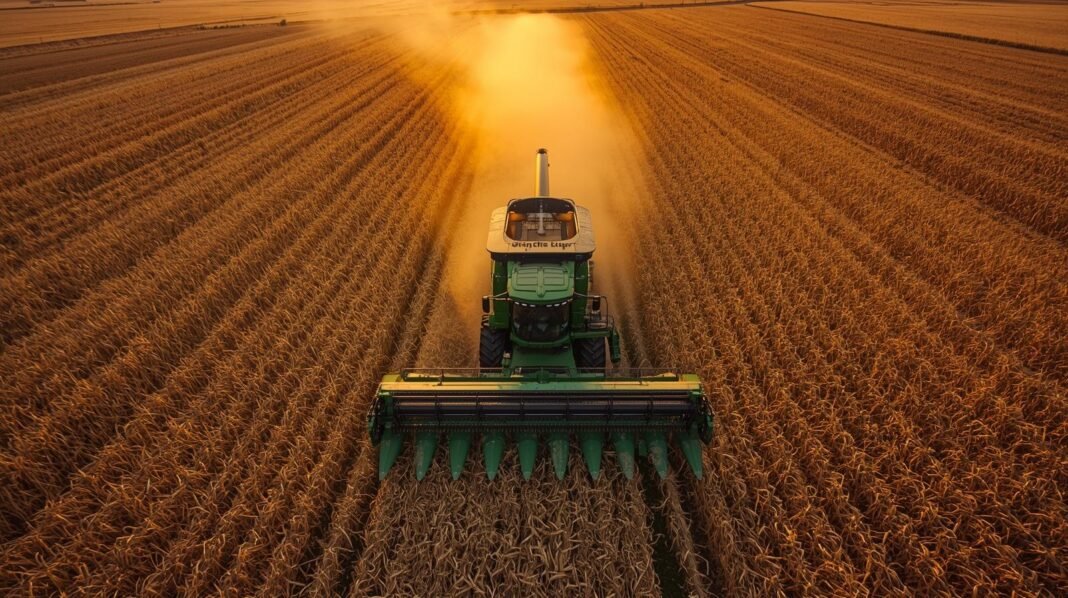
John Deere introduced the S7 combine harvester at Nampo 2026 — an upgrade designed to deliver greater throughput efficiency, smarter crop processing, and improved integration with the John Deere Operations Center digital ecosystem.
The S7 competes directly with the New Holland CR10 and Case IH Axial-Flow 9, both of which also featured at the show. All three machines are expected to reach southern African dealers from August 2026 onwards.
For commercial grain producers in South Africa’s maize, wheat, and sorghum belts — particularly in the Free State, North West, and Mpumalanga — the S7 arrives at a moment when many farms are managing aging combine fleets and looking ahead to the recovery cycle for major capital investment.
The combination of a trough market and new product availability may make 2026 a strategically attractive entry point.
540-Series High-Horsepower Rigid-Frame Tractors with eAutoPowr EVT
John Deere’s other flagship Nampo announcement was the 540-series rigid-frame tractor range — the most powerful production tractors the company has offered in Africa.
Powered by the 13.6-litre JD14 engine and equipped with the eAutoPowr Electric Variable Transmission (EVT) — described as the first electro-mechanical split-path transmission in commercial agriculture — the flagship 540 models produce 594hp (437kW) as standard.
Intelligent Power Management (IPM) boosts output on demand to 634hp (466kW) when conditions require it: heavy draft, slopes, or difficult field conditions.
Hein Snyman, John Deere’s regional production system specialist for Africa and the Middle East, confirmed the company spent six to seven years developing this powertrain specifically around customer needs in its key markets.
| The 540-series delivers up to 634hp on demand via the eAutoPowr EVT — six to seven years in development, now available to African commercial producers from August 2026. |
The eAutoPowr transmission is particularly significant for large-scale African farming operations running extended shifts in variable field conditions.
The split-path architecture combines the efficiency of a mechanical drive with the smoothness of a hydrostatic transmission — reducing fuel consumption and operator fatigue over long operating days, while maintaining full power delivery under load.
John Deere’s Africa Strategy: Mechanisation, Digital, and Hello Tractor
Deere’s Africa footprint extends well beyond the premium equipment segment showcased at Nampo.
The company holds market leadership across the African agricultural tractor market, where five major manufacturers — Deere, AGCO, CNH Industrial, Mahindra, and Kubota — collectively account for 76% of market revenue.
The Middle East and Africa farm equipment market was valued at $16.8 billion in 2025 and is projected to grow at a compound annual rate of 5.6% through 2035, according to Global Market Insights.
South Africa’s agricultural machinery market alone is forecast to reach $1.21 billion by 2030, growing at 5.9% per year from a $910 million base in 2025.
A significant element of Deere’s Africa growth strategy targets smallholder and mid-scale farmers — the backbone of food production across Kenya, Ghana, Tanzania, Nigeria, and Zambia.
The company has made a minority investment in Hello Tractor, a Nigerian-founded tractor-sharing and fleet management platform that connects smallholder farmers with tractor service providers via a mobile application.
Hello Tractor and John Deere received $4.5 million in philanthropic funding from Heifer International to expand their equipment leasing and access programs across sub-Saharan Africa.
John Deere’s director of Ag and Turf Sales and Marketing for Africa and Asia confirmed that the Hello Tractor partnership aligns with the company’s ‘Leaps Ambition’ — a target to enable 100% connectivity of small ag equipment by 2026.
Deere’s competitive advantage in Africa increasingly stems from its precision software ecosystems that generate recurring subscription revenue, rather than hardware alone — a model well suited to large commercial farming estates in South Africa, Zimbabwe, and Zambia, as well as to the growing agribusiness sector in East Africa.
| Market context: The Africa agricultural tractor market is moderately consolidated, with John Deere maintaining leadership. The South Africa agricultural machinery market is projected to grow from $910 million (2025) to $1.21 billion by 2030 at 5.9% CAGR. The broader Middle East and Africa farm equipment market is forecast to reach USD 16.8 billion CAGR 5.6% through 2035. |
What the Q2 Results Mean for African Ag Equipment Buyers and Dealers
- The cycle trough creates purchasing opportunity: Management confirms 2026 is the bottom of the large-ag equipment cycle. For farms planning a major capital refresh — combines, large tractors, precision planting systems — negotiating conditions with dealers are likely to be more favourable in 2026 than they will be once the recovery gains momentum in 2027.
- S7 combine and 540-series tractors available from August: Both machines showcased at Nampo 2026 will be available from August onwards. Farms with harvest or heavy-draft requirements in the upcoming southern hemisphere summer season should confirm order timelines with their John Deere dealer now.
- Financing terms may be softening: Deere Financial’s global net income was $190 million for Q2 — a stable business that underpins the company’s capacity to offer competitive financing packages in Africa through its dealer network and local banking partnerships. Monitor dealer promotions ahead of the August launch window.
- Precision agriculture adoption is the long-term play: John Deere’s recurring software revenue model — Operations Center, JDLink telematics, and AutoTrac guidance — is increasingly available on mid-range as well as premium equipment. African farming operations that adopt these tools now will benefit from data continuity and machine learning optimisation as the product ecosystem matures.
- Smallholder access expanding via Hello Tractor: Farmers and cooperatives in Kenya, Ghana, Tanzania, Nigeria, and Zambia without the capital for equipment ownership can increasingly access John Deere-backed machinery through the Hello Tractor platform — a viable path to mechanisation for mid-scale producers in sub-Saharan Africa.
EDITORIAL METADATA
| Meta Description | John Deere Q2 2026 earnings: large ag down 14% as cycle hits bottom, but S7 combine and 634hp tractors debut at Nampo 2026 — plus Deere’s Africa mechanisation strategy explained. |
| Focus Keyphrase | John Deere Q2 2026 agriculture Africa Nampo S7 combine tractor |
| Tags | John Deere, AgriMachinery, Nampo 2026, S7 Combine, 540-Series Tractor, eAutoPowr, Africa Agriculture, Farm Equipment, Hello Tractor, Ag Cycle |
| Category | OEM News / Earnings / Africa Market |
| Canva Image Prompt | John Deere S7 combine harvester cutting through golden maize field at sunrise, South African highveld landscape, wide editorial photography style |
| Suggested Slug | john-deere-q2-2026-agriculture-africa-nampo-s7-combine-540-tractor |
| Sister Publication | Cross-link to CCE News John Deere construction segment article |
Also Read
Mahindra Cuts Ties with Mitsubishi — Then Bets Big on North America
U.S. Tractor Sales Fall 12% in February as Farmers Tighten Belts, AEM Data Shows
