


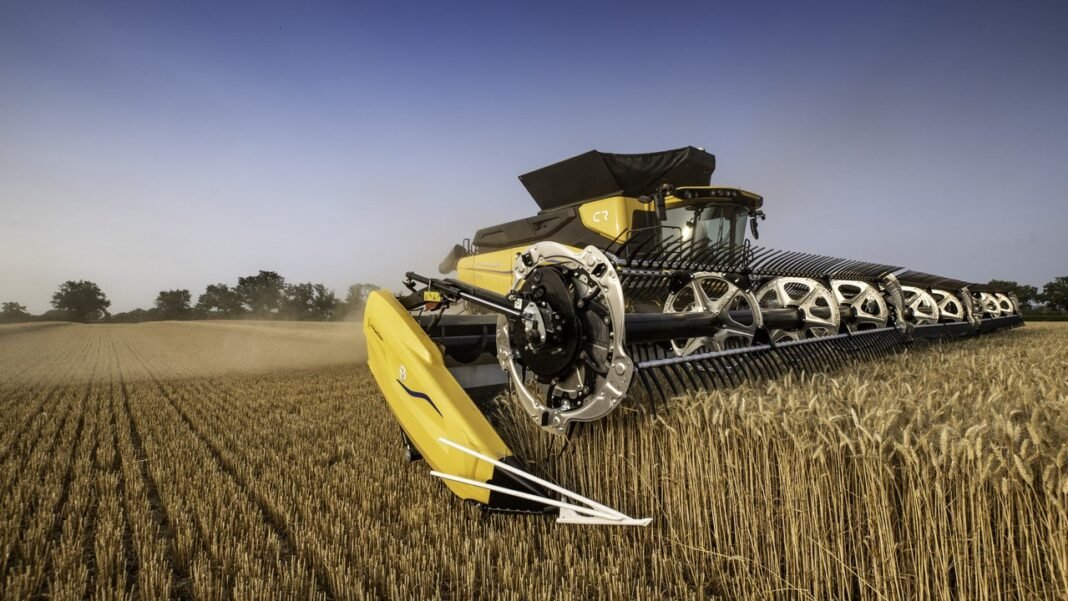

At Agritechnica 2023 in Hanover, New Holland pulled the cover off a combine unlike anything it had built before.
The CR11 was not a facelift of an existing model or a horsepower bump on a familiar frame.
It was, in the words of New Holland‘s own engineering team, a completely new machine — over 8,000 newly developed parts, accounting for more than 90% of everything on it.
Understanding how that machine came together says as much about where large-scale grain harvesting is headed as it does about New Holland’s history.
The Challenge: Why Build a New Combine?
The CR11’s engineering lineage stretches back half a century. New Holland introduced Twin Rotor threshing and separation technology in 1975 with the TR70 combine, a design that ran two rotors in place of the single-rotor or conventional straw-walker systems most competitors used.
The approach caught on because it processed crop more gently, preserving grain quality while still moving high volumes through the machine.
That platform was refined through successive generations — the CR7.90, CR8.90, CR9.90 and, in 2014, the CR10.90, which harvested 797.656 tonnes of wheat in eight hours at a farm in Lincolnshire, England, to set a Guinness World Record that still stands.
The CR11 was designed explicitly to build on that record-holding platform, arriving as New Holland approached the 50th anniversary of the Twin Rotor concept in 2025.
Built at the Centre of Harvesting Excellence
The CR11 was designed and is manufactured at New Holland’s Centre of Harvesting Excellence in Zedelgem, Belgium — the same facility responsible for the CR10.90 record-breaker and now the CR10, the CR11’s slightly smaller sibling.
Bringing design and production together on one site let New Holland’s industrial designers, engineers, product specialists and brand marketing teams work as one unit rather than handing a finished spec sheet from engineering to design late in the process.
“This is a bigger combine and is much more productive than many on the market. Its main goal is to reduce the total cost of harvest for our customers,” said Geert Nerinckx, CR11 global product manager
That collaborative process shows in the CR11’s exterior as much as its internals: New Holland moved away from its traditional blue livery for the CR11’s design language, wrapping the body in a dynamic panel line intended to signal the model’s break from earlier CR combines rather than an incremental update to them.
Reinventing the Combine from the Ground Up
New Holland’s engineers built the CR11 around four stated priorities: more productivity, close to zero grain loss, better residue management and reduced downtime. Every major system on the machine was redesigned against those four goals rather than around a single headline spec.
Power comes from FPT Industrial’s 15.9-litre Cursor C16 engine, producing 775hp — enough to drive twin 24-inch rotors that are 50% longer than those on the outgoing CR10.90, feeding through a widened channel that lets more material into the machine per pass.
The grain tank holds 20,000 litres (567 bushels) and unloads at 210 litres per second, so a full tank empties in under two minutes.
Cleaning is handled by a new system New Holland calls Twin Clean: two complete cleaning shoes running in sequence, each with its own sieves, clean-grain augers and pressure sensors, with automated cross-distribution to keep the load balanced across the full width of the machine.
It’s the part of the design most directly aimed at the zero-loss target, since cleaning-shoe overload is where most grain loss happens in a conventional single-shoe combine.
Residue management was rebuilt around a new six-row chopper — 88 straight knives and 67 adjustable counter-knives spinning at 3,600rpm — sized to match headers up to 18 metres wide, including a new 15-metre draper header built for New Holland by MacDon.
On tyres, New Holland worked with Michelin to co-develop the Cerexbib 2, a 900/65R46 tyre with a 2.32-metre diameter — the first time tyres of that size have gone onto a combine of any brand, aimed at spreading the machine’s weight to limit soil compaction.
Why it matters beyond the spec sheet
None of this comes cheap: the CR11 lists at roughly $1.0–1.2 million depending on configuration, putting it well beyond the reach of most farm operations and squarely in the territory of the largest commercial grain enterprises — the kind of scale found on major grain farms in the United States, Western Europe, Australia and South Africa’s large commercial belt.
For readers tracking New Holland’s parent company, CNH Industrial (NYSE/MI: CNHI), the CR11 is also a data point on where CNH is directing its combine R&D spend, and worth watching alongside the company’s quarterly agriculture-segment results.
For African markets, the CR11’s relevance today is less about fleet purchases and more about what it signals: New Holland is pushing hardest on total-cost-of-harvest economics — fuel efficiency, uptime, grain loss — rather than raw size alone, a trend that filters down into the smaller CR and TC-range combines that are actually being sold and serviced across the continent’s commercial farming regions.
The CR11 represents far more than New Holland’s latest flagship combine. It demonstrates how agricultural engineering is shifting towards smarter, more automated and data-driven harvesting.
While only the world’s largest grain producers may operate the CR11 today, many of its innovations are expected to influence the next generation of combines destined for farms across Africa and beyond.
Did You Know?
More than 90% of the New Holland CR11’s components were developed from scratch, making it one of the most comprehensive redesigns in New Holland’s 50-year Twin Rotor history.
Frequently Asked Questions (FAQs)
What is the New Holland CR11?
The New Holland CR11 is the largest and most advanced combine harvester ever built by New Holland. It features the latest Twin Rotor technology, a 775-horsepower engine, and a redesigned grain handling system for maximum harvesting efficiency.
How much horsepower does the New Holland CR11 have?
The CR11 is powered by an FPT Cursor C16 engine that produces up to 775 horsepower (570 kW), making it the most powerful combine in New Holland’s lineup.
What is the grain tank capacity of the CR11?
The New Holland CR11 has a grain tank capacity of 20,000 litres and an unloading rate of up to 210 litres per second, allowing operators to spend more time harvesting and less time unloading.
When was the New Holland CR11 introduced?
The CR11 was officially unveiled at Agritechnica 2023 as part of New Holland’s next-generation combine range and began entering production for global markets in 2025.
What makes the CR11 different from previous CR combines?
More than 90% of the CR11’s components were newly developed. The machine features an all-new chassis, driveline, cleaning system, residue management system, and improved automation, representing the biggest redesign in the CR series.
Who is the New Holland CR11 designed for?
The CR11 is designed for large-scale commercial grain producers and agricultural contractors who require maximum harvesting capacity, fuel efficiency, and minimal grain loss during demanding harvest seasons.
What crops can the New Holland CR11 harvest?
The CR11 is suitable for harvesting a wide range of crops, including wheat, barley, maize (corn), soybeans, canola, and other cereals, with settings that can be optimized for different field conditions.
Also Read
- Dealer’s Guide: Top 10 Tractor Dealers in South Africa (2026)
- Top Chinese Tractor Brands Making Big Inroads in Africa
