


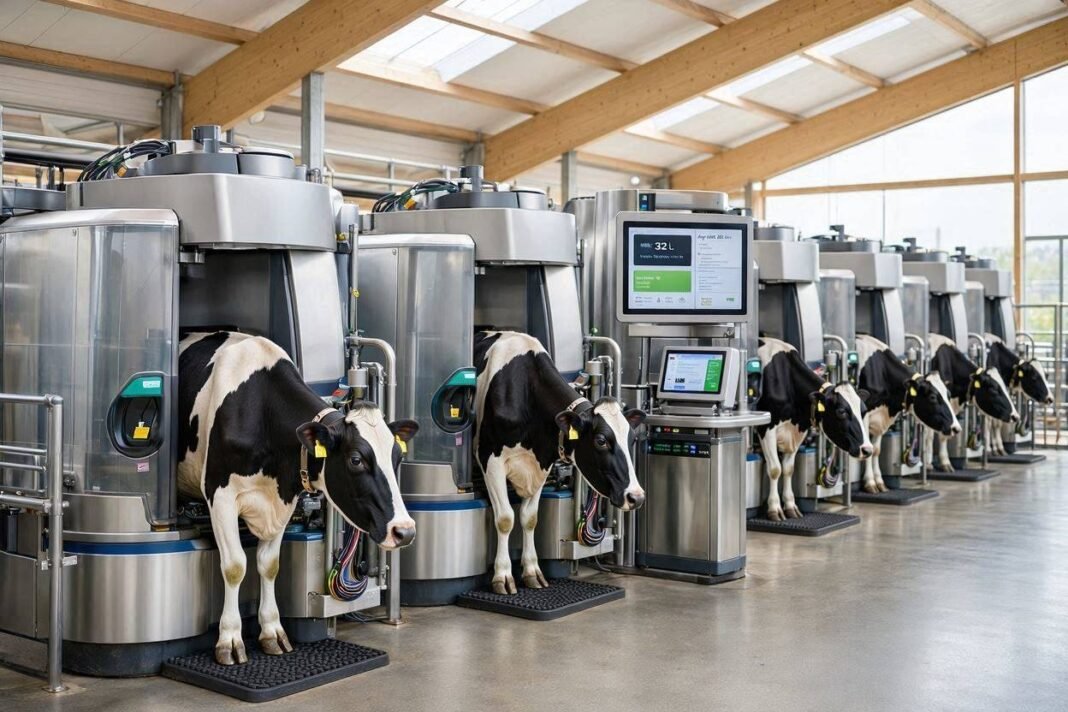
The global dairy industry is undergoing one of its biggest technological transformations in decades.
What was once a labour-intensive business built around fixed milking schedules is rapidly evolving into a data-driven enterprise powered by robotics, artificial intelligence (AI), precision livestock farming and connected herd management systems.
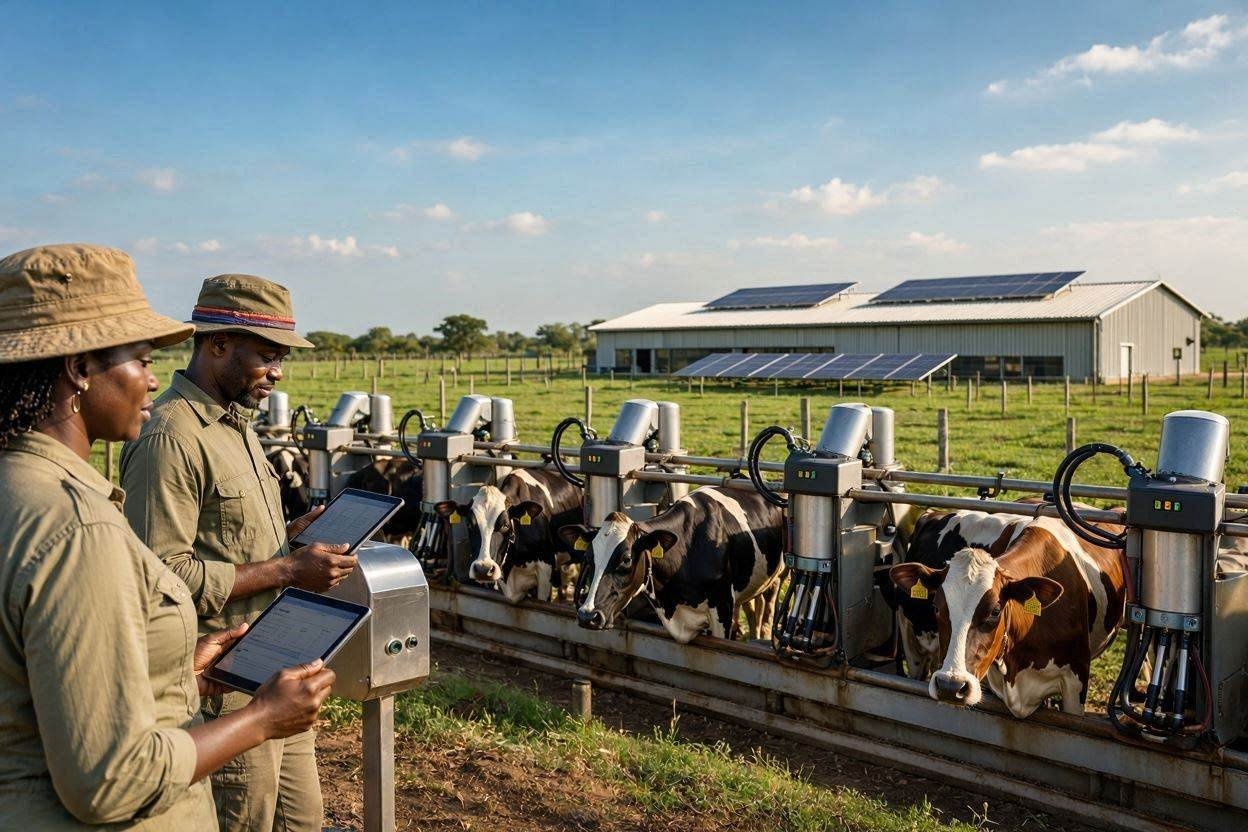
Across Europe, North America, Oceania and increasingly parts of Africa, dairy producers are investing in advanced milking technologies that improve productivity, enhance animal welfare and help farms remain profitable in an increasingly competitive market.
The shift toward automation is being driven by more than innovation alone.
Dairy farmers today face mounting pressure from rising labour costs, difficulties recruiting skilled workers, fluctuating feed prices, stricter environmental regulations and growing consumer expectations around food safety and animal welfare.
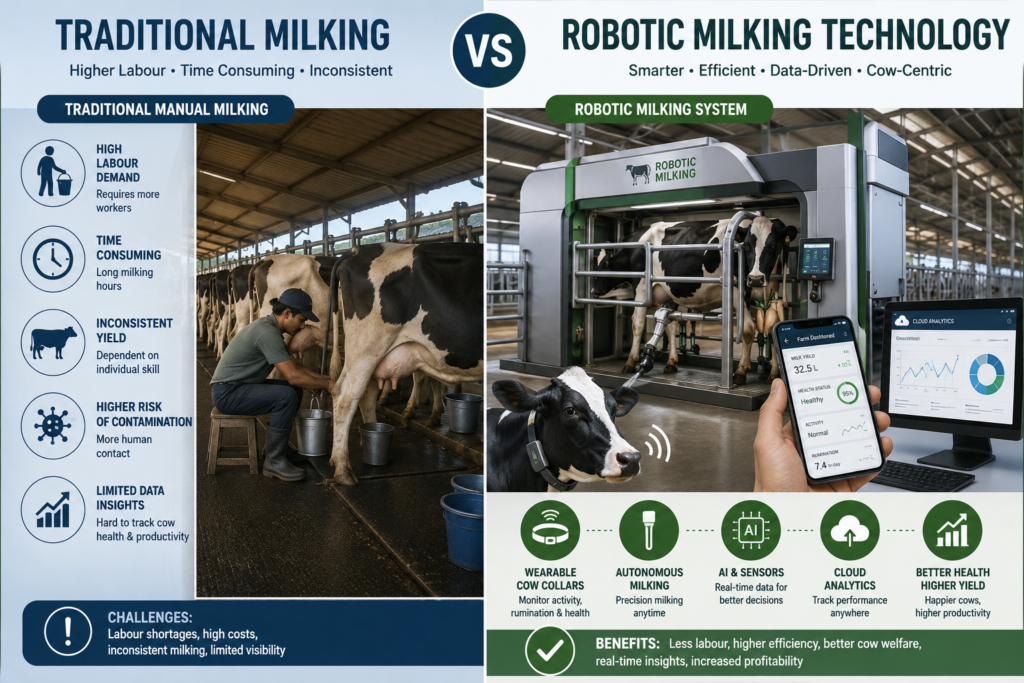
Modern robotic milking systems address many of these challenges by allowing cows to be milked voluntarily, monitoring animal health around the clock, reducing dependence on manual labour and generating real-time production data that supports faster, more informed management decisions.
Recent industry data highlights why investment in dairy automation is accelerating.
According to the Milk Cost of Production Report 2024–2025, average milk income increased by 15% (£425 per cow) during the 2024/25 production year, while labour costs rose to £568 per cow and are projected to reach £655 per cow in 2025/26.
Power and machinery expenses are also expected to continue climbing, reflecting the growing cost of operating modern dairy farms.
At the same time, the report found that the most profitable dairy businesses consistently outperformed their peers through superior cost control rather than simply producing higher milk yields.
These economic realities are reshaping investment decisions across the dairy sector.
Instead of viewing robotic milking systems as optional upgrades, many commercial farms now see them as strategic investments capable of improving labour efficiency, enhancing herd health, reducing operational costs and increasing long-term profitability.
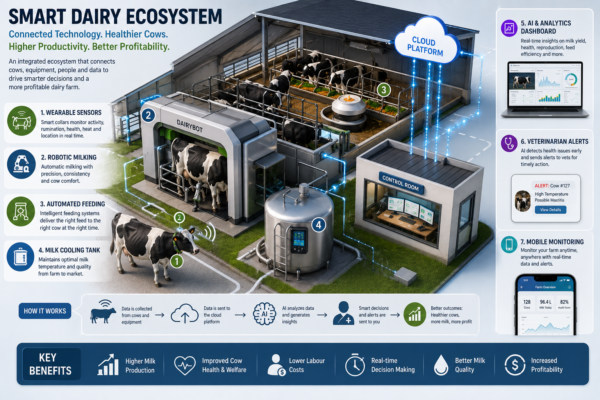
Technologies such as machine vision, wearable sensors, automated feeding systems and cloud-based herd management platforms are becoming integral components of modern dairy operations rather than experimental innovations.
The companies featured in this guide are at the forefront of that transformation.
They have been selected based on their technological innovation, global market presence, product reliability, digital capabilities, dealer and service networks, commitment to research and development, and their growing influence in emerging dairy markets, including Africa.
Whether you are managing a family-owned dairy farm, investing in a large-scale commercial operation or exploring the future of precision livestock farming, these are the manufacturers shaping the next generation of milk production.
Why Dairy Automation Is Transforming Modern Farming
The economics of dairy farming are changing rapidly, making automation an increasingly attractive investment for commercial producers.
While milk prices recovered during 2024/25, operating costs continue to rise, particularly in labour, machinery and farm maintenance.
As a result, many dairy businesses are turning to robotic milking systems and precision livestock technologies to improve efficiency, reduce costs and maintain profitability.
According to the Milk Cost of Production Report 2024–2025, average milk income increased by 15%, rising from £2,910 per cow to £3,335 per cow during the 2024/25 production year.
However, labour costs also increased from £539 to £568 per cow and are projected to reach £655 per cow in 2025/26. Power and machinery expenses are forecast to climb to £862 per cow, reflecting the increasing cost of operating modern dairy farms.
The report also found that profitability is no longer determined by milk yield alone. The top 10% of dairy producers achieved an average comparable profit of £1,098 per cow, while the bottom 10% recorded an average loss of £497 per cow.
The biggest difference was effective cost management. Leading farms spent significantly less on labour, purchased feed, and machinery while maintaining productive herds, demonstrating that efficiency has become just as important as production.
This is where modern milking technology is making a difference. Today’s systems do far more than automate the milking process.
They use artificial intelligence, computer vision, wearable sensors and cloud-based herd management software to monitor cow health, detect heat and mastitis early, optimise feeding programmes and provide real-time performance data.
These capabilities help farmers reduce labour requirements, improve milk quality and make better management decisions based on accurate data rather than observation alone.
For dairy producers planning future investments, robotic milking is no longer simply about replacing manual labour—it’s about building a more efficient, resilient and data-driven dairy business.
Top 10 Milking Technology Companies in the World (2026)
1. DeLaval (Sweden)
Founded in Sweden more than 140 years ago, DeLaval has grown into one of the world’s most respected dairy technology companies.
The company offers an end-to-end portfolio of solutions covering robotic milking, conventional milking parlours, milk cooling, feeding systems, manure management and digital herd management, making it a preferred partner for dairy farms of all sizes.
Its flagship VMS™ V300 robotic milking system combines intelligent vision technology with advanced teat detection to deliver fast, accurate and consistent milking.
The system integrates seamlessly with DelPro™ Farm Manager, allowing farmers to monitor milk production, cow health, fertility, feed intake and overall herd performance from a single digital platform.
Beyond automation, DeLaval continues to invest heavily in precision livestock farming, helping dairy producers improve milk quality, reduce labour requirements and make data-driven management decisions.
The company’s extensive dealer and service network also gives it a strong presence in major dairy regions, including parts of South Africa and East Africa, where commercial dairy farming continues to modernise.
Best for: Large commercial dairies and farms seeking a fully integrated dairy management ecosystem.
2. Lely (Netherlands)
Dutch manufacturer Lely is widely recognised as a pioneer in robotic dairy farming and one of the global leaders in automatic milking technology.
The company’s Astronaut robotic milking system has transformed dairy operations by allowing cows to choose when they are milked, reducing stress while improving productivity and animal welfare.
Beyond robotic milking, Lely has developed a complete automation ecosystem that includes robotic feeding, manure collection, barn cleaning and herd management software.
Its Horizon platform uses real-time farm data to help dairy producers optimise feeding, reproduction, milk production and overall herd health through intelligent decision-making.
Lely’s continuous investment in artificial intelligence, cloud connectivity and precision livestock farming has helped position the company at the forefront of dairy innovation.
With thousands of robotic milking systems operating worldwide, Lely remains one of the benchmark brands for farms embracing digital transformation.
Best for: Dairy farms seeking advanced robotic automation with AI-powered herd management.
3. GEA Farm Technologies (Germany)
GEA Farm Technologies is one of the world’s leading suppliers of dairy processing and farm automation equipment, serving commercial dairy operations in more than 100 countries.
The company is particularly known for delivering integrated solutions that combine robotic milking, conventional parlours, herd management software, milk cooling and dairy processing technologies under one ecosystem.
Its flagship DairyRobot R9500 features GEA’s innovative In-Liner Everything process, which performs teat cleaning, stimulation, milking and post-dipping within a single attachment.
This reduces milking time, improves udder health and minimizes stress on dairy cows. Combined with the DairyNet herd management platform, farmers gain access to real-time production data, health monitoring and performance analytics that support faster decision-making.
GEA’s ability to integrate automation across the entire dairy operation makes it a preferred choice for medium and large-scale commercial farms seeking greater efficiency and long-term productivity.
Best for: Large dairy farms looking for integrated automation and advanced herd management.
4. BouMatic (United States)
For more than 80 years, BouMatic has built a reputation for delivering reliable milking equipment and dairy management solutions to commercial farms around the world.
The company offers a broad portfolio that includes robotic milking systems, rotary and parallel parlours, milk cooling equipment and digital herd management tools.
Its Gemini robotic milking platform is designed to improve milk quality while reducing labour demands through automated milking and continuous herd monitoring.
BouMatic also places a strong emphasis on milk quality, incorporating technologies that monitor conductivity and other indicators to help farmers detect mastitis and other health issues at an early stage.
With an extensive global dealer network and flexible solutions for both conventional and automated dairies, BouMatic remains a trusted partner for producers looking to modernize existing operations without completely redesigning their facilities.
Best for: Dairy farms upgrading existing parlours with automation and milk quality monitoring.
5. Fullwood Packo (United Kingdom)
Fullwood Packo combines decades of dairy engineering expertise with modern automation technologies to deliver complete milking solutions for commercial dairy farms. The company manufactures robotic milking systems, conventional parlours, milk cooling tanks and herd management software, making it a comprehensive supplier for dairy businesses.
Its flagship Merlin robotic milking system is designed to maximize cow comfort while delivering consistent milking performance and valuable production data. Cloud-based monitoring allows farmers to track herd performance remotely, helping identify health issues and production trends before they become costly problems.
Fullwood Packo has earned a strong reputation for dependable after-sales support and customized solutions, particularly among medium-sized dairy farms looking to improve efficiency without sacrificing flexibility.
Best for: Medium-sized dairy operations seeking reliable robotic milking with strong technical support.
6. Afimilk (Israel)
Unlike many manufacturers that focus primarily on robotic milking equipment, Afimilk has built its reputation on precision dairy management.
Founded in Israel in 1977, the company develops advanced monitoring technologies that help farmers improve herd health, reproduction, milk quality and overall farm performance through real-time data.
Its flagship solutions include the AfiFarm® herd management platform, AfiCollar® wearable sensors and AfiAct II® activity monitors, which continuously track rumination, feeding behaviour, heat detection and animal health.
The system can identify potential health issues, including mastitis and fertility problems, before visible symptoms appear, allowing farmers to intervene earlier and reduce production losses.
Afimilk’s technology integrates with both conventional and robotic milking systems, making it a popular choice for farms looking to embrace precision livestock farming without replacing existing milking equipment.
The company has also established a growing presence in Africa, particularly in Kenya, South Africa and Egypt, where commercial dairy farms are increasingly adopting digital herd management technologies.
Best for: Precision herd management, dairy analytics and smart livestock monitoring.
7. Waikato Milking Systems (New Zealand)
New Zealand-based Waikato Milking Systems has become one of the world’s leading specialists in rotary milking technology, serving dairy producers in more than 50 countries.
The company’s solutions are designed around the needs of pasture-based dairy farming, where large herds require fast, efficient and reliable milking systems.
Its automated rotary platforms incorporate technologies such as automatic cup removers, milk metering, herd identification and integration with third-party herd management software.
These systems help farmers increase throughput while maintaining consistent milk quality and animal welfare.
Waikato’s expertise in large-scale rotary parlours makes it particularly attractive to commercial dairy farms with expanding herd sizes.
As dairy operations continue to grow across regions such as Oceania, Latin America and Africa, the company’s scalable solutions are increasingly being adopted by producers seeking higher efficiency and lower labour requirements.
Best for: Large pasture-based dairy farms and high-capacity rotary milking operations.
8. SAC (Denmark)
Founded in Denmark, SAC (S.A. Christensen & Co.) is a well-established supplier of dairy equipment, offering robotic milking systems, conventional parlours, automatic cleaning systems, ventilation solutions and barn infrastructure.
Its strength lies in providing complete dairy farm solutions rather than standalone milking equipment.
SAC’s robotic systems are designed to improve cow traffic, reduce manual labour and optimise milk production through intelligent automation.
The company also focuses on barn design, recognising that efficient cow movement and housing play a crucial role in maximizing the performance of automated milking systems.
While SAC’s strongest market presence remains in Northern Europe, its expertise in integrated dairy housing and automation makes it a valuable partner for modern commercial dairy projects worldwide.
Best for: Dairy farms planning integrated barn design and automated milking systems.


Martin is a writer at Agrimachinery Africa specializing in agricultural machinery, mechanization trends, and farm technology across Africa. His work focuses on tractors, harvesting equipment, irrigation systems, and emerging innovations helping farmers improve productivity and efficiency. Through in-depth industry coverage, he highlights technologies shaping the future of modern agriculture.