


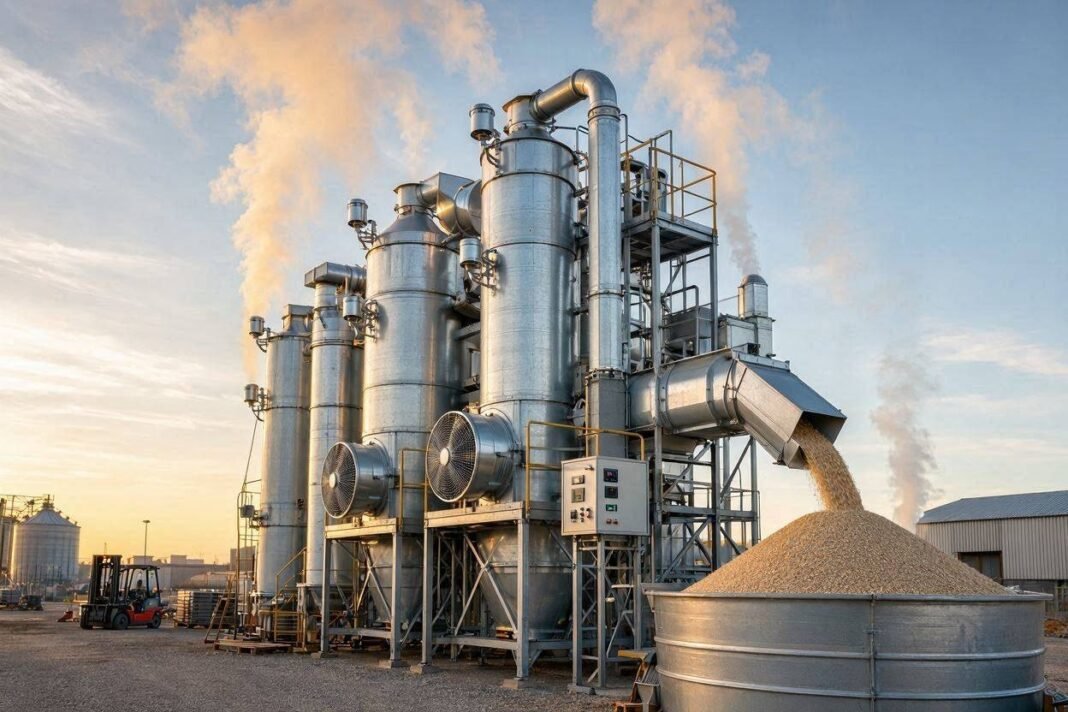

Every year, millions of tonnes of grain are lost after harvest—not because farmers fail to produce enough food, but because it is not dried and stored properly.
In Sub-Saharan Africa alone, an estimated 20–30% of cereal crops are lost after harvest due to poor drying, inadequate storage, pests, and handling. These losses cost the region approximately US$4 billion annually, enough food to feed nearly 48 million people.
Moisture is one of the biggest threats to harvested grain. If maize, wheat, rice, soybeans or other cereals are stored before reaching a safe moisture level, they become vulnerable to mould growth, insect infestations and dangerous mycotoxins such as aflatoxin.
These problems not only reduce grain quality but also lower market value and can pose serious health risks to both humans and livestock.
Grain dryers have therefore become essential equipment in modern agriculture. By quickly reducing grain moisture to safe storage levels, they help farmers minimize post-harvest losses, preserve quality and increase profitability.
As demand for food security grows and precision agriculture expands, the global grain dryer market is now valued at more than US$1.6 billion and is projected to grow at a compound annual growth rate (CAGR) of around 5–7% over the coming years, driven by automation, smart sensors and energy-efficient drying technologies.
In this guide, we explain how grain dryers work, explore the different types available, examine their benefits and applications, and highlight the leading manufacturers shaping the future of grain drying technology worldwide.
At a Glance: Grain Dryer Quick Facts
| Purpose | Removes excess moisture for safe grain storage. |
| Common Crops | Maize, wheat, rice, soybeans, barley and sorghum. |
| Main Types | Batch, continuous-flow, mixed-flow, tower and in-bin dryers. |
| Typical Capacity | 5–50+ tonnes per hour, depending on the system. |
| Key Benefit | Reduces post-harvest losses, improves grain quality and extends storage life. |
1. Why Grain Drying Matters
Freshly harvested grain is rarely ready for the bin. Maize, for example, is typically combined at 20–30% moisture content, while safe long-term storage requires it to be brought down to around 13%.
Grain Drying by the Numbers
Cereal crops lost after harvest in Sub-Saharan Africa.
Estimated annual economic losses from post-harvest grain waste.
People who could be fed with the grain currently lost each year.
Global grain dryer market value.
Projected annual growth of the grain drying market, driven by smart and energy-efficient technologies.
Wheat, rice, soybeans and sorghum all carry their own moisture targets, but the underlying problem is the same: grain straight off the field is wet enough to spoil.
That excess moisture comes from the physiology of the plant itself. Grain fills and matures faster than it dries naturally in the field, and waiting for full field-drying often means losing the crop to weather, birds, pests or shattering.
Mechanical drying lets a farm harvest at the optimum time and take moisture control into its own hands afterward.
The risks of skipping or mishandling this step are severe:
- Mold and aflatoxin contamination. Warm, moist grain is a breeding ground for fungi, some of which produce aflatoxins — toxins linked to liver disease and, in severe cases, rejected export shipments. Aflatoxin contamination has cost maize-producing regions across East and Southern Africa dearly, both in health terms and in lost trade.
- Reduced grain quality. Moisture encourages discoloration, off-odours and breakage during handling, all of which lower grading.
- Storage losses. Wet grain heats up in the bin, attracts insects and rodents, and can cake or rot from the inside out, sometimes without visible warning until it’s too late.
- Lower market prices. Buyers, millers and exporters pay a premium for grain that meets moisture and quality specifications — and dock heavily, or refuse outright, when it doesn’t.
Properly dried grain is simply worth more, keeps longer, and carries far less risk for the farmer, the buyer, and the eventual consumer.
2. How a Grain Dryer Works
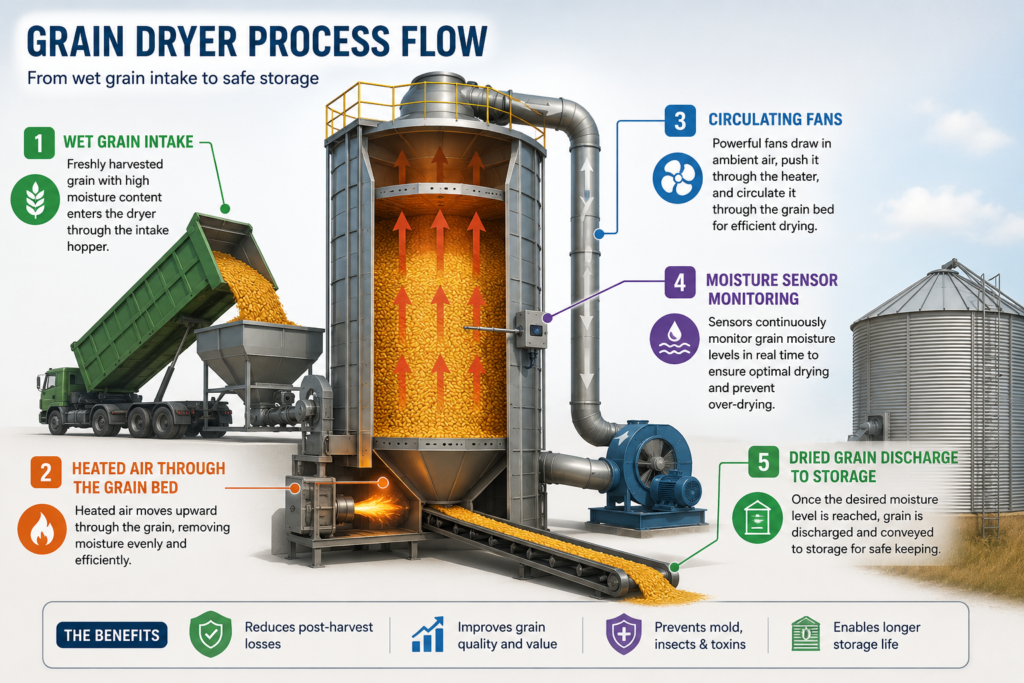
At its core, a grain dryer does one job: pass heated, moving air through wet grain until enough moisture has evaporated to make it storage-stable. The process happens in a continuous loop:
- Wet grain enters the dryer, either loaded into a batch bin or fed continuously into a drying column.
- Heated air removes moisture as it passes through the grain mass, drawing moisture out of each kernel.
- Fans circulate air through the grain bed and exhaust the humid air out of the dryer, maintaining consistent airflow throughout the drying cycle.
- Moisture sensors monitor drying in real time, allowing the system (or the operator) to judge when the target moisture level has been reached.
- Dried grain moves to storage, cooled first to prevent condensation and heat damage inside the bin.
The engineering challenge is balancing speed against grain quality — drying too fast or too hot can crack kernels, scorch grain, or create uneven moisture pockets that spoil later.
This is why airflow design, heat exchange efficiency, and sensor accuracy matter as much as raw drying capacity.
3. Types of Grain Dryers
Not every farm needs the same drying solution. The right type depends on volume, budget, crop variety, and whether drying happens on-farm or at a commercial elevator.
Smallholder and mid-scale farmers across Africa most often start with batch or in-bin systems, since they require less capital and can be sized to match existing storage. Larger commercial farms, grain aggregators, and elevators tend to move toward continuous-flow or tower dryers as volumes grow and speed becomes critical during peak harvest.
4. Key Components of a Grain Dryer
Understanding what’s inside a dryer helps buyers evaluate quality and anticipate maintenance needs:
- Burner: Generates the heat used to warm the drying air, fuelled by diesel, LPG, natural gas, biomass, or electricity depending on the system.
- Fan: Moves air through the grain bed and exhausts moisture-laden air out of the dryer; fan design directly affects drying speed and uniformity.
- Heat exchanger: Transfers heat from the burner to the airflow efficiently, in some systems separating combustion gases from the air that touches the grain.
- Moisture sensor: Continuously measures grain moisture content, feeding data to the control system so drying stops at the right point rather than over- or under-drying.
- Control panel: The operator interface for setting temperature, airflow, and drying targets; increasingly digital and programmable on modern units.
- Grain elevator (leg): Moves grain vertically into and out of the dryer, connecting it to storage bins and handling systems.
- PLC automation: Programmable logic controllers that automate the entire drying cycle, adjusting temperature and airflow based on sensor feedback with minimal manual intervention.
5. Benefits of Proper Grain Drying
The payoff for investing in the right drying equipment shows up across the entire value chain:
- Better grain quality — fewer cracked kernels, less discoloration, higher grading at market
- Reduced post-harvest losses — one of the biggest drains on farm profitability in many African grain-producing regions
- Longer storage life — properly dried grain can be held for months without significant deterioration
- Higher selling price — buyers and exporters pay premiums for grain that meets moisture specifications
- Less fungal growth — directly reducing aflatoxin risk and associated health and trade consequences
- Lower insect damage — dry grain is far less attractive to storage pests than moist grain
Did You Know?
Harvesting maize just a few days earlier and drying it mechanically can significantly reduce weather-related losses while preserving grain quality, market value and long-term storage potential.
6. Smart Grain Drying Technology
The next generation of grain dryers is where the technology gap between basic and advanced systems is widening fastest — and where forward-looking farms and cooperatives can gain a real edge.
- AI moisture prediction: Machine learning models can now forecast how grain moisture will change during drying, helping operators set optimal parameters before the cycle even starts.
- IoT monitoring: Internet-connected sensors track temperature, humidity, and airflow throughout the dryer, feeding data to cloud dashboards in real time.
- Smartphone control: Operators can start, stop, and adjust drying cycles remotely, reducing the need for constant on-site supervision during long harvest days.
- Automatic temperature adjustment: Systems that respond dynamically to incoming grain moisture and ambient conditions, rather than running on fixed settings.
- Cloud monitoring: Farm managers and cooperative staff can track multiple dryers across different sites from a single dashboard.
- Fuel optimization: Smart controls reduce fuel consumption by matching burner output more precisely to actual drying demand, a significant cost saver given how much fuel a drying season can consume.
For African grain operations dealing with unreliable grid power, variable fuel costs, and a shortage of skilled operators in remote areas, these technologies offer a genuine opportunity to close the efficiency gap with larger global operations — provided infrastructure and connectivity support them.
7. Fuel Sources for Grain Dryers
The choice of fuel affects both running costs and the practicality of a dryer for a given location:
- Diesel: Widely available and portable, common on farms without access to piped gas
- LPG (liquefied petroleum gas): Cleaner burning than diesel, popular where LPG supply chains are reliable
- Natural gas: Cost-effective where pipeline infrastructure exists, mostly limited to larger commercial operations
- Biomass: Uses crop residue, husks, or wood waste, an increasingly attractive option for farms looking to cut fuel costs and use available on-farm material
- Electricity: Clean and precise but dependent on stable, affordable grid power or on-site generation
- Solar-assisted systems: Emerging hybrid designs that use solar energy to pre-heat air or supplement conventional fuel sources, reducing overall fuel consumption
Fuel choice is often as much a decision about local availability and infrastructure as it is about cost per ton dried.
8. Grain Dryer Capacity: Matching Size to Farm Scale
Grain dryers are typically rated by how many tons of grain they can process per hour, and matching capacity to actual harvest volume is one of the most important — and most commonly miscalculated — purchasing decisions:
- 5 tons/hour: Suited to smallholder and small commercial farms with modest annual volumes
- 10 tons/hour: A common step-up for growing farms or small cooperatives
- 20 tons/hour: Fits mid-size commercial farms and aggregation points handling several farms’ output
- 50+ tons/hour: Reserved for large commercial operations, grain elevators, and terminal facilities
A dryer that’s too small forces grain to sit and wait during peak harvest, risking spoilage before it’s even processed. One that’s oversized ties up capital that could go toward other farm investments. The right sizing calculation should factor in peak daily harvest volume, not just total seasonal output.
9. Which Crops Can Be Dried?
Grain dryers are used across a wide range of crops, each with its own target moisture content and heat sensitivity:
- Maize
- Wheat
- Rice
- Soybeans
- Barley
- Sorghum
- Sunflower
- Coffee (in regions where mechanical drying supplements traditional sun-drying)
Because different crops tolerate different drying temperatures — rice and soybeans, for instance, are more prone to cracking under high heat than maize — dryer settings and, in some cases, dryer type need to be adjusted crop by crop rather than treated as one-size-fits-all.
10. Leading Grain Dryer Manufacturers
For buyers researching equipment, a handful of manufacturers dominate global grain-drying technology and are increasingly visible in African markets through dealers and distributors:
- GSI — a major US-based manufacturer known for a broad range of grain handling and drying systems
- Sukup — one of the largest family-owned grain drying and storage equipment makers globally
- Brock — long-established in grain bins, dryers, and handling equipment
- Mathews Company (M-C) — specialises in tower and continuous-flow dryer technology
- Bühler — a Swiss engineering group with a strong presence in grain processing technology worldwide
- Chief Industries — known for grain storage and drying systems across multiple capacity ranges
- Alvan Blanch — a UK manufacturer with a long history supplying drying and processing equipment to African markets specifically
- Pedrotti — Italian manufacturer known for mixed-flow drying technology
- Svegma — Swedish manufacturer specialising in continuous-flow and mixed-flow dryers
- Shivvers — known for low-temperature and in-bin drying systems
Buyers evaluating any of these should confirm local dealer support, spare parts availability, and after-sales service in their specific country before committing — equipment reliability on paper matters far less than reliability in the field during a six-week harvest window.
11. Grain Dryer Prices: What to Expect
Grain dryer pricing varies enormously depending on capacity, technology level, fuel system, and automation features. As a general guide:
- Small in-bin and batch dryer setups suited to smallholder or small commercial farms typically represent the lowest entry point in the market.
- Mid-range batch and continuous-flow dryers, in the 10–20 tons/hour range, sit in a considerably higher price bracket, reflecting greater throughput and automation.
- Large continuous-flow, mixed-flow, and tower dryers built for commercial farms and elevators represent a major capital investment, often running into hundreds of thousands of dollars once installation, elevators, and control systems are included.
Actual costs vary significantly by region, import duties, currency fluctuations, and specification level, so farmers and buyers should treat these as general orientation points rather than fixed figures, and request formal quotations from manufacturers or dealers for accurate, current pricing.
12. Maintenance: Keeping a Grain Dryer Running Reliably
A grain dryer is a significant investment, and neglected maintenance is one of the fastest ways to lose that investment during the exact weeks it’s needed most. Key maintenance tasks include:
- Cleaning: Removing grain dust, chaff, and debris regularly to prevent fire risk and maintain airflow efficiency
- Burner inspection: Checking for proper ignition, fuel delivery, and flame quality before and during the season
- Fan maintenance: Inspecting belts, bearings, and blades for wear that can reduce airflow and drying efficiency
- Moisture sensor calibration: Ensuring sensors give accurate readings, since miscalibrated sensors lead directly to over- or under-dried grain
- Bearing lubrication: Preventing premature wear on moving components under continuous harvest-season operation
- Safety checks: Verifying emergency shutoffs, fire suppression systems, and electrical connections, particularly given the fire risk posed by dust and heat operating together
A pre-season inspection, ideally weeks before harvest begins, catches most problems before they become costly mid-harvest breakdowns.
13. Future Trends in Grain Drying
The grain drying industry is evolving quickly, driven by rising energy costs, tightening quality standards, and advances in automation:
- AI-driven optimisation: Increasingly sophisticated algorithms that adjust drying parameters in real time based on grain type, moisture, and ambient conditions
- Robotics: Automated handling and cleaning systems reducing labour requirements around dryer operation
- Digital twins: Virtual models of drying systems used to simulate and optimise performance before changes are made on physical equipment
- Energy-efficient drying: New heat exchanger designs and heat-recovery systems cutting fuel consumption per ton dried
- Carbon reduction: Growing interest in biomass, solar-assisted, and hybrid systems as buyers and export markets place more weight on sustainability credentials
- Predictive maintenance: Sensor-driven systems that flag component wear before failure, reducing unplanned downtime during peak season
For African grain producers and aggregators, staying abreast of these trends matters not just for efficiency, but for meeting the quality and traceability standards increasingly demanded by regional and export buyers.
Grain drying sits at one of the most consequential junctions in the entire agricultural value chain — the point where a season’s work is either preserved or put at risk.
Whether a farm needs a simple in-bin system or a commercial-scale continuous-flow dryer, matching the right technology to actual harvest volume, crop type, and available fuel infrastructure is what separates grain that reaches market at full value from grain that never gets the chance.
As smart drying technology becomes more accessible and African grain infrastructure continues to modernise, the farms and cooperatives that invest early in the right drying capacity — and maintain it properly — will be the ones best positioned to capture the full value of every harvest.
Grain Dryers in Africa: Opportunities and Challenges
As Africa’s agricultural sector modernizes, grain dryers are becoming increasingly important for reducing post-harvest losses and improving food security. However, despite the growing need, widespread adoption remains uneven due to infrastructure and economic challenges.
Unreliable Electricity
Many rural farming regions across Africa continue to experience unreliable electricity or lack grid access altogether.
This limits the use of electric grain dryers and forces many farmers to rely on diesel-powered systems or traditional sun drying. As a result, manufacturers are increasingly developing hybrid dryers that can operate using electricity, diesel, biomass or solar energy.
Rising Diesel Costs
Fuel is one of the largest operating expenses for mechanical grain drying. Fluctuating diesel prices can significantly increase drying costs, particularly during peak harvest seasons. To reduce operating expenses, many farmers and grain processors are turning to biomass-fueled dryers that use agricultural residues such as maize cobs, rice husks and wood chips.
Increasing Maize Production
Africa’s maize production continues to grow as governments invest in improved seed varieties, fertilizer access and mechanization. Higher production means larger volumes of grain must be dried quickly to prevent spoilage, creating strong demand for efficient grain drying systems capable of handling larger harvests.
Expansion of Grain Aggregation Centres
Across several African countries, grain aggregation centres are being established to collect, clean, dry and store grain from thousands of smallholder farmers.
These facilities improve grain quality, reduce post-harvest losses and enable farmers to access better prices by supplying grain that meets commercial quality standards. High-capacity grain dryers are becoming a critical component of these centers.
Government Mechanization Programs
Many African governments are promoting agricultural mechanization through equipment subsidies, concessional loans and public-private partnerships.
National programs aimed at improving food security increasingly include investments in grain handling, storage and drying infrastructure, creating new opportunities for manufacturers and equipment dealers.
Climate Change and Unpredictable Harvests
Changing weather patterns are making harvest seasons less predictable. Unexpected rainfall during harvest can rapidly increase grain moisture, delay drying and cause severe quality losses if grain remains in the field.
Mechanical grain dryers give farmers greater flexibility by allowing harvesting to continue even under uncertain weather conditions, reducing dependence on sunshine and helping protect grain quality.
Looking Ahead
As Africa seeks to strengthen food security and reduce post-harvest losses, grain dryers are expected to play an increasingly important role across the agricultural value chain. Continued investment in rural energy infrastructure, affordable financing, biomass-powered technologies and modern grain storage facilities will be key to accelerating adoption and ensuring farmers can preserve more of every harvest.
Frequently Asked Questions (FAQs)
What moisture content is safe for storing maize?
For long-term storage, maize should generally be dried to 13–14% moisture content.
Grain stored above this level is more susceptible to mould growth, insect infestation and mycotoxin contamination, including aflatoxin. Always verify moisture using a calibrated grain moisture meter before storage.
How long does grain drying take?
Drying time depends on the grain’s initial moisture content, dryer type, ambient weather conditions and drying temperature. Small batch dryers may require 3–8 hours, while high-capacity continuous-flow dryers can process grain continuously, significantly reducing overall drying time.
Can a grain dryer reduce aflatoxin risk?
Yes. Mechanical grain dryers help lower aflatoxin risk by rapidly reducing grain moisture to safe storage levels. Since aflatoxin-producing fungi thrive in warm, moist conditions, prompt drying limits fungal growth and helps preserve grain quality.
What fuel is cheapest for grain drying?
The most economical fuel depends on local availability and energy prices. Common options include LPG, diesel, natural gas, biomass (such as rice husks, wood chips or maize cobs), and electricity.
In many agricultural regions, biomass fuels offer the lowest operating costs because they utilize readily available farm residues.
Is a grain dryer worth the investment?
For most commercial farms and grain producers, yes. A grain dryer can reduce post-harvest losses, improve grain quality, increase selling prices, minimize weather-related risks and allow farmers to harvest earlier. Over time, these benefits often outweigh the initial purchase and operating costs.
What size grain dryer do I need?
The ideal dryer size depends on your annual grain production, harvest window, crop type and future expansion plans.
Small farms may only require a 5–10 tonnes-per-hour dryer, while commercial grain operations often choose systems capable of processing 20–50+ tonnes per hour. Selecting a dryer that matches your peak harvest capacity helps avoid bottlenecks during harvest.
Also Read
- Top 10 Agricultural Machinery & Grain Storage Innovations to Watch in 2026
- Smart Technologies Transforming Grain Handling Systems Across Africa
- The future of crop storage: Advanced solutions for post-harvest loss reduction

Martin is a writer at Agrimachinery Africa specializing in agricultural machinery, mechanization trends, and farm technology across Africa. His work focuses on tractors, harvesting equipment, irrigation systems, and emerging innovations helping farmers improve productivity and efficiency. Through in-depth industry coverage, he highlights technologies shaping the future of modern agriculture.