


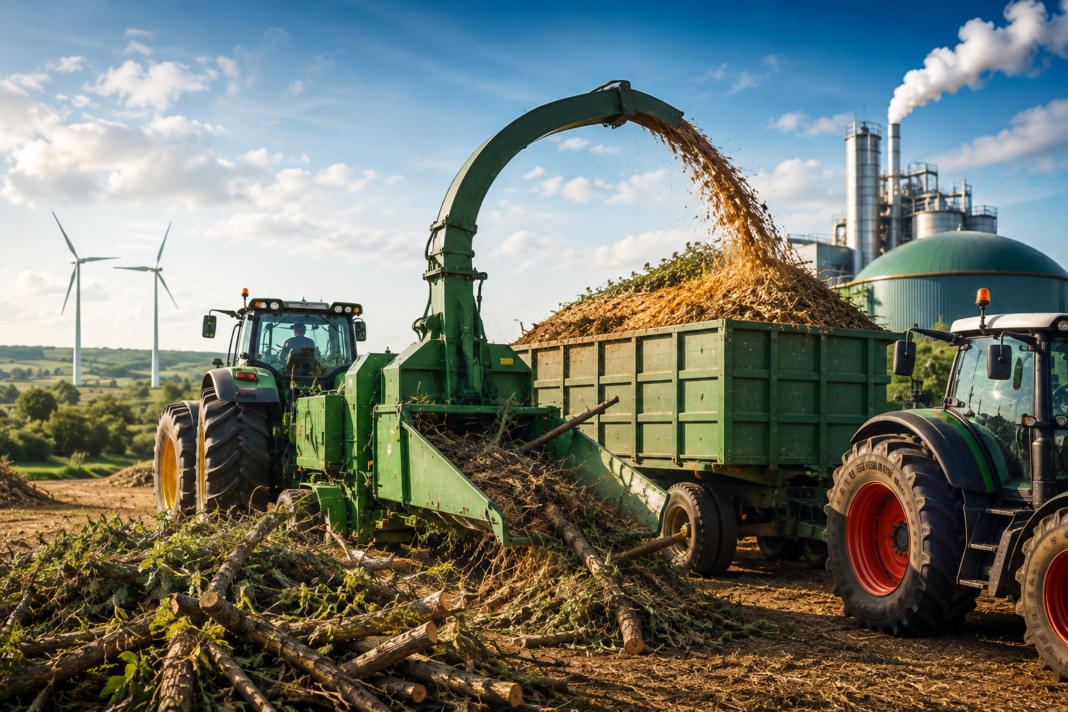

As Europe accelerates its transition to cleaner energy, agricultural machinery is taking on a role that extends well beyond food production.
Across the continent, tractors, forestry equipment, shredders and biomass handling machines are helping transform agricultural and forestry residues into renewable energy, supporting efforts to reduce fossil fuel dependence while creating new income opportunities for farmers.
The growing importance of this sector will be in focus at EIMA Energy, one of the specialist exhibitions within EIMA International, taking place in Bologna, Italy, from November 10–14.
The event will showcase the latest machinery, technologies and supply chains driving the bioenergy industry, offering a glimpse into how modern mechanization is supporting Europe’s circular economy.
For African farmers and agribusinesses, the developments are worth watching. While Europe’s energy landscape differs from Africa’s, the underlying principle remains the same: agricultural waste can become a valuable resource when supported by the right technology.
From Agricultural Residues to Renewable Energy
Biomass energy is produced from organic materials that would otherwise be discarded or left to decompose.
These include crop residues such as wheat straw, maize stalks and sugarcane bagasse, as well as forestry residues, livestock manure and agro-industrial by-products.
Instead of being treated as waste, these materials are collected, processed and converted into electricity, heat or transport fuels through a range of modern technologies.
The sector is playing an increasingly important role in Italy’s renewable energy mix.
According to figures presented during the launch of EIMA Energy, renewable sources supplied approximately 22% of Italy’s national energy demand in 2024, with bioenergy contributing alongside solar, wind, hydropower, geothermal energy and heat pumps.
The figures illustrate a broader trend across Europe, where governments are seeking greater energy security while reducing greenhouse gas emissions and making better use of agricultural and forestry resources.
Related Stories
Machinery at the Heart of the Biomass Supply Chain
Turning agricultural residues into usable energy requires far more than collecting waste from fields or forests. Every stage of the biomass supply chain depends on specialised machinery capable of harvesting, transporting, processing and handling bulky organic materials efficiently.
Modern forestry tractors are used to extract timber and logging residues from forests, while high-capacity wood chippers convert branches and logs into uniform wood chips suitable for biomass plants.
Agricultural balers collect straw and crop residues for transport, and telehandlers load biomass into storage facilities, trucks and processing plants.
Specialised shredders further reduce biomass into consistent feedstock, improving combustion efficiency and making transportation more economical. Trailers and material handling equipment complete the logistics chain, ensuring biomass reaches energy facilities with minimal losses.
Speaking during the EIMA Energy presentation, Raffaele Spinelli, researcher at Italy’s National Research Council’s Institute for BioEconomy (CNR IBE), highlighted the central role of mechanization in building efficient biomass industries.
“To establish efficient bioenergy supply chains, it is essential to have mechanization that covers the entire cycle, from biomass harvesting to transportation, through processing, and on to the plant systems for energy conversion.”
His comments reflect a growing recognition that renewable energy projects rely not only on power generation technology but also on efficient harvesting and logistics systems.
Without reliable machinery, collecting dispersed agricultural and forestry residues would be too expensive and labour-intensive to support commercial-scale bioenergy production.
Lessons for African Agriculture
Africa possesses abundant biomass resources that remain largely underutilised. Every harvest season, millions of tonnes of maize stalks, rice husks, sugarcane residues, coffee husks, cotton stalks and forestry by-products are burned, discarded or left in fields.
With growing demand for renewable energy and increasing investment in agricultural mechanization, these materials could become valuable feedstocks for local bioenergy projects.
Countries with significant sugar industries, such as Kenya, South Africa and Zambia, already generate large quantities of bagasse, while rice-producing nations have access to substantial volumes of rice husks.
Forestry operations across Southern and Central Africa also produce residues that could support biomass-based heating and electricity generation.
Developing these value chains would require investment not only in energy facilities but also in the machinery needed to collect, process and transport biomass efficiently.
For machinery manufacturers and contractors, this represents an emerging market that extends beyond traditional crop production.
EIMA Energy Highlights a Growing Industry
Organised jointly by FederUnacoma and the Italian Biomass Association (ITABIA), EIMA Energy has evolved into one of Europe’s leading showcases for biomass machinery and renewable energy technologies.
The 2026 edition will feature a dedicated outdoor demonstration area where visitors can see equipment operating under real working conditions, alongside technical seminars covering biomass supply chains, modern forestry and the circular bioeconomy.
According to Simona Rapastella, General Manager of FederUnacoma, live demonstrations remain one of the exhibition’s defining features because they allow visitors to evaluate equipment performance in practical applications.
She also stressed the wider importance of developing biomass supply chains, noting that they provide practical responses to both climate goals and energy security challenges by making better use of existing agricultural and forestry resources.
A Growing Opportunity for Agricultural Mechanization
As countries pursue cleaner energy systems, agricultural machinery is becoming an essential part of the renewable energy transition.
Equipment once associated solely with farming and forestry is now helping produce electricity, heat and biofuels from materials that were previously regarded as waste.
For Africa, Europe’s experience demonstrates that biomass is not simply an environmental solution but also a mechanization opportunity.
By investing in efficient harvesting, processing and transport equipment, countries can create new revenue streams for farmers, strengthen rural industries and improve the utilisation of agricultural residues.
While every region will develop its own approach to bioenergy, one lesson is becoming increasingly clear: the future of agricultural machinery is likely to extend beyond producing food to helping power the energy systems of tomorrow.
Also Read
- Italy’s FederUnacoma Strengthens African Outreach with Presence at Agritec Africa 2026
- Tractor Prices in Kenya (2026): New & Used Tractor Price Guide
- Tractor Prices in Kenya (2026): New & Used Tractor Price Guide

Martin is a writer at Agrimachinery Africa specializing in agricultural machinery, mechanization trends, and farm technology across Africa. His work focuses on tractors, harvesting equipment, irrigation systems, and emerging innovations helping farmers improve productivity and efficiency. Through in-depth industry coverage, he highlights technologies shaping the future of modern agriculture.