


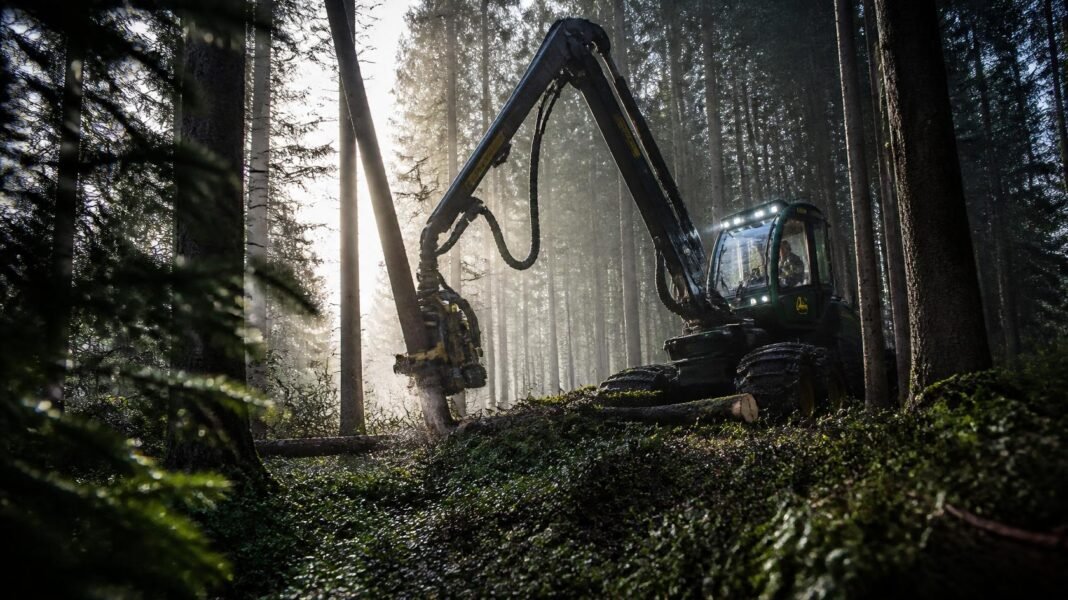

Logging has become a highly mechanised industry. Modern timber harvesting operations can involve purpose-built harvesters, forwarders, feller bunchers, skidders, processors, log loaders and sophisticated digital forestry systems.
That has created a global market populated by both large construction and agricultural equipment manufacturers and specialist forestry companies.
But choosing the world’s leading logging machinery manufacturers is not as simple as ranking companies by size.
Some manufacturers specialise in cut-to-length harvesting, while others are particularly strong in full-tree harvesting, feller bunchers and skidders. Others focus on specific parts of the harvesting chain.
For this guide, Agrimachinery Africa looks at manufacturers based on their forestry equipment portfolios, machine specialisation, technology, operating applications and relevance to modern logging operations.
The list is therefore intended as a machinery guide rather than a ranking by annual revenue.
How We Ranked the Logging Machinery Manufacturers
This is an editorial ranking by Agrimachinery Africa, not a ranking based solely on company revenue or market capitalisation. We assessed manufacturers based on their importance to modern mechanised forestry and the breadth and relevance of their machinery portfolios.
- Forestry machinery range: The breadth of equipment offered, including harvesters, forwarders, skidders, feller bunchers, loaders and forestry tractors.
- Machine specialisation: Expertise in specific forestry applications and harvesting systems such as cut-to-length and full-tree logging.
- Technology and innovation: Automation, operator-assistance systems, telematics, precision forestry and other technology used to improve productivity.
- Global market presence: The manufacturer’s international footprint, distribution network and presence across major forestry markets.
- Product capability: Machine performance, versatility and suitability for demanding timber-harvesting applications.
- African relevance: Availability, dealer support, operating suitability and the manufacturer’s relevance to African forestry markets.
- Industry influence: The manufacturer’s contribution to the development and mechanisation of modern forestry operations.
Important: The ranking should not be interpreted as a definitive league table of the world’s largest forestry machinery companies. Some manufacturers specialise in complete machines, while others focus on harvesting heads, attachments or specialised forestry equipment. Our aim is to identify the manufacturers that machinery buyers and forestry professionals should know in 2026.
The World’s Leading Logging Machinery Manufacturers
| Rank | Manufacturer | Country | Key Forestry Strength |
|---|---|---|---|
| 1 | John Deere | United States | Broad forestry equipment portfolio |
| 2 | Komatsu Forest | Sweden/Japan | Harvesters and forwarders |
| 3 | Ponsse | Finland | Cut-to-length forestry |
| 4 | Tigercat | Canada | Feller bunchers and full-tree harvesting |
| 5 | Caterpillar | United States | Feller bunchers, skidders and forestry equipment |
| 6 | Rottne | Sweden | Harvesters and forwarders |
| 7 | Eco Log | Sweden | Harvesters and forwarders |
| 8 | Bell Equipment | South Africa | Forestry haulage and logging equipment |
| 9 | Logset | Finland | Harvesters and forwarders |
| 10 | Kesla | Finland | Forestry cranes, trailers and equipment |
| 11 | Waratah | United States | Harvesting heads and forestry attachments |
| 12 | Log Max | Sweden | Harvester heads |
| 13 | HSM | Germany | Forestry tractors and forwarders |
| 14 | Pfanzelt | Germany | Forestry tractors and cable systems |
| 15 | Malwa | Sweden | Compact forestry machinery |
Important: The manufacturers are not all direct competitors. A specialist harvester-head manufacturer should not be judged against a company producing an entire fleet of forestry machines.
Instead, the ranking should be viewed as a guide to the companies shaping different parts of the logging machinery industry.
1. John Deere
John Deere has one of the broadest forestry machinery portfolios in the global market.
Its forestry range includes tracked and wheeled harvesters, forwarders, skidders, tracked and wheeled feller bunchers, knuckleboom loaders, shovel loggers and swing machines, alongside forestry attachments and technology solutions.
That breadth is one of the company’s biggest advantages.
A contractor can potentially build a substantial portion of a harvesting operation around the John Deere ecosystem rather than sourcing every machine from a different manufacturer.
The company is also investing heavily in digital forestry. Its technology portfolio includes precision forestry, machine-management systems and operator-assistance technologies.
John Deere is particularly interesting for Africa because its forestry equipment portfolio is already marketed through its African operations.
Its Africa forestry fleet guide covers everything from feller bunchers and forwarders to harvesters, loaders, skidders and precision forestry systems.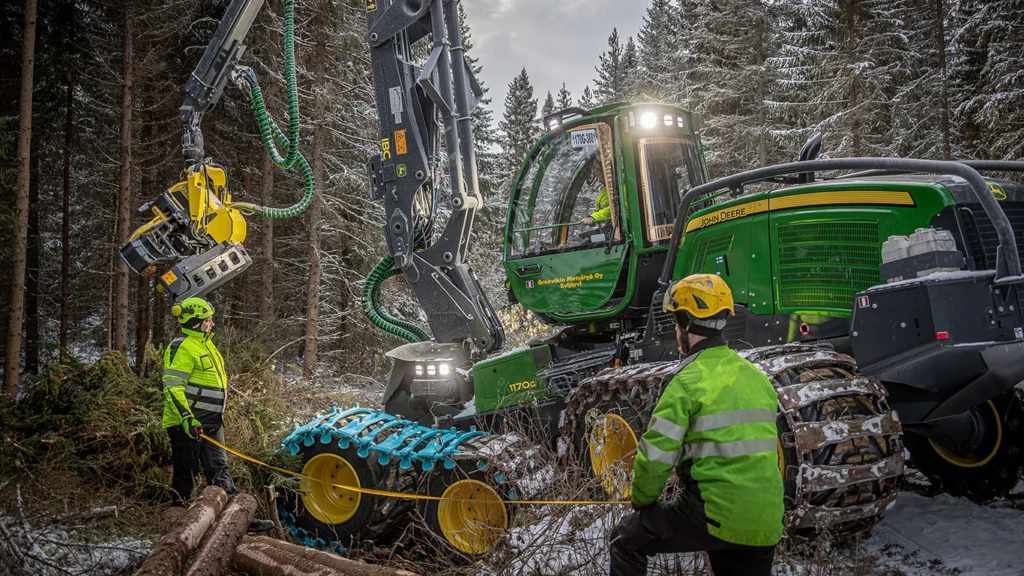
Best known for: A broad, integrated forestry equipment portfolio.
2. Komatsu Forest
Komatsu is another major name in mechanised forestry, particularly in the cut-to-length segment.
The company’s forestry portfolio includes wheeled harvesters, forwarders, log loaders, swing machines, felling heads and harvesting heads.
Its forwarder range illustrates the company’s focus on different forestry applications. Komatsu offers machines ranging from smaller thinning machines with approximately 9-tonne load capacity to large final-logging forwarders with up to 25 tonnes of load capacity.
This makes Komatsu particularly relevant to contractors operating different forest types and harvesting conditions.
Its combination of harvesting and forwarding equipment also allows operators to match machines into complete cut-to-length production systems.
Best known for: Harvesters, forwarders and integrated cut-to-length systems.
3. Ponsse
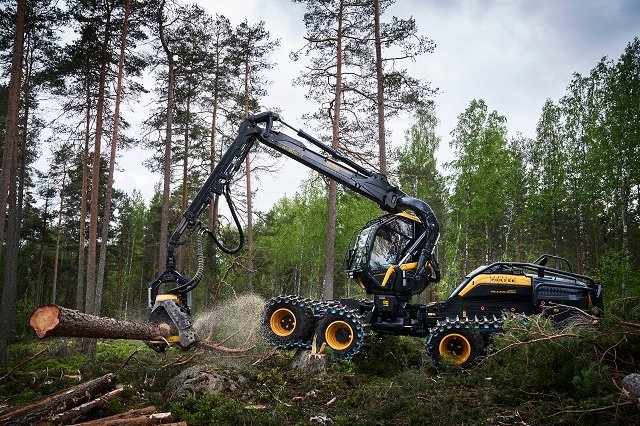
Finland’s Ponsse is one of the world’s best-known specialist forestry machinery manufacturers.
Unlike diversified heavy-equipment manufacturers, Ponsse has built its reputation almost entirely around forest machines.
Its forwarder portfolio is designed for conditions ranging from soft terrain to steep slopes, with an emphasis on power, weight distribution, traction and operator ergonomics. Ponsse also highlights the use of continuously variable transmission technology in its forwarders.
This specialisation makes Ponsse particularly significant in the cut-to-length market.
For contractors whose operation depends on the coordinated use of a harvester and forwarder, Ponsse is therefore one of the manufacturers that deserves close attention.
Best known for: Specialist cut-to-length harvesting machinery.
4. Tigercat
Canada’s Tigercat takes a different approach from companies primarily associated with cut-to-length harvesting.
The manufacturer has deep roots in full-tree and high-production logging systems, particularly feller bunchers, skidders, shovel loggers and related equipment.
Its current portfolio includes drive-to-tree and track feller bunchers designed for applications ranging from plantation thinning to mature saw-timber harvesting and difficult terrain.
Tigercat also produces skidders, forwarders, harvesters, processors, loaders and harvesting heads. Its equipment portfolio demonstrates how extensive a modern full-tree harvesting system can become.
The company is especially interesting for operators dealing with steep slopes, large timber and demanding extraction conditions.
Best known for: Feller bunchers, skidders and full-tree harvesting systems.
5. Caterpillar
Caterpillar is one of the world’s largest heavy-equipment manufacturers, and its machinery technology has long been applied to forestry.
Its forestry offering is particularly relevant where logging operations require machines based around heavy tracked equipment, felling and material-handling applications.
Caterpillar’s greatest advantage is its enormous global heavy-equipment ecosystem.
For forestry contractors operating in markets where Caterpillar already has a strong dealer and service presence, that support network can be just as important as the machine itself.
Best known for: Heavy-duty forestry applications and machines derived from a broad off-road equipment platform.
6. Rottne
Swedish manufacturer Rottne is a specialist in wheeled forestry machines designed around the cut-to-length method.
The company manufactures harvesters and forwarders and says approximately 200 machines are delivered annually from its Swedish factories to four continents.
Its forwarder range includes machines from compact thinning models to large final-felling machines, including the 15-tonne F15 and larger models.
Rottne also offers connected-machine technology through Rottne Connect, giving fleet owners access to machine information remotely.
Best known for: Swedish-engineered harvesters and forwarders.
7. Eco Log
Eco Log has built its business around modern cut-to-length forestry machinery.
The Swedish manufacturer currently offers a range of harvesters, forwarders and harvesting heads.
Its machines are designed around applications where harvesters and forwarders operate together.
One of Eco Log’s distinguishing engineering features is its hydraulically controlled pendulum-arm system, which is designed to improve machine capability in challenging terrain.
The company currently lists five harvester models and three forwarder models, covering different sizes and forestry applications.
Best known for: Harvester-forwarder systems and difficult-terrain forestry.
8. Bell Equipment
Bell Equipment is particularly important from an African perspective.
The South African manufacturer operates globally and produces equipment for several industries, including forestry, agriculture, mining and construction. The company says it operates in more than 80 countries.
Bell’s forestry and agriculture portfolio includes loggers, skidders, timber trucks, haulage tractors, log-handling equipment and specialised forestry machines.
That makes Bell different from the Scandinavian manufacturers that dominate much of the specialist CTL market.
For African forestry businesses, the company’s regional heritage and understanding of heavy equipment operating conditions make it particularly relevant.
Bell’s forestry history also stretches back decades. The company says forestry became a focus in the 1960s when its Tri-Wheeler was fitted with a timber grab to create a versatile logger.
Best known for: Forestry and timber-handling equipment with strong African roots.
9. Logset
Finland’s Logset is another specialist forestry equipment manufacturer worth watching.
The company is particularly associated with harvesters, forwarders and forestry harvesting technology.
Like Ponsse and Rottne, Logset represents the highly specialised Nordic forestry machinery industry, where manufacturers have developed machines around mechanised cut-to-length harvesting.
Best known for: Specialist harvesters and forwarders.
10. Kesla
Kesla occupies a slightly different position in the forestry equipment industry.
Rather than competing across every category of logging machinery, the Finnish manufacturer has developed expertise in forestry cranes, trailers, chippers and related equipment.
That makes companies such as Kesla important when looking beyond the headline machine manufacturers.
A logging operation is not simply a harvester and a forwarder. Cranes, loaders, trailers and processing equipment can have a major influence on productivity.
Best known for: Forestry cranes, trailers and material-handling equipment.
11. Waratah
Waratah is an important name in forestry because of its harvesting heads.
The company is associated with harvesting heads used on forestry machines, particularly in mechanised harvesting systems.
This illustrates why a list of logging machinery manufacturers should not only contain companies producing complete machines.
The harvesting head is one of the most important components of a modern harvester because it performs multiple functions including gripping, cutting, delimbing and measuring timber.
John Deere itself lists Waratah heads among its forestry products.
Best known for: Forestry harvesting heads and attachments.
12. Log Max
Sweden’s Log Max is another specialist in harvesting heads.
Its importance comes from the same principle: modern forestry productivity depends not only on the carrier machine but also on the equipment attached to it.
A high-performance harvester head can determine how quickly trees are processed, how accurately timber is measured and how effectively different tree sizes can be handled.
Best known for: Harvester heads and timber-processing attachments.
13. HSM
Germany’s HSM is known for specialist forestry machines, particularly equipment designed for demanding forest conditions.
Its machinery portfolio includes forestry tractors and forwarding equipment.
This part of the industry is particularly relevant to selective logging and operations where flexibility and terrain access matter more than simply achieving the highest possible production rate.
Best known for: Specialist forestry tractors and forwarding equipment.
14. Pfanzelt
Germany’s Pfanzelt specialises in forestry technology and machinery including forestry tractors, winches and cable-based systems.
Cable systems can be particularly important in steep terrain where conventional wheeled extraction machinery may struggle.
That gives manufacturers such as Pfanzelt an important role in specialised forestry applications rather than mass-volume plantation harvesting.
Best known for: Forestry tractors, winches and steep-terrain systems.
15. Malwa
Swedish manufacturer Malwa represents another important trend in forestry: compact mechanisation.
Instead of building only large machines designed for high-volume industrial logging, manufacturers in this category focus on smaller equipment suitable for thinning, sensitive terrain and lower-impact operations.
That can be particularly relevant as forest managers seek ways to reduce ground disturbance and operate efficiently in smaller or more challenging stands.
Best known for: Compact forestry machinery and thinning applications.
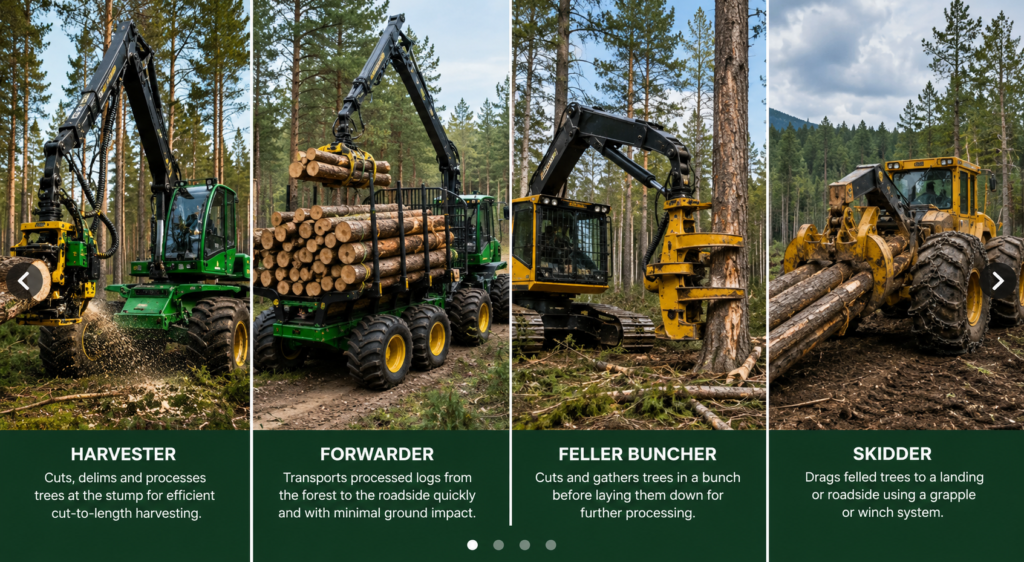
Manufacturers by machine type
| Machine type | Leading manufacturers |
|---|---|
| Harvesters | Ponsse, Komatsu Forest, John Deere, Rottne, Eco Log |
| Forwarders | Ponsse, Komatsu Forest, John Deere, Rottne |
| Feller bunchers | Tigercat, John Deere, Caterpillar |
| Skidders | Tigercat, John Deere, Caterpillar |
| Forestry loaders | John Deere, Tigercat, Komatsu |
| Harvesting heads | Waratah, Log Max, Kesla |
| Forestry tractors | HSM, Pfanzelt, Malwa |
| Chippers | Kesla and specialist manufacturers |
Cut-to-length vs full-tree logging: why the manufacturer matters
One of the biggest mistakes in comparing logging machinery is assuming that all manufacturers are competing to build the same machines.
They are not.
In a cut-to-length system, a harvester cuts, delimbs and processes the tree at the stump. A forwarder then carries the processed logs to the roadside.
This system is strongly associated with Nordic forestry machinery manufacturers such as Ponsse, Komatsu Forest, Rottne and Eco Log.
In a full-tree system, trees are felled and extracted from the forest before further processing. Feller bunchers, skidders, shovel loggers and processors can form part of the production chain.
This is where manufacturers such as Tigercat and other heavy forestry equipment producers become particularly important.
The correct question for a buyer is therefore not simply:
“Which is the best logging machine manufacturer?”
It is:
“Which manufacturer has the right harvesting system for my forest?”
Which logging machinery brands have the strongest presence in Africa?
Africa’s forestry machinery market is diverse, with equipment choices influenced by plantation forestry, terrain, timber species, dealer support and operating costs. Several global manufacturers stand out because of their equipment range, established distribution networks or regional experience.
John Deere has a broad forestry portfolio and an established equipment and dealer presence across African markets. Its range covers harvesters, forwarders, skidders, feller bunchers and loaders.
Bell Equipment is particularly significant in Africa. The South African manufacturer has decades of experience supplying equipment for forestry and timber handling and has an established presence across the continent.
Caterpillar is another important brand because of its extensive African dealer and service network, alongside equipment used in heavy forestry and material-handling applications.
Komatsu also has a strong African heavy-equipment footprint, while its specialist forestry division provides harvesters, forwarders and related machinery.
For African buyers, however, local dealer support, parts availability and technician expertise can be just as important as the manufacturer’s global reputation. A machine that has strong support in the buyer’s country can offer a significant operational advantage over an otherwise comparable machine with limited local support.
What should African forestry contractors consider?
Africa presents a very different operating environment from the Nordic forests where much of the world’s specialist CTL machinery has been developed.
Forestry businesses in countries such as South Africa, Tanzania, Mozambique, Zambia, Uganda, Kenya and other timber-producing markets need to consider several factors before buying equipment.
Forest type
Plantation forestry, natural forest and selective harvesting can require very different machines.
Terrain
A machine designed for relatively accessible plantation terrain may not be the best choice for steep or wet conditions.
Tree species
Large hardwoods, eucalyptus and pine can place different demands on harvesting heads, feller bunchers and processing equipment.
Dealer support
For African operators, access to parts and trained technicians can be more important than having the most advanced machine on the market.
Fuel consumption
Fuel is a major operating cost, particularly for machines working long shifts far from established infrastructure.
Operator skills
Modern forestry machines are increasingly sophisticated. Training and operator availability therefore need to be considered when selecting equipment.
Total cost of ownership
The cheapest machine to purchase is not necessarily the cheapest machine to operate.
Maintenance intervals, fuel consumption, parts availability, downtime, resale value and productivity all contribute to the real cost of ownership.
The future of logging machinery
The next stage of forestry mechanisation is unlikely to be defined simply by bigger engines and larger machines.
Manufacturers are increasingly focusing on automation, connectivity, operator assistance, machine monitoring, precision forestry and lower-impact harvesting.
John Deere, for example, already incorporates precision forestry and connected technology into its forestry equipment ecosystem.
Rottne has its Rottne Connect telematics platform, while other specialist manufacturers are developing their own digital systems.
The industry is therefore moving toward a model in which the machine becomes part of a connected production system.
That could eventually make data just as important as horsepower.
Which logging machinery manufacturer is best?
There is no single answer.
John Deere stands out for the breadth of its forestry portfolio.
Komatsu Forest and Ponsse are particularly strong choices for operators looking at modern cut-to-length harvesting.
Tigercat is a major name for full-tree harvesting, feller bunchers and skidders.
Rottne and Eco Log are important specialist European manufacturers of harvesters and forwarders.
Bell Equipment deserves particular attention from African buyers because of its South African roots and dedicated forestry equipment portfolio.
And specialist manufacturers such as Waratah, Log Max, Kesla, HSM, Pfanzelt and Malwa demonstrate that the global logging machinery industry extends well beyond the biggest names.
For buyers, the best manufacturer is ultimately the one whose machine configuration, harvesting system, dealer support and operating economics match the forest being harvested.
That is a much more useful way to evaluate logging machinery than simply asking which company has the largest global market share.
2026 Trends Shaping Logging Machinery
The logging machinery industry is moving beyond simply building larger and more powerful machines. In 2026, manufacturers are increasingly focusing on automation, connectivity, productivity and lower-impact forestry operations.
Automation and operator assistance
Forestry machines are becoming more automated, with advanced control systems helping operators improve cutting accuracy, machine positioning and productivity. These technologies can also reduce operator workload during long harvesting shifts.
Connected forestry machines
Telematics and remote monitoring are becoming increasingly important. Operators and fleet managers can monitor machine utilisation, fuel consumption, maintenance requirements and operating data without being physically beside the machine.
AI and precision forestry
Artificial intelligence and advanced data systems are creating new opportunities for better tree measurement, timber optimisation and production planning. Digital forestry platforms can help contractors make better decisions about where and how machines are deployed.
Lower-impact harvesting
Manufacturers are placing greater emphasis on reducing soil disturbance, fuel consumption and unnecessary passes through the forest. Compact machines and improved traction systems are particularly relevant for sensitive terrain and thinning operations.
Electrification and alternative power
Electrification is beginning to enter forestry machinery, although heavy logging equipment remains challenging to electrify because of its high power requirements and long operating cycles. Battery-electric and hybrid technologies are likely to develop gradually as battery capacity and charging infrastructure improve.
Productivity per operator
Labour availability is becoming an important consideration in many forestry markets. Manufacturers are therefore focusing on machine systems that allow one skilled operator to manage increasingly sophisticated harvesting processes.
For African forestry operators, these trends will need to be balanced against machine cost, fuel availability, local technical expertise, spare-parts support and operating conditions. The most advanced machine is not necessarily the most economical machine for every African forestry operation.
The next generation of logging machinery will be defined less by machine size and more by productivity per operator, data connectivity, fuel efficiency and reduced environmental impact.
Editor’s note: Manufacturer capabilities and product ranges can change. Buyers should confirm current specifications, availability, dealer coverage and machine configurations directly with manufacturers or authorised dealers before making purchasing decisions.
Also Read
- The Ultimate Guide to Choosing the Right Forestry Mulcher
- Ponsse´s new solutions to improve productivity and profitability in forestry
- Nokian Tyres is setting new standards in CTL segment with new size for Forest King F2

Martin is a writer at Agrimachinery Africa specializing in agricultural machinery, mechanization trends, and farm technology across Africa. His work focuses on tractors, harvesting equipment, irrigation systems, and emerging innovations helping farmers improve productivity and efficiency. Through in-depth industry coverage, he highlights technologies shaping the future of modern agriculture.