


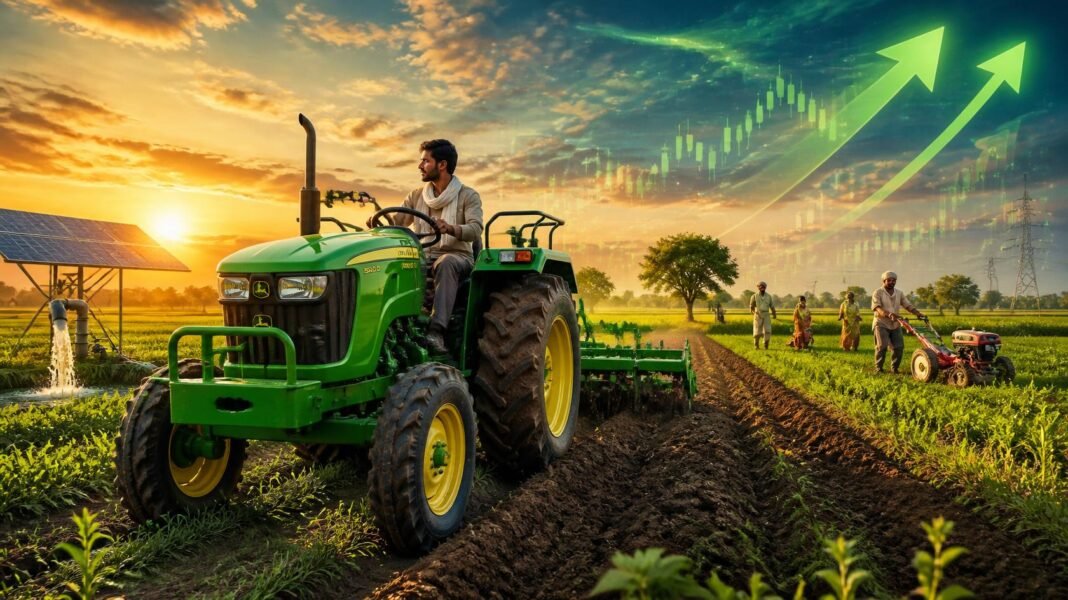

Mumbai:July 17, 2026 — While North American and European farm equipment markets navigate a cyclical slowdown with softening demand for large tractors and combines, India is experiencing a structural shift toward greater agricultural mechanization.
Driven by labor shortages, government policies, rising rural incomes, and the need for higher productivity on fragmented landholdings, the Indian farm machinery sector is creating fresh opportunities for manufacturers, suppliers, dealers, and investors.
This boom extends well beyond traditional tractors to include power tillers, harvesters, irrigation systems, and precision tools — offering B2B players in the agrimachinery space pathways into one of the world’s fastest-growing agricultural markets.
Drivers Fueling India’s Mechanization Surge
India’s agriculture sector employs a vast workforce but faces acute labor shortages due to urbanization and demographic changes.
According to industry reports, government initiatives such as subsidies under schemes promoting farm mechanization, micro-irrigation, and custom hiring centers are accelerating adoption.
Higher rural incomes, improved access to credit, and awareness of modern equipment further support demand.
The country’s small and marginal landholdings — averaging under 2 hectares — favor compact, versatile machinery like power tillers and smaller tractors rather than the high-horsepower models dominant in North America.
Monsoon performance and policy continuity remain key variables, but the long-term trend points to sustained growth.
Additional tailwinds include exports of Indian-made equipment and components, as global manufacturers seek cost-effective production bases.
Companies with strong R&D and localized manufacturing are best positioned to capture both domestic and international demand.
Key Stocks Powering the Mechanization Wave
Several publicly listed Indian companies stand out as pure-play or significant beneficiaries of this transition. Here’s a look at leading players:
Mahindra & Mahindra (M&M) As India’s largest tractor manufacturer, Mahindra dominates with a wide horsepower range suitable for small to large farms.
It also owns the Swaraj brand, broadening its market reach. The company’s strong balance sheet, rural financing arm, and focus on sustainable technologies position it as a core holding for investors tracking ag mechanization.
Its market capitalization reflects leadership in a sector with multi-year growth potential.
Escorts Kubota Formed through the partnership with Japan’s Kubota, this company offers tractors under brands like Kubota, Farmtrac, and Powertrac, spanning premium to value segments.
It benefits from technology transfer, quality enhancements, and strong dealer networks. Tractor sales momentum has been supported by favorable rural sentiment and policy backing.
VST Tillers Tractors A specialist in power tillers — ideal for smaller plots — VST has long dominated this segment.
The company pioneered compact four-wheel-drive tractors and continues to innovate in equipment suited to India’s diverse agro-climatic zones. Its focus on affordability and reliability makes it a key player for mechanizing smallholder farming.
Shakti Pumps and Swaraj Engines Beyond tractors, ancillary players are gaining traction.
Shakti Pumps benefits from the shift toward solar-powered irrigation systems, supported by government schemes promoting renewable energy in agriculture.
Swaraj Engines supplies reliable power solutions for farm equipment, riding the overall mechanization wave.
These stocks offer investors exposure to India’s domestic growth story, which contrasts with the inventory corrections and tariff sensitivities affecting some global majors like CNH Industrial, Deere, and AGCO in North America.
B2B Opportunities Beyond Retail Sales
For international agrimachinery businesses, India represents more than just end-user demand. Key avenues include:
- Component and Technology Exports — Indian manufacturers often seek high-quality parts, engines, hydraulics, and precision ag electronics. Partnerships for joint ventures or licensing can accelerate market entry.
- Used and Refurbished Equipment — As fleets modernize, opportunities arise in trading, refurbishing, and exporting mid-life machinery to other emerging markets.
- Custom Hiring and Rental Models — High capital costs for small farmers favor pay-per-use models. B2B suppliers of financing solutions, telematics, and fleet management tools are in demand.
- Precision and Sustainable Tech — Integration of GPS, sensors, and solar solutions aligns with India’s sustainability goals. Global players can collaborate on localized adaptations.
- Manufacturing and Supply Chain — India’s cost advantages and improving infrastructure make it attractive for component sourcing or assembly bases serving Asia, Africa, and beyond.
Global firms like CNH (with its New Holland and Case IH brands) and others already have footprints in India and are expanding through localized production, such as CNH’s facilities focused on harvesters and crop solutions.
Challenges and Realistic Outlook
The boom is not without hurdles. Monsoon variability, commodity price fluctuations, and rural debt levels can affect short-term purchasing power. Competition is intense, and success requires deep distribution networks and after-sales support tailored to remote areas.
Analysts project multi-year growth in the sector, with tractor and tiller demand remaining resilient even if large equipment cycles vary globally. Government emphasis on doubling farmer incomes and boosting productivity underpins the structural shift.
Why India Matters for Global Agri-Machinery Stakeholders
As North American markets work through inventory normalization and await stronger farmer profitability, India offers a counterbalancing growth narrative.
For stock investors, equipment suppliers, dealers, and manufacturers, the subcontinent’s mechanization drive presents diversified opportunities — from equity exposure in resilient Indian players to B2B partnerships that leverage local strengths.
Businesses that invest early in understanding regional needs, building local alliances, and offering adaptable, cost-effective solutions are likely to benefit most as India’s farms become increasingly mechanized.
This article is for informational purposes and does not constitute investment advice. Stock prices and market conditions fluctuate; conduct due diligence and consult financial professionals. Data drawn from public industry reports and market analyses as of mid-July 2026.
Also Read
- Nigeria Scraps All Import Duties on Farm Machinery in Biggest Tariff Overhaul in Years
- Why Tractor Sales Are Rising in Nigeria in 2026

Martin is a writer at Agrimachinery Africa specializing in agricultural machinery, mechanization trends, and farm technology across Africa. His work focuses on tractors, harvesting equipment, irrigation systems, and emerging innovations helping farmers improve productivity and efficiency. Through in-depth industry coverage, he highlights technologies shaping the future of modern agriculture.