

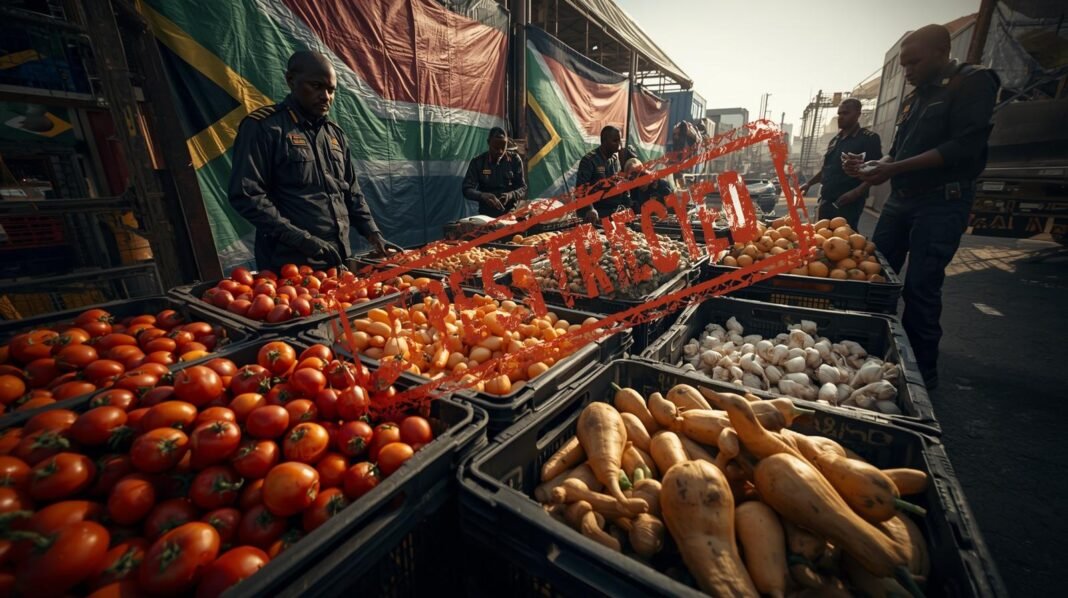

Gaborone/Johannesburg — South African vegetable producers are reeling from yet another abrupt trade reversal after Botswana reinstated a sweeping import ban just months after lifting restrictions that had stifled cross-border trade for years.
The Botswana Ministry of Lands and Agriculture announced the ban on December 8, blocking imports of 16 vegetables including tomatoes, potatoes, onions, carrots, peppers, garlic, and butternut “until further notice.”
The move represents a stunning about-face from President Duma Boko’s administration, which had progressively reopened the market starting in late 2024 after inflationary pressures hammered Botswanan households.
For South African farmers who had begun rebuilding their operations to serve the Botswanan market, the sudden reversal has left them scrambling to redirect produce worth millions of dollars.
“They Just Wake Up and Place a Ban”
Agricultural economist Wandile Sihlobo, chief economist at the Agricultural Business Chamber of South Africa, expressed deep frustration with the recurring pattern.
The lack of consultation between the neighboring countries, both members of the Southern African Customs Union, has created an atmosphere of uncertainty that makes long-term planning virtually impossible for producers.
“The issue is not tomatoes. The issue is the rules that are not being followed in SACU,” Sihlobo emphasized, noting that the customs union was established to promote free trade and economic integration among its members.
The ban affects roughly $17 million worth of annual vegetable exports to Botswana, representing about 8% of South Africa’s total vegetable export market. While that may seem modest in percentage terms, the impact on individual farming operations that had invested in serving the Botswanan market is significant.
A Pattern of Disruption
This is far from the first time Botswana has closed its borders to South African vegetables. Similar bans were imposed in 2021 and maintained at various points in subsequent years, ostensibly to support domestic production and reduce dependence on imports.
Previous restrictions pushed vegetable prices in Botswana up by 24%, hitting low-income households particularly hard, according to a December 2024 Econsult report.
When Boko took office in late 2024, he lifted the bans as part of an effort to ease the cost of living for Botswanan consumers.
The reopening occurred in two phases, with Phase 1 beginning in December 2024 and Phase 2 following in April. Now, just months later, most of those same vegetables are back on the restricted list.
“Economically and Agriculturally Unsound”
Trade experts have questioned the logic behind Botswana’s approach. Global trade advisory consultant Kgothatso Nkgadima described the ban as economically and agriculturally unsound, noting that only 3% of Botswana’s land is arable and the country has historically depended on imports to ensure food security.
“Local production is unlikely to replace South African imports in the short term, leading to higher food prices that will have the opposite effect than that intended by government,” Nkgadima warned.
Botswana’s commercial farming sector, while robust, is largely centered on livestock rather than vegetables. Critics argue the country is not positioned to quickly fill the gap left by blocked South African imports.
SACU Under Strain
The recurring trade disputes have exposed deeper structural problems within the Southern African Customs Union.
While South Africa is required to consult SACU members whenever it negotiates bilateral trade agreements with external partners, the same discipline is not reciprocated by its neighbors.
“We are having to come back to consult countries—countries that do not consult South Africa,” Sihlobo said, highlighting the imbalance that has become a major friction point.
The unilateral approach also complicates South Africa’s efforts to diversify its agricultural exports globally, as potential trading partners must navigate the complex web of SACU obligations.
A Call for Measured Response
Despite the frustration, South African agricultural leaders are urging a diplomatic approach. Sihlobo emphasized that antagonistic responses would not benefit anyone in the region, where citizens primarily want affordable, accessible, and safe food.
Instead, he suggested Botswana could implement seasonal restrictions that clearly communicate which production windows are protected for domestic farmers, allowing South African producers to plan accordingly and fill gaps when they occur.
“Having hostile neighbours will not benefit any of these countries’ citizens,” Sihlobo said, calling for temporary time-bound restrictions rather than indefinite bans.
He added that Botswana’s desire to expand agricultural production could actually benefit South African agribusiness, which could supply farm implements and inputs to support that growth.
For now, South African farmers are left to absorb another policy shock from a market they had counted on for stability.
The ban remains in place indefinitely, with no indication from Botswana’s government about when, or if, the restrictions might be lifted again.
As regional trade tensions simmer, the incident has renewed calls for a comprehensive review of SACU’s mechanisms to ensure the customs union works equitably for all members—not just on paper, but in practice.
Also Read
US Farmers Caught in the Middle: Is Tariff-Funded Aid Real Support or Political Spin?
Kenya to Host IUFRO World Congress 2029: A First for Africa
