


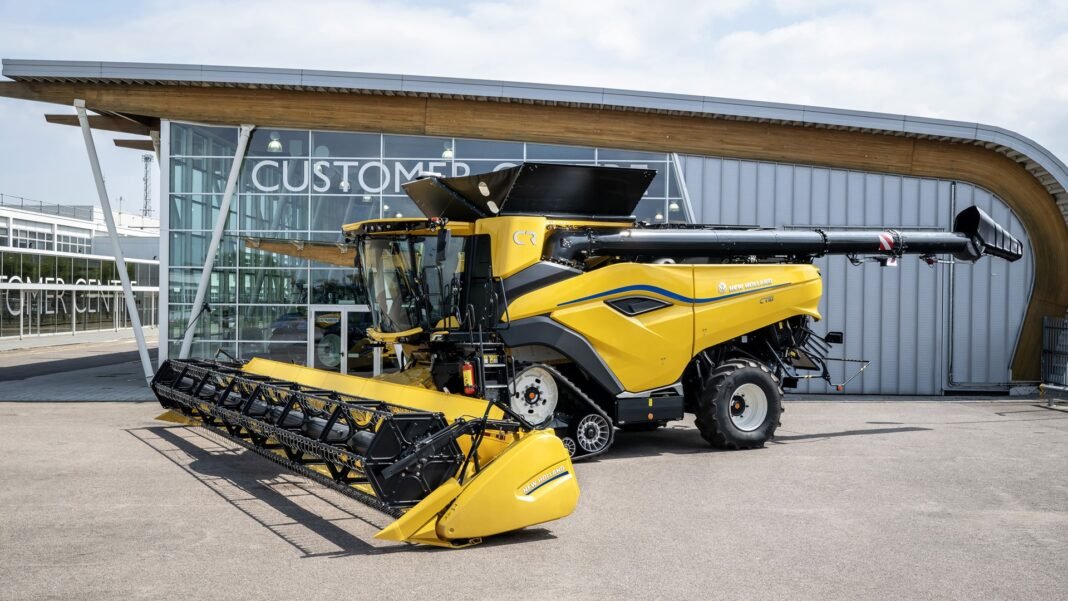

With over 910 exhibitors and more than 4,000 products on display across NAMPO Park this week, the pressure is always on for machinery brands to cut through the noise.
This year, two standouts have dominated the conversation on the exhibition floor: New Holland’s next-generation CR10 combine harvester, making its Southern Hemisphere stage debut, and the Scania Super — a heavy-duty transport powertrain officially unveiled on Wednesday that is reshaping how the agricultural logistics sector thinks about fuel costs.
Both machines arrive at a moment when African farmers and agribusinesses are squeezing every rand, shilling, and kwacha from their operations. NAMPO 2026’s theme — Resilience through Innovation — was not chosen lightly.
Against a backdrop of rising input costs, constrained margins, and logistical bottlenecks from Bothaville to Nairobi, the question driving every handshake on the showgrounds is simple: does this machine pay for itself faster than the last one? On current evidence, these two answers — one in the field, one on the road — are hard to ignore.
New Holland CR10: 50 Years of Twin Rotor Technology, Reimagined
New Holland’s stand A2/A3 is drawing some of the longest queues on the grounds, and the centrepiece is a machine that has been half a century in the making.
The CR10 is the latest evolution of New Holland’s Twin Rotor combine technology — a platform the brand introduced to the world in 1975 and which has since become the reference point for virtually every high-capacity combine harvester on the global market.
The numbers command attention. The CR10 is powered by a 12.9-litre FPT Cursor 13 turbocharged six-cylinder engine developing 635 horsepower, fed from a 1,300-litre fuel tank engineered for extended harvesting runs without refuelling stops.
The grain tank holds 16,000 litres and unloads at a rate of 210 litres per second — fast enough that a semi-trailer can be loaded while the machine barely breaks stride across the field.
New Holland CR10 — Key Specifications at a Glance
What makes the CR10 technically distinctive beyond raw capacity is the redesigned threshing architecture.
The 24-inch rotors sit inside a wider and longer threshing compartment compared to predecessors, creating more crop rotations per pass and driving what New Holland describes as a new generation of grain loss reduction.
The hydraulic system has also been overhauled: all harvest hydraulic drives are mechanically disengaged during road travel via a main engine gearbox clutch, saving up to 20 horsepower and reducing drag.
Load-sensing pumps further cut hydraulic power demands in-field.
For large-scale grain producers across South Africa, Zimbabwe, Zambia, and increasingly East Africa, the CR10 addresses a persistent operational challenge: reducing the number of machine passes required per hectare while protecting grain quality.
The redesigned residue management system and the machine’s intelligent automation package — which recalibrates settings dynamically to adapt to changing crop conditions — are being positioned by New Holland as the answer to the productivity-loss equation that has frustrated producers for years.
“The CR10 is unmatched in its class. Its 24-inch rotors, housed in a wider and longer threshing compartment, feed a 16,000-litre grain tank and unload harvested grain at 210 litres per second.”
Alongside the CR10, New Holland is also presenting the upgraded T9 and Genesis T8 tractor ranges at NAMPO — reinforcing a clear brand message that the company is positioning itself at the large-scale, high-output end of African production agriculture.
The T9 range in particular has gained significant traction in South Africa’s maize belt, where the economics of large-field farming increasingly favour fewer, more powerful machines over larger fleets of mid-horsepower tractors.
Scania Super: The Agri-Logistics Equation Gets a New Variable
If the CR10 is the headline act in the field, the Scania Super is making an equally forceful case for what happens after harvest.
Unveiled at NAMPO Park on Wednesday 13 May, the Scania Super 13-litre powertrain is being positioned as a direct response to one of agricultural Africa’s most stubborn cost pressures: the price of moving bulk grain, fresh produce, and farm inputs across road networks where fuel expenditure can consume between 30 and 50 percent of total transport operating costs.
The engineering proposition is straightforward but significant. Scania’s new 13-litre Super engine achieves up to 50 percent brake thermal efficiency — a figure that represents the proportion of fuel energy converted into useful work, and a benchmark that heavy transport engineers have chased for decades.
The practical result: fuel savings of up to 8 percent against the previous generation Scania powertrain.
Scania Super 13-Litre — Performance Metrics
For fleet operators running grain haulage corridors in South Africa — and increasingly for those operating across the wider SADC region — an 8 percent fuel reduction is not a marginal gain.
On a long-haul heavy-duty truck covering 150,000 kilometres per year, it translates into a material reduction in fuel spend that compounds over the operational life of the vehicle.
Scania South Africa’s Sustainability Manager Mark Templeton was direct about the company’s philosophy at the NAMPO launch: sustainability in transport is not solely a future-state ambition dependent on electric or hydrogen transition, but something achievable today through the efficiency of existing combustion technology.
“Improving efficiency within current fleets is one of the most immediate and scalable ways to reduce environmental impact and lower fuel costs,” Templeton said at the unveiling.
The Scania Super platform is also designed as a coherent powertrain system — engine, gearbox, axles, and control systems engineered together rather than as separate components.
This holistic integration is what enables the efficiency gains, Scania argues, compared with platforms where individual components are upgraded incrementally.
The Super 13-litre is also compatible with HVO and biodiesel, giving operators in markets with improving biofuel infrastructure a pathway toward lower-carbon operations without capital fleet replacement.
The Bigger Picture: What These Machines Signal for African Agriculture
The simultaneous prominence of the CR10 and the Scania Super at NAMPO 2026 is not coincidental.
Together, they represent two ends of a supply chain that African agriculture has long struggled to optimise simultaneously — harvesting capacity and post-harvest logistics.
Increasing grain output through high-throughput combine technology only delivers full value if the transport infrastructure exists to move that grain efficiently to storage or export points.
This has historically been one of sub-Saharan Africa’s most persistent agricultural bottlenecks.
South Africa, with its relatively well-developed road freight network and established grain trading infrastructure, is the natural entry point for both technologies on the continent. But the appetite for mechanisation is spreading.
Brazilian machinery exporters — eleven companies of whom are also exhibiting at NAMPO this week — recorded USD 1.65 billion in agricultural machinery exports in 2025, up 11.9 percent year-on-year, specifically targeting African markets including Angola, Mozambique, Tanzania, and Zimbabwe. The global industry is watching this market.
For readers and operators across East Africa, the relevance is direct. Kenya’s large-scale grain production in the Rift Valley, wheat growing in Trans Nzoia, and maize production in the Western counties are all reaching scale thresholds where equipment like the CR10 begins to make economic sense on cooperative or contract farming models.
Meanwhile, transport operators serving port corridors from Mombasa to Kampala, Dar es Salaam to Lusaka, face fuel economics that make the Scania Super’s 8 percent efficiency gain commercially interesting at any route distance.
NAMPO 2026 by the Numbers
Outlook
NAMPO runs through Friday 15 May. Further product announcements and demonstrations are expected on the final day, with precision agriculture technology — including spray drone demonstrations — scheduled for the showgrounds.
AgriMachinery.Africa will continue covering developments from the show floor.
For African farmers and agribusinesses evaluating capital equipment purchases in the 2026 cycle, the CR10 and Scania Super represent a clear direction of travel: higher capacity, lower operating cost per unit of output, and longer service intervals.
In an agricultural economy where margins are under structural pressure, that combination may prove to be the most compelling sales pitch of the year.
Also Read
NAMPO 2026 kicks off Tomorrow but Cloven-Hoofed Animals are Banned
Kenya to Host IUFRO World Congress 2029: A First for Africa
